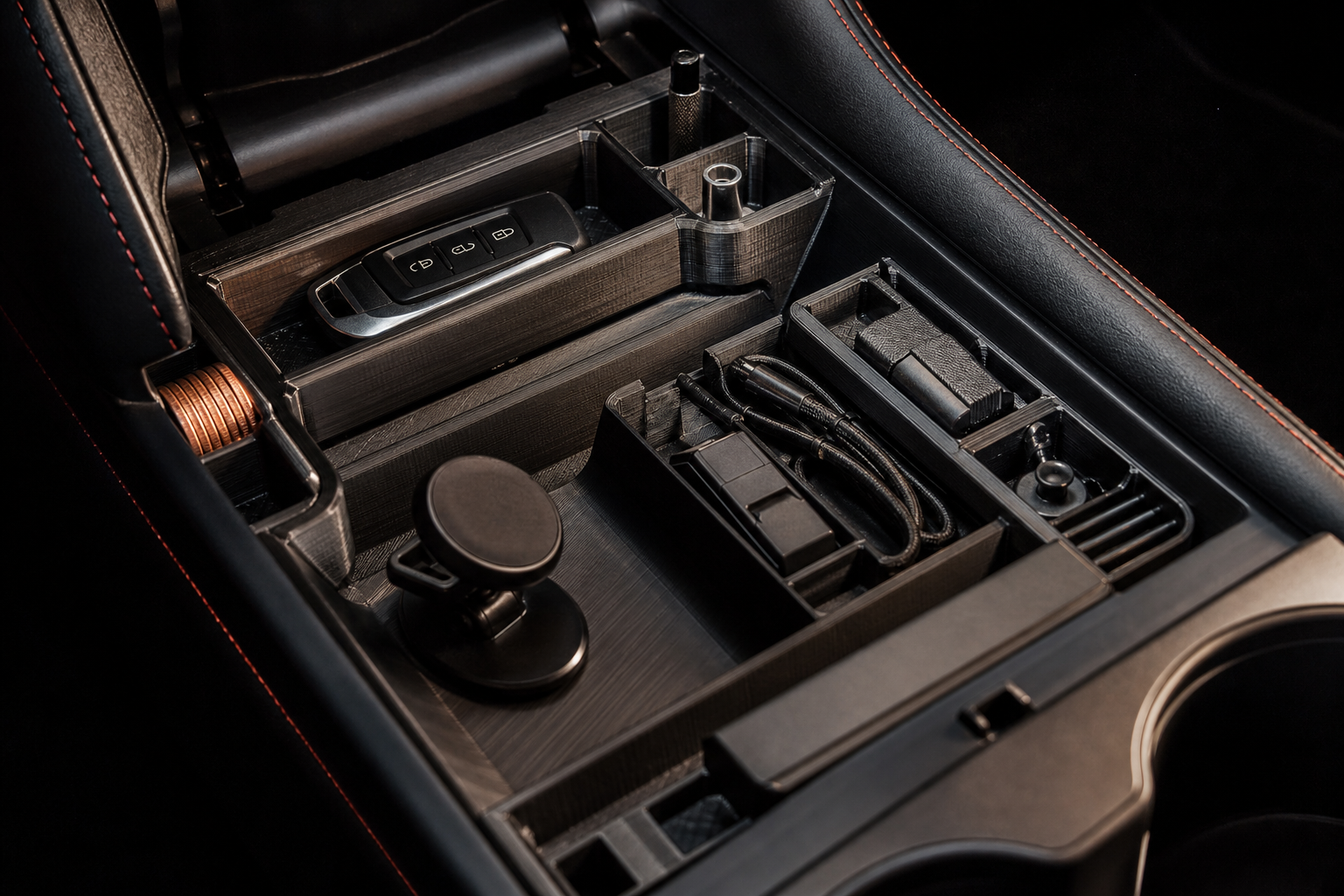
If you own a 3D printer and a car, you’re already sitting on a combination that makes your life measurably better. The problem is that most people don’t realise it until they’ve wasted money on a plastic phone mount that snaps after three weeks, or a cup holder insert that’s slightly too wide for the can and slightly too narrow for the bottle. Your printer can fix all of that. And it already has what it takes to do the job.
I’ll be honest, this article was partly inspired by two prints I did recently for my Tesla Model 3. One was a spacer for my Samsung earbuds case that lets me charge them on the car’s wireless charger pad without the case tipping off. The other was a small air fragrance holder that sits neatly behind the centre screen. Neither cost me anything except a bit of PETG filament and about twenty minutes of my time. That’s the beauty of 3D printing for your car. Once you start, you genuinely cannot stop.
Material matters more than you think
Before we get into the gadgets, let’s get one thing straight. Not everything in your car lives in the cool, shaded glove box. Dashboards, window mounts, and anything near the windscreen can hit temperatures that will warp PLA filament on a warm British summer day, never mind a hot one. For anything exposed to direct sunlight or sitting near a vent, use PETG as a minimum. It’s easy to print and handles heat far better than PLA. For extreme cases, PETG+ or ASA is even better. Cable organiser clips tucked in the centre console? PLA is absolutely fine there. Think about placement before you hit print.
Where to find the STL files
You don’t need to design anything yourself. The three platforms you’ll use most are Printables, Thingiverse, and Cults3D. Between them, they cover virtually every car accessory you could want. If you want to search across all platforms at once, Yeggi works as an aggregator and is worth bookmarking. MakerWorld is also growing quickly and has some genuinely well-designed functional prints. MyMiniFactory is worth a look for curated, tested models where the designer has actually checked the fit before uploading. All of the prints in this list have free STL files available across one or more of these platforms.
Print quality is not optional for some of these
For decorative stuff, a 0.2mm layer height is absolutely fine. But for anything that needs to fit precisely, tyre valve caps being the obvious example, you’ll want to drop to 0.1mm. A loose valve cap is worse than no valve cap. Always print one test piece first, check the fit, and scale in small increments in your slicer if needed. The same logic applies to anything that clips onto a vent or snaps into a trim piece. A slightly undersized clip will crack your vent louvre. These are small prints, so there’s no good reason not to test one before committing to a full set.
The 10 Prints
1. Phone Mount (Vent Clip) A vent-clip phone mount is probably the first thing anyone with a printer should make for their car. Designs on Printables and Cults3D cover most phones and most vent styles. The bonus of printing your own is that you can size it exactly for your phone rather than relying on a universal grip that inevitably lets go at roundabouts.
Pros: Costs pennies in filament. Cons: Vent-clip designs vary in grip strength, so read the comments on the file before printing.
2. Air Freshener Holder There are two styles worth knowing about. The first is a fan-shaped design that attaches to your air vent and gets dabbed with scented oil. As air flows through, the smell disperses naturally. The second is a frame-style holder inspired by those classic tree air fresheners, designed to hold a standard insert inside a reusable printed shell. The second one is the one I’d recommend starting with. Print at 0.16–0.2mm, no supports needed. Mine lives behind the screen in the Tesla and looks like it belongs there.
Pros: Reusable and cheap to run. Cons: Scented oil versions need re-dabbing every few days.
3. Tyre Valve Caps Possibly the most satisfying print on the list. You can do them in any colour, or go glow-in-the-dark filament for a bit of fun. The thread pitch is 0.75mm, which is right at the limit of most FDM printers, so you must print at 0.1mm layer height to get a clean thread. These caps fit standard Schrader valves, and the designs tend to have more threads than stock caps, so they grip better and you’re less likely to lose them. Print one first, test the fit on an actual valve, then scale up or down in your slicer by 5% increments until it’s right. Bear in mind that different filaments shrink at different rates, so what works perfectly in PETG might need a slight adjustment in PLA+. Thingiverse and Printables both have solid options.
Pros: Personalised, essentially free, genuinely useful. Cons: Thread fit requires patience and a test print. Don’t print all four at once.
4. Cup Holder Adapter Standard cup holders are sized for a mythical cup that no one actually owns. A printed adapter lets you slot in any size bottle or can securely. Printables has a good customisable version where you can adjust the inner diameter before slicing. Print in PETG to handle the occasional warm drink without deforming.
Pros: Genuinely solves a real problem. Cons: Needs PETG, not PLA, if you drink hot drinks in the car.
5. Samsung Earbud Charging Spacer This one’s for wireless charger pad users. Specifically, if like me you’ve got a Samsung Galaxy Ultra and Galaxy earbuds and your Tesla’s wireless pad doesn’t quite align with the earbud case. A simple printed spacer raises and centres the case perfectly over the charging coil. It takes about ten minutes to design in Fusion 360 or you can find similar spacer files on Printables. This is the kind of print that makes you feel like you’ve outsmarted the problem.
Pros: Costs almost nothing, solves a specific and irritating problem. Cons: May need tweaking for different car models and case sizes.
6. Cable Organiser Clips These are among the most beginner-friendly prints on the list. Simple clip-style organisers keep USB cables, charging cables, and aux leads tidy in the centre console. PLA is fine here since they’re away from direct heat. MakerWorld and Printables both have solid designs.
Pros: Great first car print. Cons: If your cable management is already a disaster, you’ll need a few iterations to get the routing right.
7. Sunglasses Holder Most designs clip to the sun visor and hold a single pair of glasses securely. Some slot into the overhead console area if your car has the right trim. Print in PETG to handle summer temperatures if it’s going anywhere near the top of the windscreen. Thingiverse has several tried-and-tested versions with plenty of makes logged.
Pros: Keeps glasses safe and accessible. Cons: Visor-clip designs can leave marks if the filament is too rigid. Softer PETG is better here.
8. Rear Seat Screen Mount / Tablet Holder If you’ve ever driven more than two hours with kids in the back, you already know why this exists. Headrest-mounted tablet holders can be printed in modular sections to fit different tablet widths. PETG is essential given the stress the mount will take over time. Cults3D has some well-reviewed options.
Pros: Genuinely transforms long journeys. Cons: Larger prints, so budget for a longer print time and check your bed size first.
9. Pocket Divider and Coin Tray Insert Door pocket dividers and coin tray inserts keep the loose change, receipts, and random LEGO bricks from turning your car interior into a skip. These are simple, flat prints that sit inside existing cavities. PLA is fine. Printables and Cults3D both have solid generic designs.
Pros: Easy win for a tidy interior. Cons: Generic designs may need slight resizing for your specific car model.
10. Replacement Trim Clips and Small Broken Parts This is the underrated one. If a small plastic clip breaks inside your car, a mirror housing tab, a door handle piece, a vent louvre pin, a 3D printer can often replace it. You might need to design it yourself or find a car-specific version on Printables, but the community is enormous and covers a surprising number of makes and models.
Pros: Can save you real money versus dealer parts. Cons: Structural parts need the right filament. Check whether PETG or nylon is appropriate before printing.
Quick Comparison
| Filament | Best For | Verdict | |
|---|---|---|---|
| Phone Mount | PETG | Daily drivers | Essential first print |
| Air Freshener Holder | PLA/PETG | Anyone | Simple, very satisfying |
| Tyre Valve Caps | PETG/PLA+ | Detail lovers | Patience required |
| Cup Holder Adapter | PETG | Bottle/can users | Genuinely useful |
| Charging Spacer | PLA | Samsung/Tesla owners | Niche but brilliant |
| Cable Clips | PLA | Tidy console fans | Perfect beginner print |
| Sunglasses Holder | PETG | Sunny days | Solid visor print |
| Tablet Mount | PETG | Family road trips | Game changer for kids |
| Pocket Divider | PLA | Interior tidiness | Low effort, high reward |
| Replacement Trim | PETG/Nylon | Broken bits | Can save real money |
Bottom line
If you’re new to printing car accessories, start with the cable clips or the air freshener holder. Low stakes, quick to print, and you’ll actually use them. If you’ve already got a few prints under your belt, the valve caps and the charging spacer are the ones that will genuinely impress people. And if you’ve got kids in the back asking “are we nearly there yet” every twenty minutes, get that tablet mount printed before your next long drive. You’ll thank yourself.
The filament cost across all ten of these is probably less than a single trip to Halfords. That’s the whole point.
Want more print ideas, honest gear reviews, and family tech that actually works? Sign up to the Tech Dads Life newsletter at techdadslife.beehiiv.com and I’ll drop the good stuff straight to your inbox.