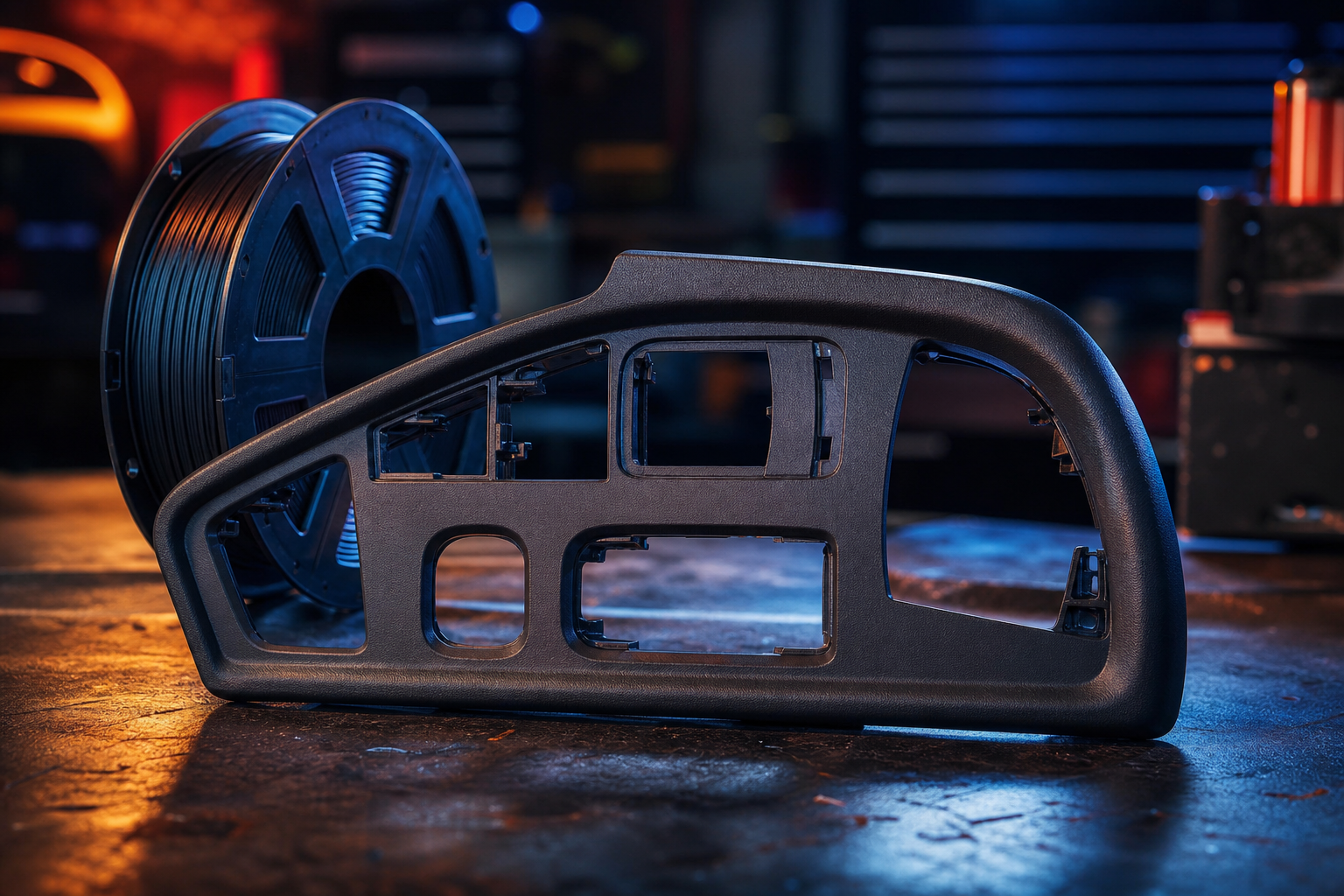
The Modified Nationals at Peterborough Arena wrapped up on Sunday, and if you were there over the weekend you’ll have seen exactly what I mean when I say car culture in the UK is alive and very much doing its own thing. Three days of wild builds, jaw-dropping paint, slammed suspension, and enough carbon fibre to keep a small aircraft factory busy for a year. I didn’t make it this time, which I’m quietly gutted about, but I followed it closely online and one thing kept catching my eye: the number of builds quietly incorporating 3D printed components. Not as a gimmick. As proper parts.
That’s a shift. A couple of years ago, 3D printing at a show like Modified Nationals would have been a novelty. Now it’s becoming part of the toolkit, sitting alongside fibreglass, vinyl wrap, and custom fabrication. People are designing their own interior trim, printing replacement plastics that haven’t been available from dealers for years, and producing show-quality badge surrounds and grille inserts on machines that cost less than a set of alloys. I run a Bambu Lab P2S and spend more time than I should admit thinking about what to print next, so this is genuinely exciting territory.
But there’s an important question sitting underneath all of this, especially if you’re planning to drive your modified car on UK public roads rather than just park it at a show: what is actually legal? That line is blurrier than most people think, and with the DVSA tightening up MOT enforcement, it’s worth knowing before you fit anything.
What the Law Actually Says About Modified Cars in the UK
Since 2025, the DVSA has had expanded authority during MOT tests and roadside inspections. If an officer or tester finds an unapproved or unsafe modification, the consequences can include a failed MOT, a prohibition notice, a fine of up to £2,500 with penalty points, or a voided insurance policy if undeclared modifications were a contributing factor to an incident. That last one is the one that should keep you up at night.
The framework divides modifications into two broad camps: cosmetic and performance. Cosmetic changes, things like alloys, body kits, wraps, and trim, are generally legal as long as they don’t compromise safety or mimic emergency vehicles. Performance modifications, anything touching the engine, exhaust, suspension, or braking system, face much tighter scrutiny and often require documented compliance.
For 3D printed parts specifically, the key tests are straightforward. Does the part affect the structural integrity of the vehicle? Does it interact with a safety system? Does it affect lighting output or visibility? If the answer to any of those is yes, you are in difficult territory and you need to be able to prove the part meets type-approval or ECE standards. For a home-printed component, that is essentially impossible.
If the answer is no to all three, and you’re printing something interior and non-structural, you’re almost certainly fine. Keep receipts, take photos, and notify your insurer of any visible exterior changes. That last step matters. Under the Consumer Insurance (Disclosure and Representations) Act, you are legally obliged to declare changes that affect the appearance of your vehicle, and “I didn’t think it counted” is not a defence an insurer will accept.
The Number Plate Question (It’s Murkier Than You Think)
The Modified Nationals crowd loves a custom plate, and 3D and 4D gel plates are genuinely popular right now. Here’s where it gets specific. Three-dimensional and four-dimensional plates are legal in the UK, but only if every other requirement is met exactly. The characters must use the Charles Wright 2001 font, they must be 79mm high with a 14mm stroke width, and the registration must be completely clear and unobscured. That standard is BS AU 145e, and there is no wiggle room.
A lot of 3D and 4D plates being sold online, including from some fairly visible sources, do not meet these requirements. Fonts are slightly stylised, spacing is tweaked, backgrounds are patterned. Any of those deviations can result in an MOT failure and a fine of up to £1,000.
For 3D printing specifically, the relevant distinction is this. Printing a plate surround, a badge holder beside the plate, or a decorative frame that doesn’t touch the plate characters themselves sits in a much safer space. Printing the actual plate as a complete unit, with embedded characters, is almost certainly going to be non-compliant. The characters need to be produced by a registered supplier to a defined standard, and a home FDM print is not that. Print the surround. Buy the plate from a registered plate supplier.
What You Can Absolutely Print (and What the Community Is Building)
This is where it gets fun. The range of automotive prints available on platforms like MakerWorld, Printables, Thingiverse, and Cults3D is enormous, and a good chunk of it falls squarely into legal, road-safe territory.
Interior parts are the sweet spot. Cup holders, phone mounts, seat-back organisers, gear shifter trim, dash bezels, vent housings, delete plates for unused switches, and cable management clips. These are non-structural, they don’t affect any safety system, and they can be genuinely useful as well as personalised. I’ve rounded up some of my favourites before in 10 genius 3D printed gadgets for your car , most of which are still free files on MakerWorld. One of the most practical categories is replacement plastics for older vehicles. The small clips, tabs, mirror surround sections, and door handle internals that go brittle with age and are impossible to source from a dealer. If you own a car that’s more than ten years old, there’s a reasonable chance someone has already modelled and uploaded the part you need.
On the exterior, the community is producing mirror caps, grille inserts, badge surrounds, and hood scoops. These are cosmetic, they’re not structural, and done well they can look genuinely impressive, particularly when printed in a material like PETG or ASA that handles UV and temperature properly. PLA is fine for indoor use but it will warp in a hot car or start to degrade in prolonged UV exposure, so material choice matters for anything going outside.
The impressive end of the spectrum includes full custom grille designs printed in sections and assembled, bespoke door panel inserts with integrated map pockets, and brake cooling duct configurations for track days. For shows like Modified Nationals, where the car is trailered rather than driven there, the options open up further. If it’s going on the road though, stick to the non-structural rule.
Comparison: What’s Printable, What’s Not
| Part Type | Road Legal? | Notes |
|---|---|---|
| Interior organiser / cup holder | Yes | Non-structural, no safety impact |
| Replacement plastic clips and tabs | Yes | Direct like-for-like replacements |
| Dash bezel / vent trim | Yes | Cosmetic interior, no safety system interaction |
| Mirror cap / exterior trim cover | Yes | Cosmetic, no structural role |
| Grille insert (decorative) | Yes | Must have no sharp edges |
| Custom number plate surround | Yes | Must not obscure plate characters |
| Full 3D-printed number plate | No | Non-compliant with BS AU 145e |
| Headlight surround affecting output | No | Affects lighting, fails MOT |
| Structural bracket or mount | No | Requires type-approval |
| Airbag housing or safety system part | No | Absolutely not |
Hype Cycle Check
LIKELY TO LAST: Interior replacements and hard-to-source plastics for older vehicles. This is a genuine, practical use case that gets better as printers improve and material libraries expand. The community around platforms like MakerWorld is producing high-quality files faster than dealers can keep up with parts availability.
WATCH CLOSELY: Exterior cosmetic parts printed in engineering-grade materials. ASA and PETG prints are already showing up at shows with real quality, but long-term UV and road durability still needs more real-world data over time. This is the category most likely to become mainstream in the next two to three years.
VAPOURWARE RISK: Anything claiming to replace structural or safety-rated components with home prints. The material science and certification requirements make this a non-starter for road use in the foreseeable future, regardless of how good desktop printers get.
CES 2027 Angle
Modified car culture and desktop fabrication are converging, and that story is going to have a presence at CES 2027 . Bambu Lab and its competitors will be pushing their latest machines, and the automotive integration angle is increasingly part of how they market to mainstream audiences. Expect to see automotive-specific filament profiles, partnership announcements with aftermarket parts suppliers, and possibly design software integrations that let owners scan existing trim pieces and generate printable replacements. The show floor will frame this as the democratisation of manufacturing, and for once, that framing won’t be entirely wrong.
What to Watch
- DVSA enforcement consistency at MOT. As 3D printed parts become more common on road cars, how testers handle visually unfamiliar components is going to matter. Clearer guidance from DVSA would help everyone.
- Material development for outdoor automotive use. Carbon-fibre-infused PETG and high-temperature ASA are already viable, but as filament manufacturers focus on the automotive hobbyist market, expect better-performing materials at lower prices.
- Platform-quality file curation. MakerWorld’s reward system is encouraging higher-quality uploads. As community-verified files carry more weight, the confidence level for printing automotive parts should increase.
- Insurer recognition of printed parts. A handful of modified vehicle insurance packages are already adapting to aftermarket culture. Whether they start to reference 3D printed components specifically is something worth following.
If you’re into making things, whether that’s 3D printing, building, or just modifying what you already own, the Tech Dads Life newsletter is where I share the stuff that doesn’t always make it into a full article. Sign up at techdadslife.beehiiv.com and I’ll keep you posted.