Bambu Lab has done it again. Less than two years after the A1 won over thousands of families with its reliable, no-fuss printing experience, the company has quietly dropped something bigger, quite literally. The A2L launched on 1 June 2026, and if you’ve ever stared at a half-finished cosplay prop or a toy that needed splitting into three pieces just to fit the print bed, this might be the machine you’ve been waiting for.
What Actually Is the A2L?
The A2L is not the A1 Mini. It is not the A1 with a fresh coat of paint. It is a genuinely new machine built around one core idea: printing big things without the headaches that usually come with large-format printers.
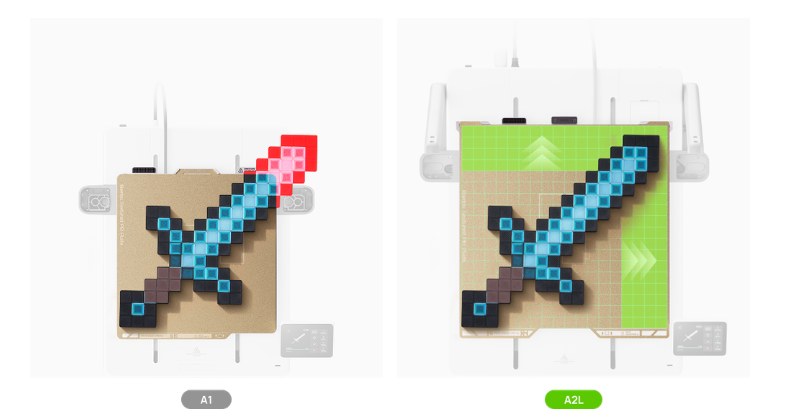
The build volume is 330 x 320 x 325 mm. That is 105% more print space than the standard 256 mm-class machines, including the A1. In real terms, that means a Minecraft sword as one piece, a helmet visor without a seam, or a full batch of desk organisers in a single run.
Bambu describes it as “H2S Lite” philosophy, taking engineering features from their professional-tier printers and bringing them into a family-friendly price bracket. Having used the A1 for a year, I can tell you that Bambu’s accessible-but-capable approach is not marketing fluff. It is genuinely how their machines feel to use.
A2L vs A1: What’s Actually Different?
This is the bit that matters if you already own an A1 and are wondering whether to upgrade.
Build volume is the headline. The A1 gives you 256 x 256 x 256 mm. The A2L gives you 330 x 320 x 325 mm. That extra space changes what is physically possible, not just marginally, but in a category-shifting way. Projects that previously needed splitting and gluing can now print in one go.
The extrusion motor is completely different. The A1 uses a standard stepper motor. The A2L runs a PMSM closed-loop servo motor, the same type of motor used in industrial applications. This gives it more stable power delivery at high speeds and actively monitors for extrusion problems before they turn into failed prints.
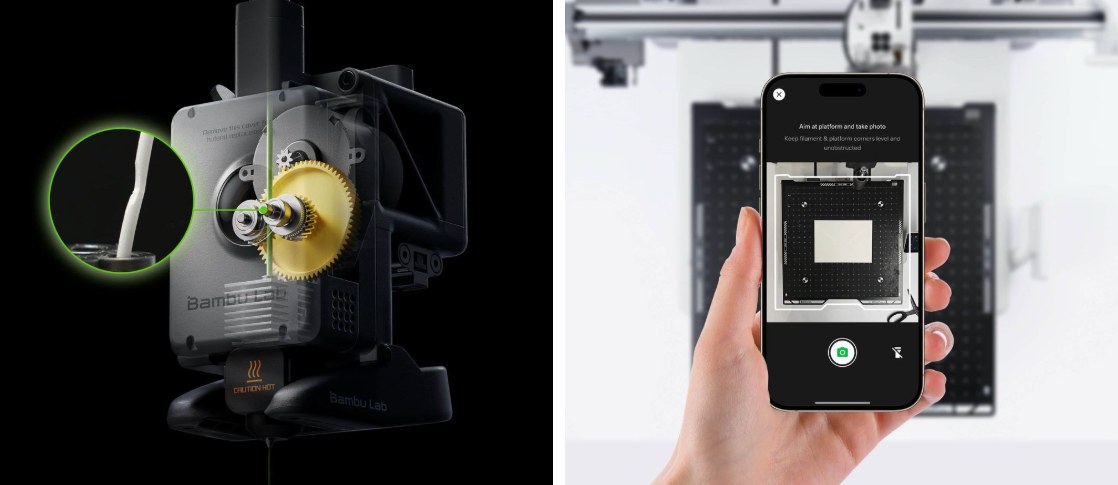
Vibration compensation is new to the A Series entirely. The A2L is the first A-series machine to feature adaptive vibration compensation with multi-point calibration and load adaptation. The A1 has input shaping, but the A2L’s system goes further, adjusting dynamically based on what you’re printing and how heavy it is. This matters a lot on large prints where ghosting and ringing artifacts are more visible and more annoying. On top of that, there are two physical granular dampers built into the frame that absorb resonance mechanically, not just through software.
The detection suite is upgraded. The A1 has solid filament runout and clog detection. The A2L adds a physical blob detector (which protects the nozzle from filament buildup) and PMSM motor monitoring that can catch extrusion issues earlier. For long prints, the kind you’ll be running more often on a large-format machine, that extra layer of reliability matters.
New modularity. The A2L has a dedicated mounting point for expansion modules. The Blade Cutting Upgrade Kit turns it into a precision cutter for stickers, fabric, and leather, or a drawing plotter. The A1 does not have this. Worth noting: the A2L does not support laser modules due to safety concerns with its open-frame design.
What stays the same. The A2L is still a bed-slinger, not a CoreXY. Top print speed is 500 mm/s, the same as the A1. Max nozzle temperature is 300°C and bed tops out at 80°C, so it is PLA and PETG territory, not engineering filaments. Multi-colour support goes up to 19 colours (four AMS units plus one AMS Lite). The Bambu ecosystem, Bambu Studio , MakerWorld, Bambu Handy, all works exactly as you’d expect.
Who Should Buy the A2L?
Buy it if you keep hitting the edge of your print bed. If you’ve lost count of the number of times you’ve chopped a model into pieces to fit a 256 mm bed, the A2L solves that problem directly. This is its primary reason to exist.
Buy it if you have kids who are into making things. The larger bed means bigger creative projects, full-size phone stands, larger Minecraft builds, props for school plays, all in one piece. The A1 already makes 3D printing accessible for families. The A2L just gives you more canvas.
Buy it if you’re into cosplay. Helmet components, shoulder armour, prop weapons. The 330 x 325 mm footprint removes a lot of the constraints that currently force cosplay makers to design around their print volume rather than their vision.
Buy it if you want a home production machine. The multi-colour ceiling of 19 colours and support for up to four AMS units makes it genuinely capable for small-batch production. Print farms and Etsy sellers take note.
Stick with the A1 if volume isn’t your problem. The A1 is still an excellent machine. If 256 mm beds are serving you fine and you’re happy with print quality, there is no reason to upgrade. The A2L is not better in every way, it is bigger and more capable in specific ways. If those specific ways matter to you, it is worth the step up.
Pricing (UK)
The A2L starts at around £399 for the standard version, with the Combo (including AMS Lite for multi-colour printing) sitting higher. Check the Bambu Lab UK store for current pricing as launch offers may apply. In the US it is $469 for the base model and $569 for the Combo.
My Take
The A2L feels like Bambu Lab taking the question “what if I need to print something bigger?” seriously for the first time at this price point. They have not just scaled up the A1. They have added a better motor, smarter vibration handling, and expandable modules while keeping the price in reach of hobbyists and families.
If you’ve been putting off a large-format printer because the options were either too expensive, too complex, or both, the A2L is genuinely worth a look. The Bambu ecosystem does a lot of the hard work for you, and that does not change just because the bed is bigger. The A1 earned its place in a lot of tech-dad workshops. The A2L is aiming for the ones where the projects have started outgrowing it.