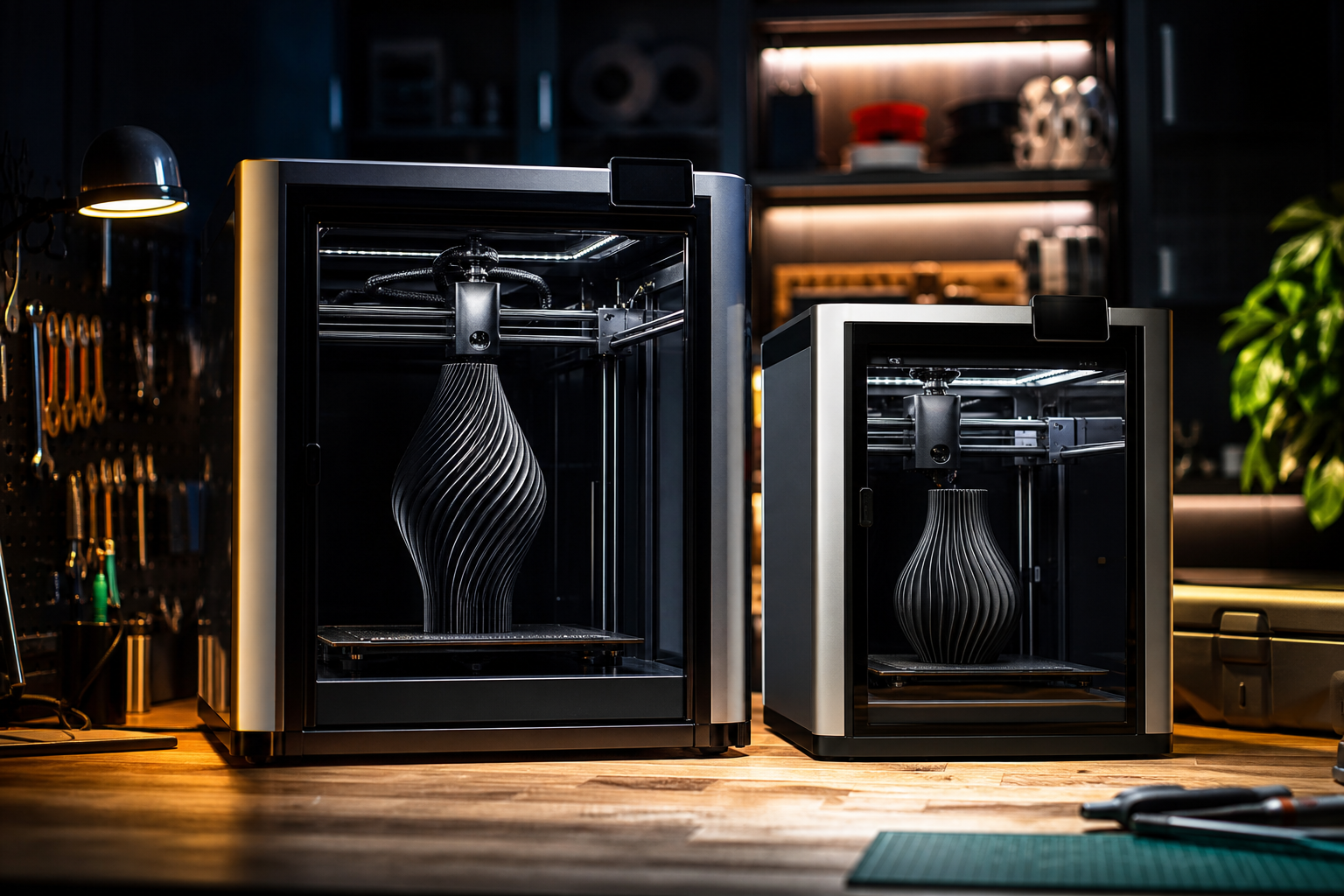
I’ve had a bit of an ongoing internal argument with myself about which Bambu Lab printer deserves permanent residence on my workbench. The P2S has been the workhorse for a good while now, but since Bambu dropped two genuinely interesting machines in quick succession this year, that question has got considerably more complicated. The A2L landed in June 2026, and I got proper hands-on time with it for my full review . The X2D arrived a couple of months earlier, in April, and I covered it in depth against the P2S. Now the question I keep getting asked is simpler: if you’re choosing between the two big-bed machines, which one do you actually buy?
Let me be direct about something first. These two printers are not really competing for the same buyer, even though they sit closer together in price than you might expect. Understanding why is the whole point of this piece.
My youngest has developed a worrying obsession with large cosplay props and terrain pieces for tabletop gaming. Big, awkward, single-piece prints that used to mean either splitting a model or accepting seam lines in frustrating places. That’s the lens I kept coming back to with the A2L. But I also kept thinking about the people who don’t just want big prints. They want the best prints. That’s a different conversation entirely, and it leads you somewhere else.
Build Volume: The A2L Is in a Different League
Let’s start with the most obvious differentiator, because it genuinely matters. The A2L has a build volume of 330 × 320 × 325 mm. The X2D, depending on configuration, runs to 256 × 256 × 260 mm on its primary nozzle, and that figure shrinks to 235.5 × 256 × 256 mm when you’re printing in dual-nozzle mode. That’s not a small asterisk. It’s something you need to factor in if multi-material printing is part of why you’re considering the X2D.
In real terms, the A2L’s print bed offers roughly 61% more XY area than the X2D’s primary lane. To put that another way, Bambu has positioned the A2L as giving you the same 330 × 320 mm build plate as the H2D, a machine that costs roughly four times as much, at around £450. That’s an extraordinary piece of value engineering, and I noticed it immediately when I first loaded a large terrain piece during my review. Things that would have needed splitting just fit. In one piece. The first time.
If physical size is your primary requirement, the A2L wins this category without argument. There is no close second.
Print Quality and Technology: Where the X2D Pulls Ahead
Build volume is one thing. What the X2D brings to the table is a fundamentally more sophisticated machine under the hood. The enclosed CoreXY design, the actively heated chamber reaching up to 65°C, the dual-nozzle system pairing a direct drive with a Bowden extruder, the servo extruder with real-time flow sensing, 31 onboard sensors, LiDAR, and a three-stage HEPA filtration system. Reading that list back, it’s still impressive.
The practical upshot of all this is that the X2D is purpose-built for engineering-grade and technical filaments. Anything that needs a controlled thermal environment, whether that’s ABS, ASA, PA, or PC, becomes genuinely approachable rather than a dice roll. The A2L, being open-frame, doesn’t offer that. It’s an excellent machine for PLA, PETG, and TPU, but if you need a heated chamber, you’re looking at the wrong printer.
The dual-nozzle setup on the X2D also enables soluble supports and multi-material printing in a way the A2L simply can’t replicate. The AMS Lite combo on the A2L gives you multi-colour single-material work, which is great fun, but it’s not the same thing. I covered the X2D’s technical credentials in more detail in the X2D vs P2S piece , but the short version is this: it prints at a level that genuinely narrows the gap between desktop and professional machines.
Price and Value: Closer Than You Think, Then Not
Here’s where it gets interesting. The A2L starts at around £450 for the standalone unit, with the AMS Lite combo adding a bit more on top. The X2D base is around £569, rising to approximately £769 for the Combo with AMS 2 Pro. Confirm the latest figures at Bambu’s UK store before you buy, as pricing through third-party retailers varies.
That gap at base level, roughly £120 to £200 depending on where you shop and which configuration you’re comparing, is smaller than you might assume for machines that are genuinely quite different in what they offer. The Combo comparison is where the gap becomes more significant.
| Spec | Bambu Lab A2L | Bambu Lab X2D |
|---|---|---|
| Form factor | Open frame, bed-slinger | Enclosed, CoreXY |
| Build volume (main) | 330 × 320 × 325 mm | 256 × 256 × 260 mm |
| Build volume (dual mode) | N/A | 235.5 × 256 × 256 mm |
| Nozzles | Single | Dual (direct drive + Bowden) |
| Chamber heating | None | Active, up to 65°C |
| Max print speed | ~500 mm/s | 500 mm/s (primary) |
| LiDAR | No | Yes |
| Filtration | None | 3-stage HEPA + carbon |
| Bed temp max | 80°C | Higher (enclosed) |
| Approx. UK base price | ~£450 | ~£569 |
| Approx. UK Combo price | ~£490 | ~£769 |
| Best for | Large single-piece prints, PLA/PETG | Technical filaments, dual extrusion, engineering parts |
The value question really depends on what you’re printing. If your workflow is mostly PLA terrain, cosplay parts, household items, or anything where sheer size matters more than filament versatility, the A2L is exceptional value. If you’re printing in ABS, need soluble supports, or want the confidence of a closed system with serious environmental control, paying the premium for the X2D is entirely justified.
Who Should Actually Buy Each One
This is the bit I refuse to fence-sit on, so here it is plainly.
Buy the A2L if you want the biggest print bed you can get for under £500, you primarily print PLA, PETG, or TPU, and you’re making props, terrain, cosplay parts, household items, or anything where size is the constraint you keep hitting. The open-frame design means no chamber heating, which rules out certain engineering filaments, but for the overwhelming majority of home and family printing this simply won’t matter. It punches well above its price point, and my hands-on time confirmed that the print quality is genuinely good for what it is. It’s also Bambu’s most approachable large-format machine to date.
Buy the X2D if you need a heated chamber for technical filaments, dual-nozzle printing is important to your workflow, you want soluble supports, or you’re producing functional parts where material performance matters as much as size. Yes, the build volume is smaller, but the X2D compensates with a level of print sophistication that the A2L simply doesn’t offer. It’s the machine for people who have already mastered the basics and want to push into more demanding territory.
Keeping your printer running at its best matters regardless of which you choose, and if you’re new to Bambu’s ecosystem, the maintenance guide on the site is worth a read before you start.
Hype Cycle Check
LIKELY TO LAST: The A2L’s value proposition. Matching the H2D’s build plate at a fraction of the cost is a genuinely compelling engineering achievement, and that price-to-plate-size ratio should resonate with hobbyists and families for years.
WATCH CLOSELY: The X2D’s dual-nozzle ecosystem. Multi-material and soluble support printing are powerful, but they add complexity. How well Bambu’s slicer and firmware support matures over the coming year will determine whether the dual-nozzle system becomes a genuine everyday workflow tool or a feature most owners rarely use.
VAPOURWARE RISK: Low for both. These are shipping machines with confirmed specs and real user feedback in the wild. Neither is vapourware in any meaningful sense. The only caveat is that UK retail pricing through third-party channels can shift, so always verify before purchasing.
CES 2027 Angle
Bambu Lab has had an extraordinary 2026 in terms of product cadence, with the X2D and then the A2L both arriving in the first half of the year. CES 2027 will be interesting to watch for what comes next. The H2D sits above both of these machines, but Bambu has shown a clear pattern of trickling down technology from premium models at speed. My expectation, having attended CES more times than I can easily count, is that we’ll see either a refinement of the A2L concept with some of the X2D’s sensor suite added, or a push into multi-material large-format territory that these two machines hint at but don’t fully deliver together. There’s an obvious gap in the lineup between a big open-frame bed-slinger and a smaller enclosed multi-material machine, and Bambu are not the kind of company to leave an obvious gap unfilled for long.
What to Watch
AMS 2 Pro compatibility with the A2L. Currently the A2L ships with AMS Lite support. If Bambu expands full AMS 2 Pro compatibility to the A2L’s platform, it becomes a very different proposition for multi-material printing.
Third-party enclosure accessories for the A2L. The open-frame design is the A2L’s main limitation for engineering filaments. If a quality aftermarket enclosure solution emerges at a sensible price, that changes the machine’s material versatility considerably.
X2D firmware and slicer updates. The dual-nozzle system is only as good as the software managing it. Watch Bambu’s update cadence closely over the next six to twelve months.
Price movement at retail. Both machines launched at competitive prices, but Bambu has a history of adjusting pricing as newer models arrive. If the X2D drops closer to the A2L’s price point, the calculus shifts significantly.
If you want to keep up with exactly this kind of hands-on comparison as Bambu and the broader 3D printing market keeps moving, the Tech Dads Life newsletter is the easiest way to stay across it. No fluff, no weekly spam, just the stuff worth knowing, when it’s actually worth knowing. Sign up at techdadslife.beehiiv.com .