The Short Answer
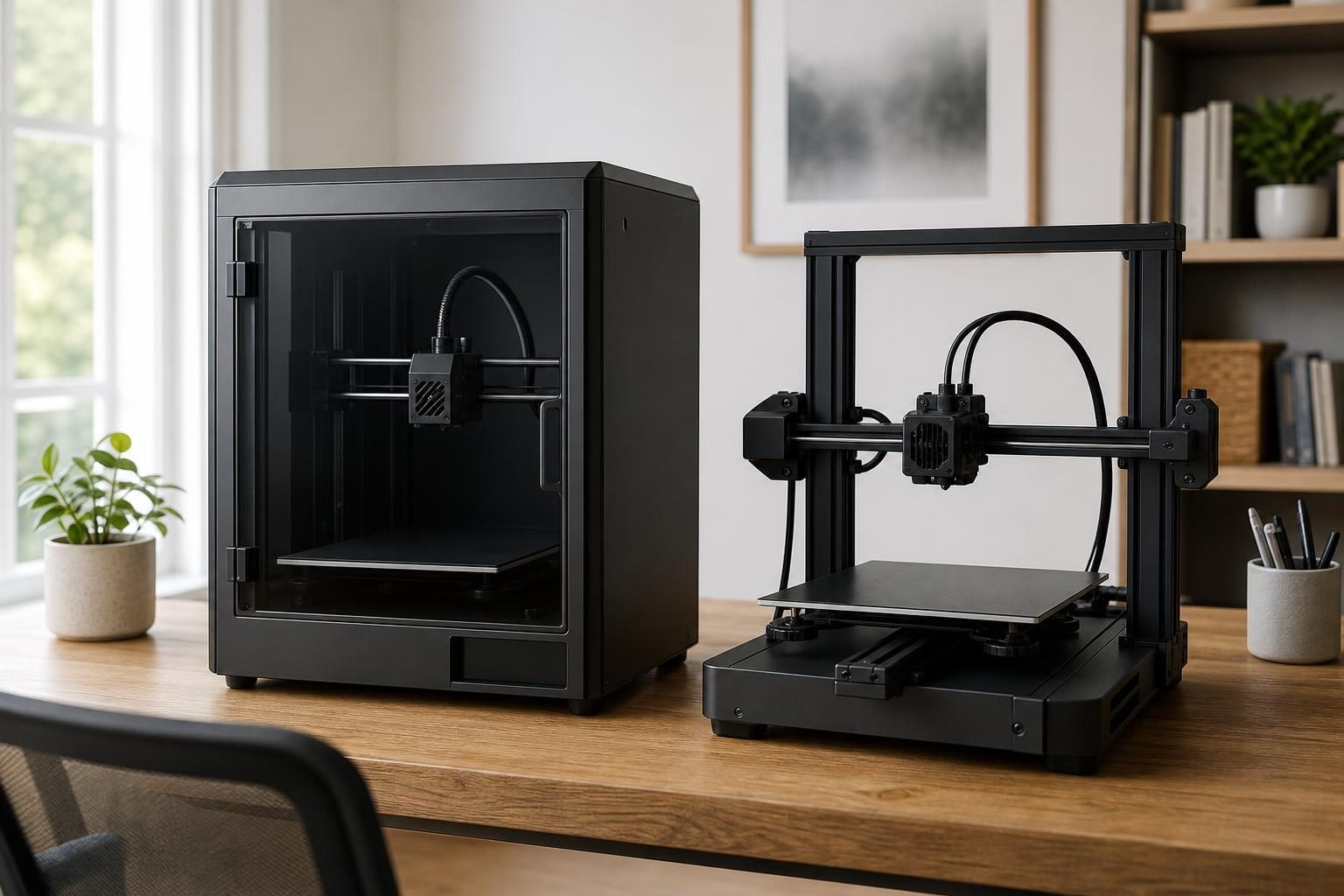
If you want a printer that is safe around kids, handles engineering materials, fits on a desk and keeps fumes contained, buy the P2S . If you want the largest possible print bed, the lowest entry price and the option to cut vinyl or draw with a pen attachment, buy the A2L . Both are current mid-range Bambu Lab machines sold new in the UK. The right one depends on what you are actually going to print and where you are going to put it.
Affiliate disclosure: some links in this article are affiliate links. If you buy through them, I may earn a small commission at no extra cost to you. All prices dated 9 October 2026 and sourced independently.
Who This Guide Is For and Inclusion Criteria
This guide is written for UK families buying their first or second 3D printer in 2026, with a budget of up to roughly £700. I am comparing only two machines: the Bambu Lab P2S and the Bambu Lab A2L (including the Combo versions of each). Both are current, in-stock Bambu Lab models sold new in the UK and priced below £700 in their Combo configurations.
Out of scope: the X2D, H2D, H2C, the discontinued P1S and A1, and any machine outside the Bambu Lab ecosystem. If you are weighing up the A2L against the X2D, I have covered that in detail on the Bambu Lab A2L vs X2D comparison page . If you want to understand where the P2S fits against Bambu’s flagship, the X2D vs P2S guide covers that angle.
I have not personally tested either printer. Where I quote specifications and prices, I link to the source. The A2L launched on 1 June 2026, so long-term reliability data is limited and I will note that clearly.
Top Picks
Meets the inclusion criterion of enclosure, material flexibility and sub-£700 Combo price: Bambu Lab P2S Price: £479 standalone or £699 with AMS 2 Pro Combo, as of 9 October 2026 (Bambu Lab official specs ; 3DJake UK lists it at £477.79; Additive-X at £449.00 standalone). Affiliate links used where present; see disclosure above.
Meets the inclusion criterion of large build volume, lowest entry price and creative add-ons: Bambu Lab A2L Price: £319 standalone or £429 with AMS Lite Combo, as of 9 October 2026 (TechRadar UK pricing ; 3DJake UK at £358.10). Prices vary by retailer; confirm at the Bambu Lab UK store before ordering. Affiliate links used where present; see disclosure above.
Comparison Table
| Feature | Bambu Lab P2S | Bambu Lab A2L |
|---|---|---|
| Price (standalone, 9 Oct 2026) | £479 | £319 |
| Price (Combo, 9 Oct 2026) | £699 (AMS 2 Pro) | £429 (AMS Lite) |
| Build volume | 256 × 256 × 256 mm | 330 × 320 × 325 mm |
| Machine footprint | 392 × 406 × 478 mm | 544 × 529 × 505 mm |
| Weight | 14.9 kg | 12.8 kg |
| Enclosure | Yes, fully enclosed | No, open frame |
| Air filtration | Activated carbon, VOC filtration | None |
| Max nozzle temp | 300°C | Not publicly stated |
| Max bed temp | 110°C | 80°C |
| Speed (peak) | 600 mm/s | 500 mm/s |
| Acceleration | 20,000 mm/s² | 10,000 mm/s² |
| Motion system | CoreXY | Bed-slinger |
| Camera | 1080p with AI detection | 1080p timelapse |
| Touchscreen | 5-inch | 3.5-inch |
| Noise (silent mode) | Not officially published | 49 dB |
| Materials (core) | PLA, PETG, ABS, ASA, PA, CF | PLA, PETG, TPU (dried) |
| Multi-colour (Combo) | Up to 16 colours (AMS 2 Pro) | 4 colours (AMS Lite) |
| Creative add-ons | None | Blade cutter, pen drawing |
| Software support until | October 2030 | Not published |
All specifications sourced from Bambu Lab official specs , the A2L launch blog , Tom’s Hardware P2S review and Tom’s Hardware A2L review .
Enclosure and safety
The P2S is fully enclosed. That means a door between your children and a nozzle running at up to 300°C with a bed at 110°C . It also retains heat, which is what allows it to print ABS and ASA reliably. The A2L is open-frame, which is fine for most prints but worth thinking about if your printer will live in a shared room with young children nearby. As lessfume.com notes , the enclosure is not just about materials; it is also a meaningful safety and containment factor.
Air quality
Both printers release VOCs and fine particles when printing, particularly at high speeds. The P2S includes an activated carbon filter with VOC filtration support . The A2L has no built-in filtration. If your printer is in a bedroom or main living space, this matters. I would recommend ventilating the room regardless of which you buy, but the P2S gives you a baseline of protection that the A2L does not.
Build volume
The A2L’s bed is roughly twice the working volume of the P2S : 330 × 320 × 325 mm (about 34.3 litres) against 256 × 256 × 256 mm (about 16.8 litres). If you are printing cosplay props, large decorative pieces or batches of smaller parts, that extra space is genuinely useful. If most of your prints are phone stands, toys and household fixes, you will rarely hit the P2S’s limits.
Footprint
This works the other way around. The A2L’s machine body (544 × 529 × 505 mm) is considerably larger than the P2S (392 × 406 × 478 mm). The A2L will dominate a desk; the P2S tucks in more neatly. If space is tight, the P2S wins here despite having the smaller print bed.
Noise
The A2L is rated at 49 dB in silent mode , which is quiet enough for a home office or living room. There is no official decibel figure published for the P2S, so I cannot make a direct comparison. The enclosure does reduce noise qualitatively, but I will not quote a number that does not exist.
Materials
The P2S can print PLA, PETG, ABS, ASA and fibre-reinforced composites including PA-CF and PLA-CF . The A2L, with its open frame and 80°C maximum bed , is reliably limited to PLA, PETG and dried TPU. If you think you might ever want to print functional parts in tougher materials, the P2S is the only option between these two.
Multi-colour
The Combo versions differ significantly. The A2L Combo includes the AMS Lite (4 colours, open design, no active drying). The P2S Combo includes the AMS 2 Pro (4 colours per unit, expandable to 16 total, with active filament drying). The AMS Lite’s open design means your filament is more exposed to moisture unless you store spools carefully. The AMS 2 Pro’s drying capability is a meaningful difference for anyone printing regularly with moisture-sensitive materials like PETG.
Creative modules
The A2L supports blade cutting and pen drawing add-ons, which Bambu Lab describes as tools for custom stickers, leather and fabric work . The P2S has no equivalent modular expansion. If craft-style making alongside 3D printing interests your family, the A2L has a clear edge here.
Longevity and track record
Bambu Lab has confirmed software feature support for the P2S through to October 2030 . The A2L launched in June 2026 and has no equivalent published support window. As a newer machine, long-term reliability is genuinely unknown. Early buyers should follow owner forums and firmware update notes before drawing conclusions about durability.
Budget and Alternative Options
At the lower end, the A2L standalone at £319 is a credible starting point for a family that wants a large bed and straightforward PLA printing. The Combo at £429 adds multi-colour for a reasonable premium. If you want to step up to a sealed AMS 2 Pro later, that is possible, as the A2L is compatible with it.
The P2S at £479 standalone is the more capable machine in a smaller box. The Combo at £699 is a larger investment, but the AMS 2 Pro’s drying and expandability make it the more useful long-term system if multi-colour printing is part of your plan.
For context on running costs, both machines use standard 1.75 mm filament and the Bambu Lab ecosystem. There is no significant per-print cost difference between the two. Filament choice and print settings matter far more than the machine model.
If you are also considering how Bambu Lab compares to other brands entirely, the Bambu Lab vs Creality 2026 guide covers the wider ecosystem question.
What to Avoid
Do not buy the A2L Combo expecting it to match the AMS 2 Pro. The AMS Lite is a simpler, open unit with no active drying. If you are printing moisture-sensitive materials regularly, you will likely want to upgrade or add a proper drying setup.
Do not buy the P2S if you are regularly going to want to print items larger than 256 mm in any dimension. The enclosure is a fixed constraint and no upgrade path changes the build volume.
Do not treat the A2L as a proven long-term platform yet. It is a June 2026 launch and the reliability data simply does not exist in the way it does for the more established P2S lineage.
Verdict by Use Case
Buy the P2S if your printer will live in a shared family room or bedroom, you want to print with ABS, ASA or engineering-grade materials, you need the smallest possible desk footprint between these two, or air quality and enclosure safety around children is a priority. The P2S is the more contained, more material-capable, more established machine.
Buy the A2L if your projects keep bumping into size limits, you want to print large cosplay parts, family props or batch runs of everyday items, you are drawn to the blade-cutting and pen-drawing add-ons, or you want to spend less upfront and prioritise bed area. The A2L is the larger, cheaper, more creatively flexible option, as long as you are comfortable with an open-frame machine and sensible about ventilation.
For most families buying their first printer and unsure which way to lean, the P2S edges it on practical grounds. The enclosure, the material range, the AMS 2 Pro in the Combo and the published software support timeline make it the safer long-term choice. The A2L is compelling, but it is newer and the bigger footprint is a real-world constraint. Keep an eye on the A2L review as owner data builds up over the next six to twelve months.
All prices quoted as of 9 October 2026. Verify current pricing at the retailer before ordering, as prices change. Affiliate disclosure: links to 3DJake UK, Additive-X and Bambu Lab may be affiliate links. See site policy for full details.