What Happened
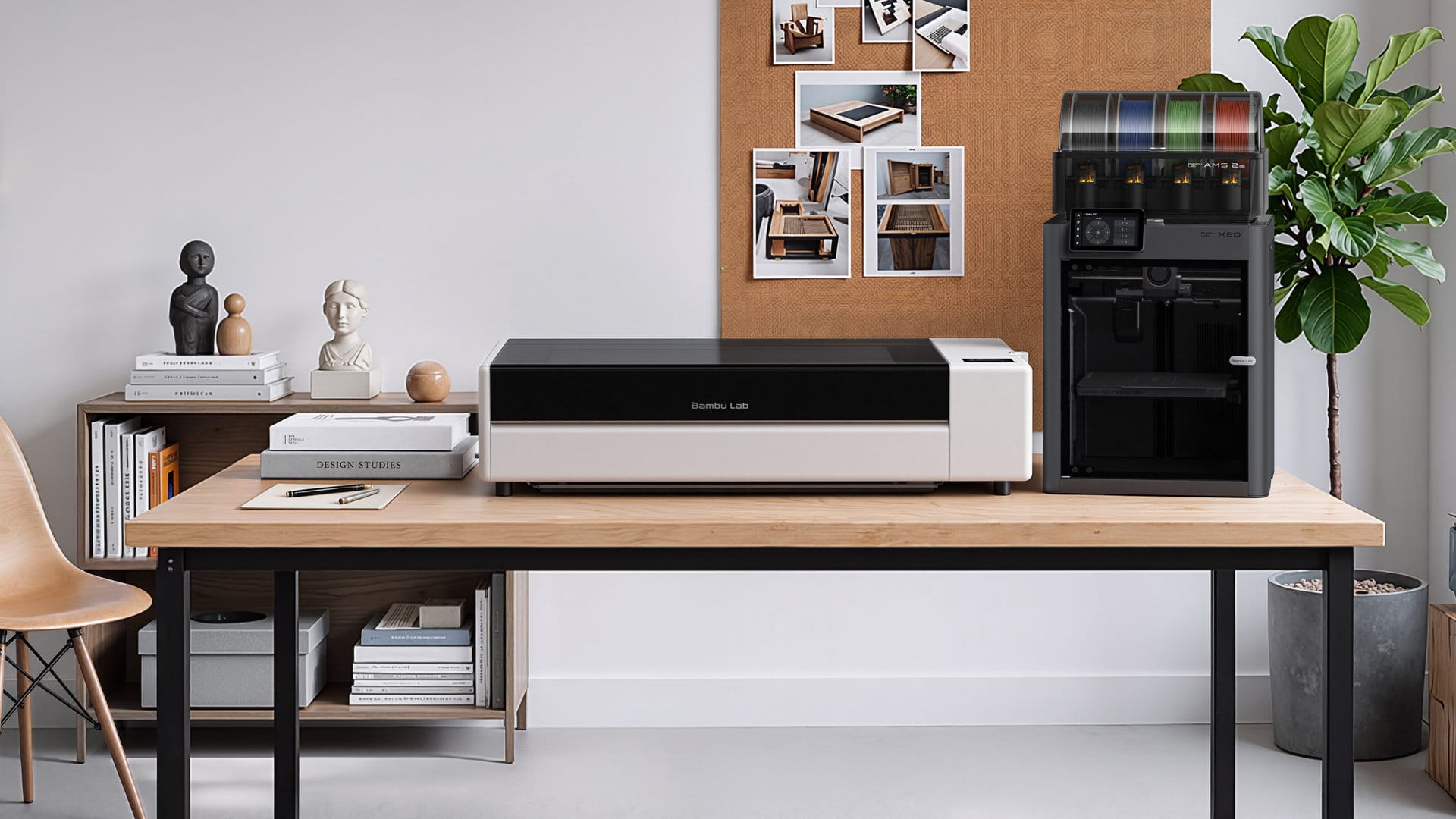
On 22 September 2026, Bambu Lab officially launched the R1, its first standalone laser cutter and engraver. The announcement was published on the official Bambu Lab blog and corroborated by multiple independent outlets including TechRadar, Tom’s Hardware, All3DP, and Develop3D. This is a significant moment: a company that in just a few years has come to dominate the consumer 3D printer market is now making its move into laser cutting.
The R1 uses a 55W CO₂ laser, housed in a fully enclosed cabinet. It weighs 33.5 kg and requires at least two people to set up. According to Bambu Lab’s own specifications (which have not been independently verified at time of writing), the machine cuts wood, acrylic, leather, paper, and fabric, and engraves glass, stone, and coated metals. The working area is 600 × 300 mm and the claimed top speed is 1,000 mm/s.
The headline cutting figures Bambu Lab quotes are 20 mm thick acrylic and 18 mm black walnut plywood in a single pass. There is an important footnote here: the 18 mm plywood claim requires the medium or long-focus lens, both of which are sold separately. With the short-focus lens that comes in the box, the plywood limit drops to 15 mm. The acrylic figure holds at 20 mm regardless of lens choice.
CO₂ lasers behave differently to the diode lasers found in most budget desktop cutters. A diode laser beam passes straight through transparent materials such as clear acrylic and glass, making them impossible to process. A CO₂ beam is absorbed by those surfaces, which is why the R1 can cut clear acrylic and engrave glass where a diode machine simply cannot.
Bambu Lab has built several features into the R1 that reflect its 3D printer engineering background. The machine includes what the company calls TriSense positioning, combining two cameras, two lasers, and two encoders to track surfaces and place cuts accurately. There is also an automatic optical alignment system: you mount a sensor on the toolhead, and the machine measures and corrects its own beam path in around one minute, without test shots or manual tuning.
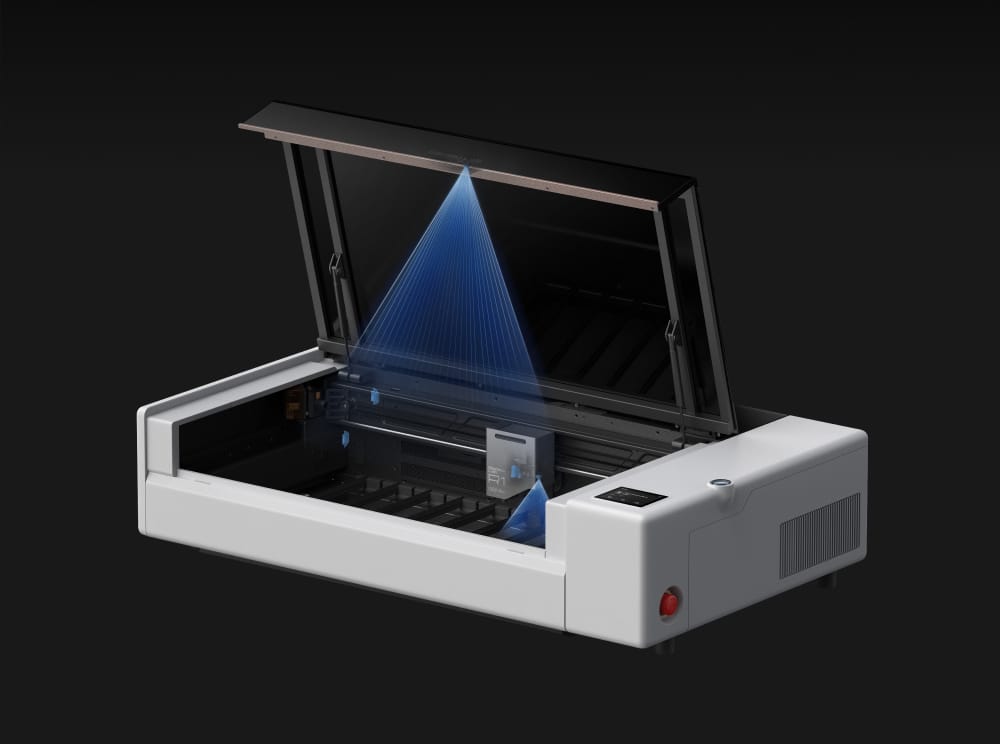
Safety features include automatic flame detection, a lid-open stop, an emergency stop button, and compatibility with an optional auto fire extinguishing system. In its standard enclosed configuration the R1 is rated Class 1, meaning it does not require laser safety eyewear for normal desktop use.
The safety caveat you must not skip: when you add the optional Riser Base or the auto-feed Conveyor accessory, the enclosure is no longer complete. At that point, Bambu Lab’s own product page states clearly that the R1 reclassifies from a Class 1 device to a Class 4 laser, the highest hazard category. It requires CO₂-rated laser safety eyewear and is intended for use by trained professionals only. This is not an inferred risk. It comes directly from Bambu Lab’s own US product and store pages. If you are planning to buy the Conveyor to handle long stock, or the Riser Base to accommodate taller objects (which is also required for the rotary attachment), you need to factor this in before you set anything up in a home workspace.
Pre-orders opened on 22 September, with first shipments expected in October. Pricing is US$2,499 excluding tax in the United States and €2,499 including tax in the EU. The Bambu Lab UK Store and TechRadar’s launch-day coverage quoted a UK price of £2,249. I of course rushed to look and shipping has an ETA of 11 December for the UK. I would recommend checking the UK product page directly before committing.
Analysis: Why It Matters
Bambu Lab’s entry into laser cutting matters for the same reason its entry into 3D printing mattered: the company has a track record of taking a category that required significant technical knowledge to operate well and making it significantly more approachable without gutting the capability.
The automatic optical alignment is a good example. Beam alignment on a CO₂ laser has traditionally been a fiddly, time-consuming process involving test shots on thermal paper and iterative adjustment. If Bambu Lab’s one-minute automated process works as described, that removes one of the more intimidating barriers to ownership. The same logic applies to the TriSense surface tracking.
The 55W power rating also puts the R1 in a different league to most desktop diode lasers, which typically run between 5W and 40W. That translates directly into thicker cuts and faster throughput, assuming the company’s claims hold up to independent testing, which has not happened yet.
That said, the accessories model deserves scrutiny. The Vision Encoder calibration board, the Conveyor, the Riser Base, the rotary attachment, the fire suppression system, and the medium and long-focus lenses are all sold separately. The headline cutting depth for plywood requires a lens that is not in the box. Anyone pricing up a fully capable setup should build in a realistic accessories budget on top of the machine cost.
For context on how Bambu Lab approaches its broader ecosystem, my Bambu Lab A2L review covers similar territory on the printer side. If you are new to Bambu Lab’s software approach, the Bambu Studio beginner guide gives useful background. It is worth noting that at launch the R1 only supports Bambu Suite software on Windows and macOS, with no third-party software compatibility confirmed.
What Is Still Unclear
Several things remain unresolved. All performance specifications are Bambu Lab’s own claims and no independent lab testing of cutting depth or speed figures has been published at time of writing. Bambu Lab has not publicly explained what mechanism physically corrects the beam path during automatic alignment. The rotary attachment currently only supports cylinder processing at launch, with a more advanced revolve shape mode promised in a future firmware update. The UK price of £2,249 comes from TechRadar’s review, not directly from the Bambu Lab UK store, so treat it as indicative until you can verify it yourself.
What to Watch Next
The immediate things to look for are independent reviews testing the actual cutting depth and speed claims, particularly the 18 mm plywood figure and whether it holds with the optional lens in real-world conditions. The accessories pricing, once fully published, will determine what a genuinely capable setup actually costs in the UK. And if Bambu Lab’s expansion into laser cutting follows the pattern of its printer launches, expect rapid firmware development and community feedback to shape the experience significantly in the first few months after shipping begins.