UK families are voting with their searches, and Bambu Lab is winning by a widening margin
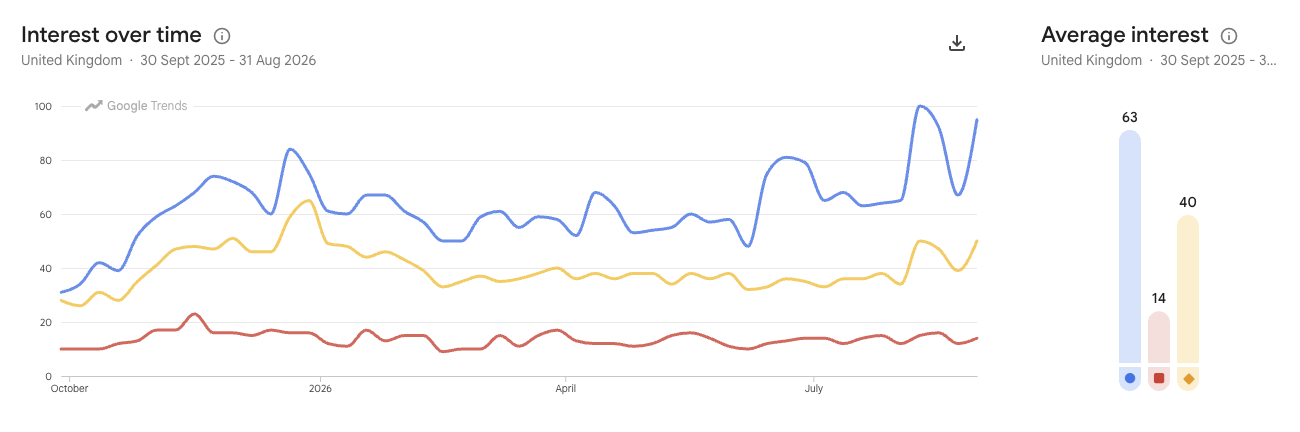
Google Trends data for Great Britain over the past 12 months (to August 2026, web search) shows Bambu Lab averaging an index score of 63, Creality at 40, and Prusa at 14. Those are not close numbers. Bambu Lab and Creality were genuinely neck and neck through most of 2025, both hovering in the mid-30s, but from late October and November 2025 onwards Bambu Lab pulled decisively ahead and never gave the lead back. It then surged to a new high of 96 in June 2026, a figure that represents peak interest in the brand, not absolute search volume. Prusa sat in a flat 15 to 20 range all year. Within GB, England shows the strongest Bambu Lab interest of all the sub-regions reviewed by TDL.
This piece is a companion to the ChatGPT vs Claude vs Gemini vs Grok search trends article and follows the same format: Google Trends as a proxy for real consumer intent, not sales figures or editorial opinion. A note on methodology before we go further: these index values are editorial figures reviewed by TDL and are approximate scores on a 0 to 100 scale, not absolute search volumes. They show relative interest between terms over time, and the pattern they reveal is striking enough to be worth unpacking properly.
First-hand testing context
This article does not involve hands-on testing of any of the three brands. No printers were loaned or owned for the purposes of this piece. All claims below are drawn from published third-party sources, manufacturer specifications, and market intelligence data from research firm Context. Where comparisons are made between brands, they are based on sourced reporting and spec sheets, not personal findings. That limitation is worth being clear about, because the 3D printing community is rightly sceptical of brand comparisons that dress up press releases as lived experience. Where I link to reviews by others who do claim first-hand use, I have noted that provenance.
If you want first-hand impressions of Bambu Lab machines specifically, the Bambu Lab A2L review on this site goes into considerably more detail based on actual ownership. This article is about the brand war at search level, and what the numbers suggest about where the market is heading.
What is genuinely good
The search inflection point in late 2025 lines up with something concrete. Market intelligence firm Context published full-year 2025 data showing Bambu Lab had overtaken Creality to claim the top spot in global entry-level 3D printer shipments, holding a 37 per cent share of the sub-$2,500 segment. For context, Creality had led that same category with a 39 per cent share as recently as Q1 2025, while Bambu Lab was already growing year-on-year shipments at 64 per cent. The growth rate was always going to close the gap; the question was when. The answer, based on both the Context data and the Google Trends signal, appears to be Q4 2025.
European retailer data adds texture. German platform Galaxus reported selling 59 per cent more 3D printers in the first four months of 2026 compared to the same period in 2025. Almost every second printer sold in that window came from Bambu Lab, with only one in four from Creality. Those are retail figures for one European market, not a global statistic, but they are consistent with the pattern the search trends suggest.
Bambu Lab’s own numbers are bold but come with the caveat that they are self-reported. The company claims close to two million app downloads for BambuHandy in 2025, over 290 million print hours logged across its platform that year, and an 83 per cent user retention rate after 12 months. Independent surveys of active 3D printer owners in early 2026 placed Bambu Lab at over 40 per cent market share in the roughly £800 to £4,000 price bracket, a segment that Prusa and Creality had previously divided between them.
The honest explanation for Bambu Lab’s search dominance is that it made the setup problem disappear. Traditional home 3D printing involved buying a kit, assembling it, calibrating it, arguing with firmware, and then starting to learn the actual creative part. Bambu machines arrive close to ready to run. For a parent who wants to print something useful on a Tuesday evening rather than spend a weekend levelling a bed, that is not a minor convenience. It is the reason you buy one brand and not another. I have written about the multi-colour side of the Bambu ecosystem separately in the AMS piece if that aspect is relevant to your decision.
What is not
The trade-off with Bambu Lab is a relatively closed ecosystem. Bambu Studio works well but is proprietary software, and the company has historically been more cautious about third-party integrations than Prusa or even Creality. For most families buying into 3D printing for the first time, that trade-off is invisible. They are not interested in running Klipper or writing custom G-code macros. They want it to work, and Bambu Lab generally delivers that. But if openness matters to you, it is a real limitation.
Creality’s challenge is polish. BGR, writing in August 2026 with the author noting first-hand ownership of an Ender 5, characterised Creality as hitting a midpoint between Bambu’s closed convenience and Prusa’s open technical approach, while acknowledging the software and hardware polish is a step behind Bambu Lab. That framing feels accurate based on the sourced literature. Creality works better for tinkerers who want to tune and modify. Its open-source compatibility and large community of firmware contributors mean there is always something new to try, but that same openness means the setup curve is steeper.
Prusa’s situation is more concerning at a trends level. A search index average of 16, sitting flat between 15 and 20 all year, suggests the brand is not growing its UK audience. Community commentary has raised questions about whether the company is losing ground to Asian competitors including Bambu Lab, Creality, and others. Reports from community forums in 2025 referenced internal financial difficulty and significant staff reductions. Those reports originated from third-party commentary sites rather than official Prusa communications, and Prusa has not confirmed specific figures, so they should be treated as unverified community-level reporting rather than established fact. The CORE One was in production throughout 2025 despite whatever was happening internally, and the INDX launch in early 2026 showed genuine innovation.
Compared to alternatives
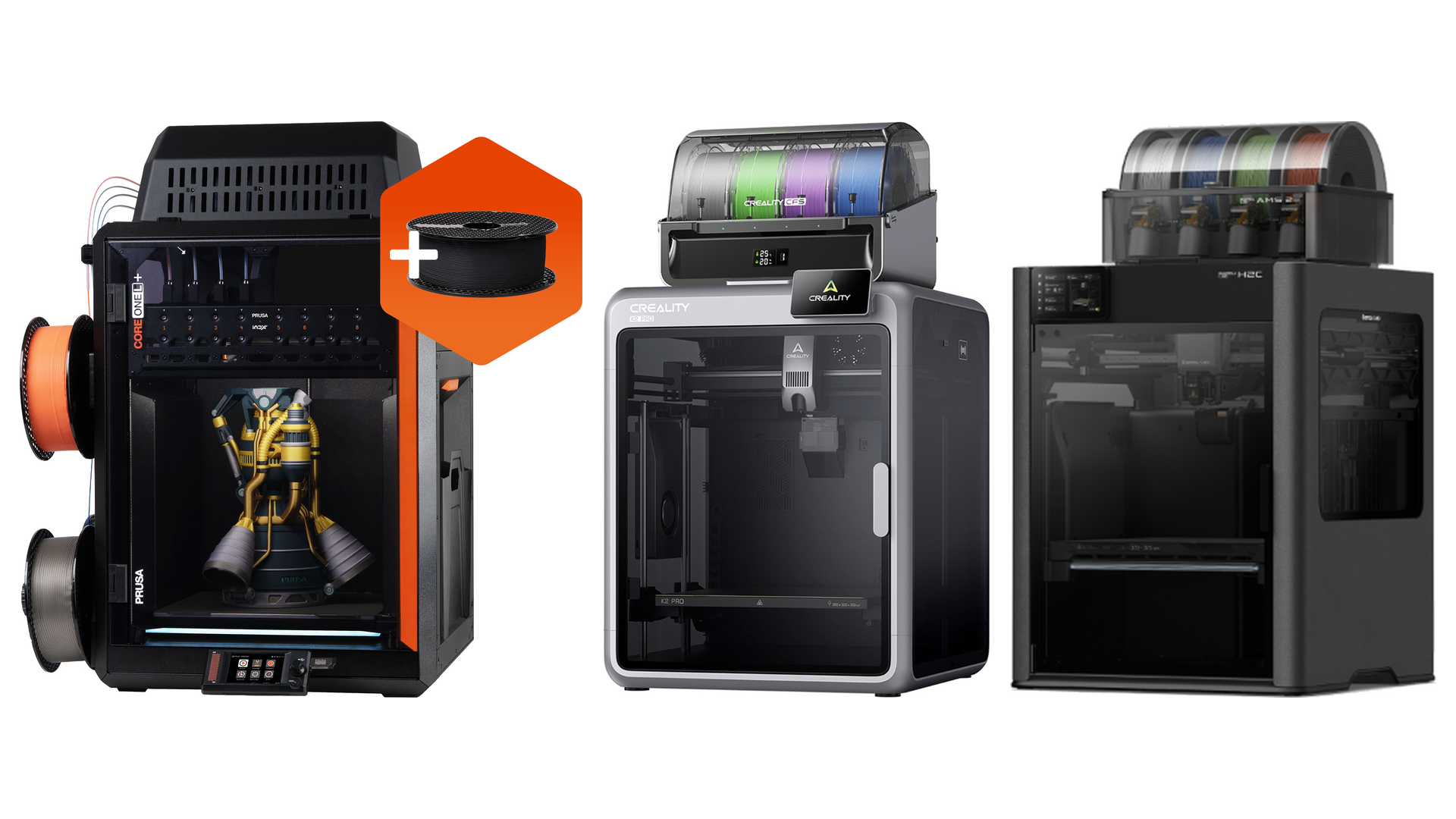
The breakout model searches from the Trends review surface four hardware lines worth flagging, all pointing to recently launched or evolving products.
Bambu Lab H2C. Launched 18 November 2025 with immediate UK availability. The headline feature is the Vortek multi-material system, which uses up to six interchangeable, contactless hotends rather than a single nozzle switching between materials. According to manufacturer specifications, the result is multi-material printing with up to seven colours or materials in a single job without the purge waste that single-nozzle systems require. The machine includes a 65°C actively heated chamber, 350°C capable hotends, and 59 onboard sensors alongside AI print monitoring. UK pricing was not confirmed within our research; check bambulab.com directly before budgeting.
Creality K2 Pro Combo. Manufacturer specs list a 300 × 300 × 300 mm build volume, speeds up to 600 mm/s, a 60°C actively heated chamber, and four-colour printing out of the box expandable to 16 colours via Creality’s CFS system. A third-party review at 3D Tech Valley, whose author claims hands-on testing, placed the price at roughly $999 to $1,049 and described it as offering capabilities that previously required a $1,500-plus investment, with the caveat that the Creality ecosystem is still maturing relative to Bambu Lab. Confirm current UK pricing at creality.com. We covered the SPARKX i7 announcement and Creality’s 2026 printer plans earlier this year for broader context.
Prusa CORE One and INDX. Worth clarifying what INDX actually is, because search interest could easily confuse the two. The INDX is not a standalone printer. It is a passive toolchanger conversion kit developed by Prusa Research alongside Bondtech, designed to transform a CORE One+ into a multi-material machine supporting up to eight tools. Because each material has its own dedicated nozzle, no purging between colours is needed, which means minimal wasted filament and clean transitions. Orders opened in April 2026 and the first batch sold out quickly. Orders for the CORE One L+ INDX opened in August 2026, but stock availability changes rapidly. Check prusa3d.com directly and do not assume availability based on this article.
Prusa’s appeal remains real and specific. If you want a printer with no cloud dependency, full offline capability, and an ecosystem built on open standards, Prusa is still the clearest choice. The CORE One L supports that workflow natively, integrating with PrusaSlicer, Prusa Connect, and EasyPrint while remaining fully functional without an internet connection. That matters in some contexts, particularly for schools or makers with privacy requirements, but it is not what most UK families buying their first printer are searching for. Where Prusa does justify its premium is longevity: MK3 printers from 2018 are reportedly still running production workloads in 2026, a lifespan that is rare in consumer 3D printing hardware.
Who should buy it
If you want the quickest route to a working printer with strong multi-colour capability and are comfortable with a proprietary software ecosystem, the search trends reflect a real-world reality: Bambu Lab is what most UK buyers are gravitating towards, and the market data supports why. The Bambu Studio beginner guide is a useful starting point if that route appeals.
If you want more flexibility, a lower entry price, and do not mind spending time on configuration, Creality remains a legitimate and well-supported choice with an enormous community behind it.
If you want maximum openness, offline capability, and are buying into a long-term ecosystem rather than a single machine, Prusa is still the most principled option in the market. The low search numbers reflect marketing reach and brand recognition more than product quality.
Verdict
The UK search data reviewed by TDL tells a clear story. Bambu Lab won the brand-awareness battle sometime in late 2025 and has extended that lead through 2026. The search trend aligns with shipment data from Context, retail sales figures from Galaxus, and the general direction of community conversation. Creality is a stable and significant second. Prusa is present but not growing.
None of that means Bambu Lab makes the right printer for every buyer. Search volume reflects who is being talked about, not necessarily who makes the best machine for your specific needs. But if you are trying to understand where British 3D printing interest is flowing, the answer is increasingly unambiguous. The breakout models across all three brands suggest the next 12 months will be competitive at a product level, even if the brand-awareness gap continues to widen at search level.
I will be looking at the H2C, the K2 Pro Combo, and the CORE One INDX in more detail as independent reviews become available and, where possible, as hands-on time can be arranged.