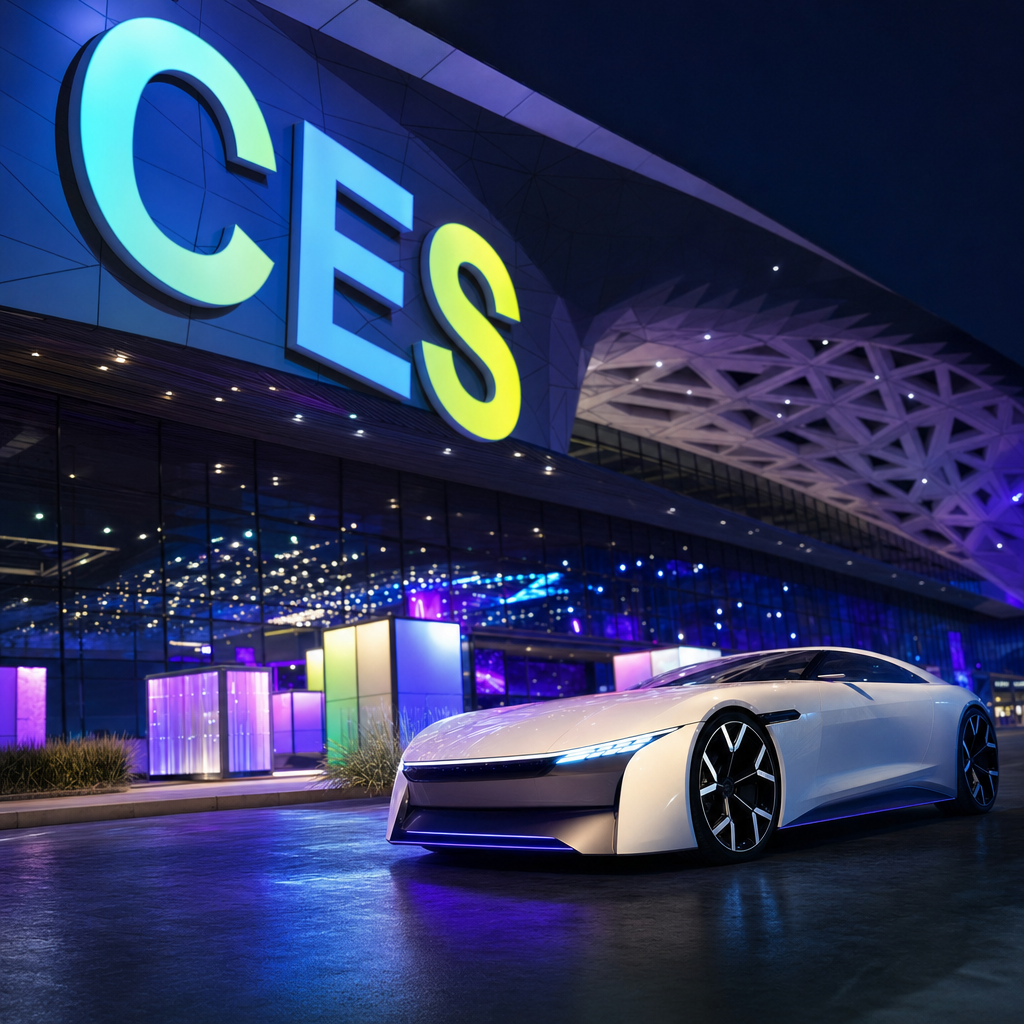
I’ve just about recovered. My feet have stopped aching, the jetlag has finally loosened its grip, and I’ve managed to unpack my suitcase full of lanyards, branded tote bags, and roughly forty USB sticks I’ll never use. CES 2026 is done, and I’m still processing everything I saw across those mad few days in Las Vegas. If you’ve ever tried to explain to a seven-year-old why Daddy needs to fly to America to “look at robots,” you’ll know the feeling. My eldest asked if I’d brought one home. Honestly, after what I saw this year, that might not be far off.
But here’s the thing. CES isn’t just a spectacle, although it absolutely is that. It’s a genuine barometer for where consumer technology is heading. And when you look at the raw numbers from this year’s show, the direction of travel is unmistakable. With 148,000 attendees packing the halls, up from 142,000 at CES 2025 , this was the biggest post-pandemic edition the show has ever staged. That’s 4,100+ exhibitors spread across 2.6 million square feet of show floor. To put that in perspective, that’s roughly 45 football pitches of technology. My Fitbit was not happy with me.
Among that enormous crowd were 55,841 international visitors from 141 countries and territories, 6,900 media representatives frantically typing on laptops in every corner, and a striking stat: 52% of attendees were senior-level executives. This wasn’t just tire-kicking tech enthusiasts. Decision-makers with serious budgets were there in force, and they were all gravitating towards the same three themes. Under the official banner of “Innovation for All,” CES 2026 was defined by agentic AI, humanoid robotics, and always-on wearable intelligence. Let me break down what I saw, what matters, and what you can safely ignore.
Agentic AI: Your New Digital Co-Parent (Almost)
If CES 2025 was the year everyone slapped “AI” on their product label, CES 2026 was the year AI actually started doing useful things. The buzzword this time around was “agentic AI,” meaning artificial intelligence that doesn’t just respond to your prompts but proactively takes actions on your behalf. Think less chatbot, more digital butler.
AI sessions drew 39,929 attendees this year, up 22% year-on-year, and it was easy to see why. Every major player, from Samsung to Google to a wave of ambitious startups, was demonstrating AI systems that could book appointments, manage your smart home, handle online returns, and even negotiate with your energy provider. One demo I watched had an AI agent rescheduling a family’s entire week after a child’s school called to say they were poorly. It adjusted calendar entries, cancelled a restaurant booking, ordered groceries for delivery, and sent a message to the grandparents. All without a single human tap.
The hot phrase of the show was “affectionate intelligence,” a term that kept cropping up in keynotes and panel discussions. The idea is that AI companions should feel warm, empathetic, and emotionally attuned rather than coldly efficient. Several companies showed AI companions designed for elderly relatives living alone, offering conversation, medication reminders, and gentle nudges to stay active. As a dad who worries about his own parents, this one genuinely resonated. Whether these systems can deliver on that promise outside a polished demo environment remains to be seen, but the ambition is there.
The startup contingent was enormous this year. A staggering 1,230 startups exhibited at CES 2026, described by organisers as a 13-fold increase. Eureka Park, the startup area, was heaving. Many of the most interesting AI demos came from small teams with big ideas, particularly around family-focused applications. I saw AI-powered homework tutors, meal planners that adapt to dietary needs and what’s already in your fridge, and a bedtime story generator that weaves your child’s name and interests into original narratives. Not all of these will survive to market, but the sheer volume of innovation was genuinely exciting.
Humanoid Robots: They Fold Laundry Now (Sort Of)
If agentic AI was the brains of CES 2026, humanoid robotics was the body. Robotics sessions drew 19,605 attendees this year, up a remarkable 26% year-on-year, and the show floor was absolutely crawling with bipedal machines doing things that ranged from genuinely impressive to charmingly absurd.
Let’s start with the headline act. Multiple companies demonstrated humanoid robots performing household tasks, and the one that had the biggest crowd was a robot folding laundry. Now, I need to be honest here. It wasn’t quick. It picked up a t-shirt, studied it for a moment with what I can only describe as mechanical contemplation, and then folded it with reasonable accuracy over about 45 seconds. My wife could do a full load in that time. But the fact that a robot can now identify a garment, understand its shape, and manipulate soft fabric with dexterous hands is a genuine engineering milestone. Give it a few iterations and this could be transformative for families juggling work and domestic life.
Then there were the robots that were just having fun. One booth featured a humanoid robot doing a convincing country dance, complete with coordinated arm movements and a do-si-do that drew whoops from the crowd. Another had a robot squeezing fresh citrus juice, delicately picking up oranges and applying just enough pressure to extract the juice without crushing the rind. Practical? Debatable. Entertaining? Absolutely. But underneath the showmanship, the dexterity on display was a step change from even two years ago.
What struck me most was how many of these robots were being pitched not as industrial tools but as domestic helpers. The target customer, increasingly, is families. Companies talked about robots that could tidy up after the kids, carry shopping from the car, or assist elderly family members with mobility challenges. We’re still years away from any of this being affordable or reliable enough for a normal household. But the trajectory is clear, and the investment flowing into this space is enormous.
Always-On Wearables: The Glasses, the Rings, and the Quiet Revolution
The third pillar of CES 2026 was wearable AI, and this is the category I think will have the most immediate impact on everyday family life. Not because the tech is flashy, but because it’s becoming invisible.
Meta’s Ray-Ban smart glasses were everywhere at the show, both on display and on people’s faces. The latest iteration has improved the onboard AI assistant significantly. You can glance at a restaurant menu in a foreign language and get an instant translation in your ear. You can look at a plant in your garden and ask what it is. You can receive walking directions as subtle audio cues without ever pulling out your phone. I wore a pair for an afternoon on the show floor and genuinely found them useful for navigating the labyrinthine convention centre. They just look like normal sunglasses, which is the whole point. The “I’m wearing a computer on my face” stigma that killed Google Glass a decade ago has been quietly engineered away.
Smart rings were another major presence. Multiple manufacturers showed rings packed with health sensors that track heart rate, blood oxygen, sleep quality, skin temperature, and stress levels. The data feeds into AI-powered health dashboards on your phone that can spot patterns and flag potential issues. For parents trying to keep on top of their own health while running around after small children, this kind of passive monitoring is genuinely appealing. No need to remember to charge a chunky watch or strap on a chest monitor. Just wear a ring and let the AI do the analysis.
The broader trend here is “on-device AI,” processing that happens locally on the wearable rather than being sent to the cloud. This matters for privacy, for speed, and for battery life. Several companies demonstrated wearables that could run meaningful AI models entirely on-chip, meaning your health data never leaves your wrist or finger. For parents who are rightly cautious about where their family’s data ends up, this is a significant development.
Other Hardware Worth Mentioning
Beyond the big three themes, two pieces of hardware caught my eye. Samsung unveiled a crease-free foldable display that genuinely looked seamless when unfolded. If you’ve ever been put off foldable phones by that visible crease running down the middle of the screen, Samsung appears to have cracked it. This could be the generation that makes foldables mainstream rather than niche.
And then there was Verge Motorcycles, who showed a solid-state battery system promising a 370-mile range for their electric motorcycle, with a 10-minute charge adding an extra 186 miles. That’s not a phone or a laptop. That’s a full-sized vehicle with range and charging speeds that would make most electric car owners weep with envy. Solid-state batteries have been “coming soon” for years, but if Verge can deliver on this at production scale, the implications for everything from EVs to home energy storage are massive.
CES 2026 vs CES 2025: By the Numbers
| Metric | CES 2025 | CES 2026 | Change |
|---|---|---|---|
| Total Attendance | 142,000 | 148,000 | +4.2% |
| Exhibitors | 4,500+ | 4,100+ | Slight decrease |
| AI Session Attendees | ~32,700 | 39,929 | +22% |
| Robotics Session Attendees | ~15,560 | 19,605 | +26% |
| International Attendees | Not confirmed | 55,841 (141 countries) | Record |
| Startups Exhibiting | ~1,000 | 1,230 | 13x growth cited |
| Senior-Level Executives | N/A | 52% of attendees | New benchmark |
Hype Cycle Check
LIKELY TO LAST: On-device wearable AI. Smart glasses and smart rings are genuinely useful, increasingly affordable, and solving real problems. The privacy advantages of local processing give them legs. This isn’t hype. This is the smartphone accessory layer arriving properly.
WATCH CLOSELY: Agentic AI companions. The demos were impressive, and the concept of AI that acts on your behalf is powerful. But reliability, trust, and security all need to be proven in the real world. One rogue AI agent booking you a non-refundable holiday would kill consumer confidence fast. Give it 18 months before committing.
VAPOURWARE RISK: Affordable domestic humanoid robots. The engineering is real, the progress is visible, but the gap between a trade show demo and a robot that reliably folds your laundry at a price a normal family can afford is still enormous. Five to ten years at minimum for anything approaching mainstream adoption.
What This Means for CES 2027
Looking ahead, CES 2027 is shaping up to be the year these threads converge. Expect agentic AI to move from standalone demos to being deeply embedded in every product category, from fridges that order their own replacement filters to cars that negotiate insurance renewals. Humanoid robotics will likely focus on specific, repeatable tasks rather than general-purpose butlers, narrowing the scope to nail the execution. And wearables will push further into health diagnostics, possibly with regulatory approvals that let smart rings flag early signs of conditions like atrial fibrillation or sleep apnoea.
Solid-state battery technology could also be a major storyline at CES 2027 if companies like Verge deliver on production timelines. The knock-on effect for portable tech, wearables, and electric vehicles would be significant.
If you want to follow along as we track the road to CES 2027, with hands-on testing of the products that actually make it to market, you can keep up with everything at ces.tech .
What to Watch
Meta Ray-Ban Gen 3 release window. The current smart glasses are already compelling. If Meta nails a UK-friendly price point under £300 ($380) for the next generation, these could become a genuine everyday accessory for parents who want hands-free information without screen addiction.
Agentic AI platform wars. Google, Samsung, Apple, and Amazon are all building competing agentic ecosystems. Whichever platform can reliably handle multi-step family tasks, think school pickup logistics, grocery ordering, and appointment juggling, will win a massive audience. Watch for real-world reliability reviews in the second half of 2026.
Solid-state battery production announcements. Verge’s 370-mile claim is extraordinary. If they or another manufacturer announce production-ready solid-state cells in 2026, it changes the calculus for electric vehicles, home batteries, and even laptops. Keep an eye on pricing and availability timelines.
Smart ring health approvals. Several smart ring manufacturers are seeking medical device certifications in both the EU and the US. If approved, these tiny devices could become legitimate health monitoring tools rather than wellness gadgets. Particularly worth watching for families with members managing chronic conditions.
That’s the wrap on CES 2026. The biggest, busiest, most AI-saturated show in its history, and one that genuinely felt like a turning point rather than just another lap around the convention centre. If you want weekly breakdowns of the tech that actually matters for families, with honest takes and no fluff, sign up for the Tech Dads Life newsletter. I promise to keep it shorter than a CES keynote.