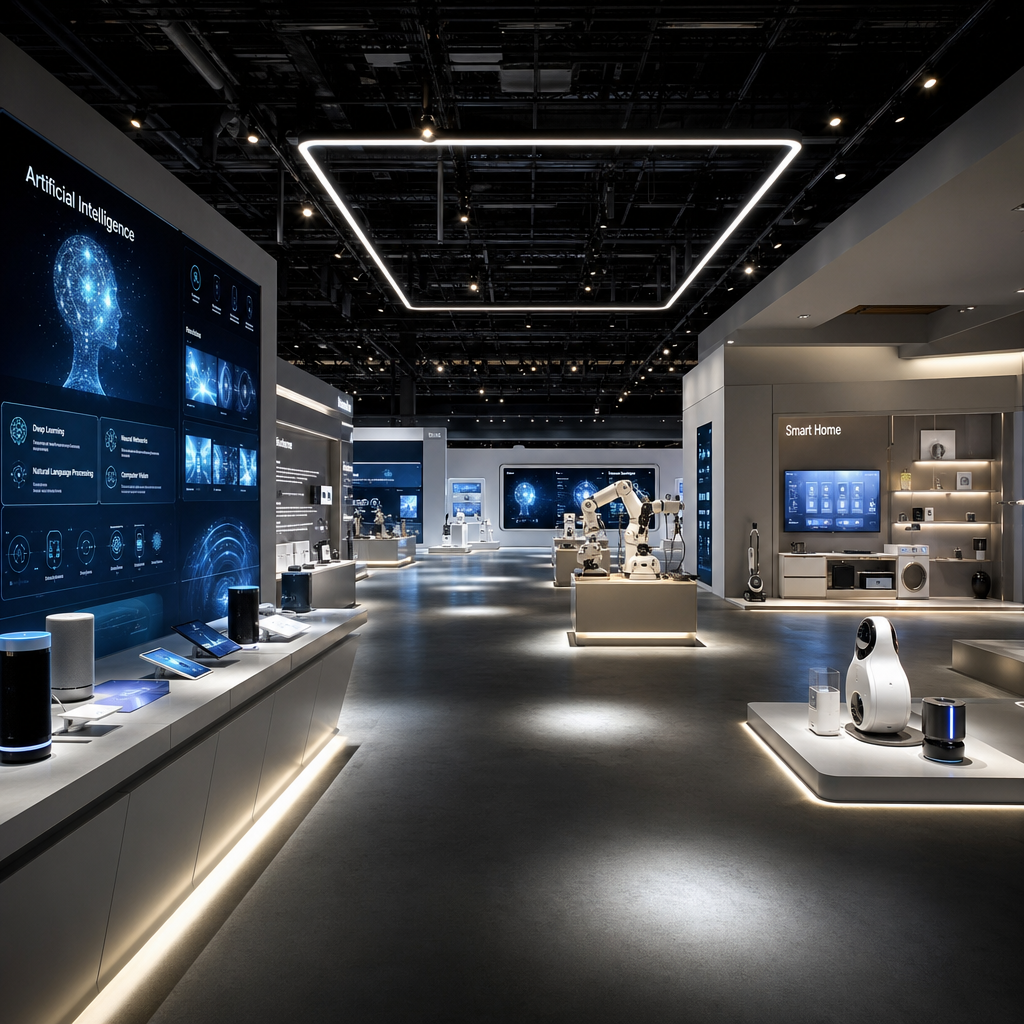
It’s April 2026, and I’m already thinking about January. That might sound ridiculous, like buying Christmas presents in July, but if you’ve ever been even remotely interested in where consumer technology is heading, CES has a way of pulling you in months before the doors open. I’ve been tracking the signals, reading the announcements, and quietly building a watch list for CES 2027. This one feels significant. It marks 60 years of the show, running January 6 to 9 in Las Vegas, and the themes shaping up are the kind that genuinely affect how families like mine live day to day.
What’s got me particularly excited is how practical everything is becoming. We’ve had years of concept videos and “imagine if” demos. Now the tech is landing in actual products. AI that does things for you rather than just chatting. Glasses you’d actually wear in public. Health sensors that could flag a problem before your GP appointment. Smart home gear that finally talks to each other properly. If even half of what’s brewing makes it to the show floor, CES 2027 could be the most relevant one yet for normal people, not just Silicon Valley insiders.
And here’s the thing. I’m seriously considering being there in person this time, and pulling together a self-organised UK meetup while I’m at it. More on that later. First, let me walk you through what the signals are telling us right now.
AI Agents: From Chatbots to Actual Helpers
The biggest shift I’m watching is the move from AI you talk to, to AI that acts on your behalf. At CES 2026, the buzzword was “agentic AI,” and it’s only gathered pace since. Unlike a chatbot that waits for your prompt, an AI agent can perceive its environment, make decisions, and carry out multi-step tasks with minimal hand-holding. Think less “Hey Siri, set a timer” and more “book the cheapest family campsite in Dorset for the August bank holiday weekend, check the weather forecast, and add it to the shared calendar.”
Enterprise AI spend hit $37 billion in 2025 , with agentic AI the fastest-growing category. AMD’s CEO Dr. Lisa Su predicted AI users jumping from one billion to five billion within five years. That’s not a niche anymore. That’s everyone’s mum. On the device side, edge AI is pushing intelligence onto phones and laptops rather than relying entirely on the cloud. Deloitte noted that generative AI-capable smartphones grew nearly 364% year over year in 2024, reaching 234.2 million units, and heading towards 912 million by 2028. The direction of travel is clear: AI is moving from data centres into your pocket.
For CES 2027, I expect to see AI agents embedded in everything from kitchen appliances to cars to children’s educational tools. The “Physical AI” trend, where robots and machines understand and safely act in real environments, was already a headline at CES 2026. NVIDIA, Qualcomm, and others are pouring resources into making this work at consumer scale. If you’ve got Alexa devices around the house like I do, imagine a version that doesn’t just respond to commands but anticipates what your household needs and coordinates it. That’s what’s coming.
Echo Show 10 (3rd Gen)
Spatial Computing and Smart Glasses: This Time It’s Real
I’ll be honest. I’ve been burned before by the “this is the year of AR glasses” promise. But CES 2026 genuinely felt like a turning point. Smart glasses seemed to finally go mainstream, with seemingly everyone and their aunt debuting a pair. ASUS showed the ROG Xreal R1 AR glasses with a 240Hz refresh rate aimed at gamers, which caught my eye given my ROG setup at home. RayNeo teased what could be the first truly phoneless smart glasses with an eSIM built right in. That’s a meaningful step. No tethering to a phone, no awkward pairing. Just put them on and go.
Qualcomm’s CEO Cristiano Amon summed it up nicely at CES when he said humans have already decided what they’re going to wear: glasses, rings, bracelets, pendants. The form factor battle is settling. Spatial computing, the blending of physical and digital worlds, has matured from a lab curiosity into something that can solve real problems. Industry projections suggest XR hardware shipments could reach over 40 million units per year, and with rumours of Apple’s Vision Pro 2 potentially arriving at a sub-$2,000 (roughly £1,550) price point, the market could crack wide open. Meta still commands roughly 74.6% of XR hardware share, but competition is exactly what drives prices down.
For families, this matters more than you might think. Spatial computing could reshape how kids learn, how we navigate on holiday, and how remote workers collaborate. If I’m standing in front of a CES booth trying on glasses that overlay recipe instructions while I’m cooking dinner, that’s the kind of review I want to bring back to the site.
Meta Quest 3
Health Wearables: The Quiet Revolution
Health tech was one of the standout categories at CES 2026, and it’s set to be even bigger in 2027. We’re not just talking step counters anymore. The latest generation of wearables is pushing into continuous glucose monitoring, blood pressure tracking, sleep apnoea detection, and even stress hormone analysis. For a dad who’d rather not spend Saturday mornings at a walk-in centre, having early warning data on your wrist is genuinely appealing.
The convergence of AI and health sensors is where it gets really interesting. Devices that don’t just collect data but interpret it, flag anomalies, and suggest action. Picture a watch that notices your resting heart rate has been creeping up over three weeks and nudges you to book a check-up. Or a ring that tracks your sleep quality and adjusts your smart home lighting schedule to help you wind down earlier. These aren’t science fiction concepts. Prototypes existed at CES 2026, and by January 2027, I’d expect polished consumer-ready versions.
The NHS angle matters here too. Anything that helps catch problems early reduces pressure on an already stretched health service. I’m particularly keen to see what UK-based health tech startups bring to Las Vegas. The CES startup area, Eureka Park, had over 1,200 companies in 2026, and health innovation punches well above its weight in that zone.
Samsung Galaxy Watch Ultra
Smart Home Consolidation: One App to Rule Them All
If your house is anything like mine, you’ve got a patchwork of apps controlling different things. One for the lights, one for the heating, one for the air purifier, one for the TV. My TP-Link Deco mesh network holds it all together reliably enough, but the software layer is still a mess. The Matter standard was supposed to fix this, and it’s been gaining traction, but adoption has been slower than anyone hoped.
CES 2027 should be where we see the next leap. Samsung, Google, Amazon, and Apple are all doubling down on unified smart home platforms. The promise is simple: one interface, every device, no compatibility headaches. For families juggling school schedules, remote work, and the general chaos of a household with three kids, the value of a smart home that actually works as a system rather than a collection of gadgets is enormous.
I’m also watching the energy management space closely. With UK energy costs still painful, smart home tech that optimises when your EV charges, when the heating kicks in, and which devices draw power during peak hours could save real money. My Tesla Wall Charger already schedules off-peak charging, but imagine that logic applied across every appliance in the house automatically.
TP-Link Deco X60 Mesh WiFi System
Comparison: CES 2027’s Predicted Dominant Themes
| Theme | Maturity Level | Family Relevance | UK Market Impact | CES 2027 Expectation |
|---|---|---|---|---|
| AI Agents | Rapidly advancing | High. Scheduling, budgeting, homework help | Strong. Edge AI in phones and laptops | Expect working demos, not just concepts |
| Spatial Computing / Smart Glasses | Turning point | Medium-High. Education, navigation, entertainment | Growing. ASUS, Meta, Apple all accessible in UK | Consumer-ready products at lower price points |
| Health Wearables | Maturing fast | Very High. Family health monitoring | High. Potential NHS relevance | Clinically validated devices with AI interpretation |
| Smart Home Consolidation | Overdue | Very High. Whole-household simplification | High. Matter adoption accelerating | Unified platforms from major ecosystems |
| Sustainable / Energy Tech | Emerging strongly | High. Cost savings, EV integration | Very High. UK energy prices drive demand | Smart energy management and solar-plus-storage |
Hype Cycle Check
Not everything pitched as the future actually gets there. Here’s my honest read on where these trends sit right now.
LIKELY TO LAST: AI agents and edge AI. The investment is too large and the practical applications too obvious for this to fizzle. When enterprise spend is at $37 billion and climbing, it filters down to consumer products fast. Health wearables are in the same camp. The data is too valuable, the sensors are good enough, and the demand is there.
WATCH CLOSELY: Smart glasses and spatial computing. The hardware is impressive, but consumer adoption depends on price, battery life, and social acceptance. We’re close, but “close” has been the story for five years. Matter-based smart home consolidation also sits here. The standard works, but getting every manufacturer to play nicely together is like herding cats.
VAPOURWARE RISK: Fully autonomous home AI that manages your entire household without intervention. The demos will look slick at CES, but real-world complexity (think three kids with different schedules, dietary needs, and homework deadlines) is a different beast entirely. Also, any product promising to “replace your smartphone” with glasses alone. We’re years from that being practical for most people.
What CES 2027 Means for the Show’s Future
CES 2027 marks the show’s 60th anniversary, and the CTA is clearly positioning it as a landmark event. CES 2026 already welcomed more than 148,000 attendees, over 4,100 exhibitors across 2.6 million square feet, and more than 55% of attendees were senior-level executives. This isn’t a consumer electronics fair anymore. It’s where industries converge. Automotive, healthcare, agriculture, education. All of it runs through Las Vegas in January.
The CTA projected the US consumer technology industry would reach $565 billion (roughly £436 billion) in revenue in 2026, growing 3.7% year over year. For CES 2027, that trajectory suggests the industry will push well past that mark, particularly with AI agents driving new product categories. The 60th anniversary will likely bring special programming, retrospectives, and landmark keynotes. If there was ever a year to be there in person, this is it.
Registration isn’t live yet, but you can sign up for notifications at ces.tech to be first in line when it opens. For reference, CES 2026 pricing had the Exhibits Plus pass at around £115 ($149) if you booked early, jumping to roughly £270 ($350) closer to the event. The full Deluxe Conference pass ran approximately £1,080 ($1,400). CES 2027 pricing hasn’t been announced yet, so these figures are indicative only. Worth noting: CES is a trade-only event for those 18 and over with verified industry affiliation, so it’s not a family day out. But if you work in or around tech, you qualify.
What to Watch in the Coming Months
Apple’s next moves in spatial computing. If Vision Pro 2 gets announced before CES, it changes the entire smart glasses conversation at the show. Pricing under $2,000 (around £1,550) would be a tipping point.
Matter 2.0 updates. The smart home standard needs a visible leap in device compatibility. Watch for announcements from Samsung, Google, and Amazon in the autumn that signal what they’ll demo at CES.
UK health tech startups securing CES floor space. The Eureka Park startup area is where some of the best innovation hides. British companies in digital health and AI could have a strong showing.
CES 2027 registration and UK meetup details. I can’t find an official UK delegation for 2027, so we’re organising our own UK Meetup . Keep an eye on the CES registration page at ces.tech too.
Be There When It Happens
I’ve covered CES from my desk for years, reading every liveblog and watching every keynote stream. But there’s a growing part of me that knows the real value is in being on that show floor, picking up a pair of smart glasses, feeling the weight of a new health wearable, and asking the engineer standing next to me the questions that press releases never answer. CES 2027, with its 60th anniversary energy and the sheer momentum of AI, spatial computing, and health tech, feels like the right year to make that leap.
If you’re in the UK tech space and considering it, the UK Meetup is a good way in. It’s unofficial and self-organised, but you get a group of like-minded people who understand that a 5am alarm for a keynote is perfectly normal behaviour. Head to ces.tech to sign up for registration alerts and start planning now. January will arrive faster than you think.
📬 Want CES 2027 updates, trend breakdowns, and honest tech reviews delivered straight to your inbox? I send a regular newsletter covering exactly this kind of thing. No spam, no fluff, just useful tech for real families. Sign up here at Tech Dads Life and you’ll be first to know when I publish my full CES 2027 coverage plan.