
I’ll be honest with you. I spend a lot of time reading breathless tech coverage about which AI model just “destroyed” the competition, which one has the best benchmark scores, and which CEO said something provocative on a podcast. And almost none of it reflects how real people, families included, are actually using these tools day to day.
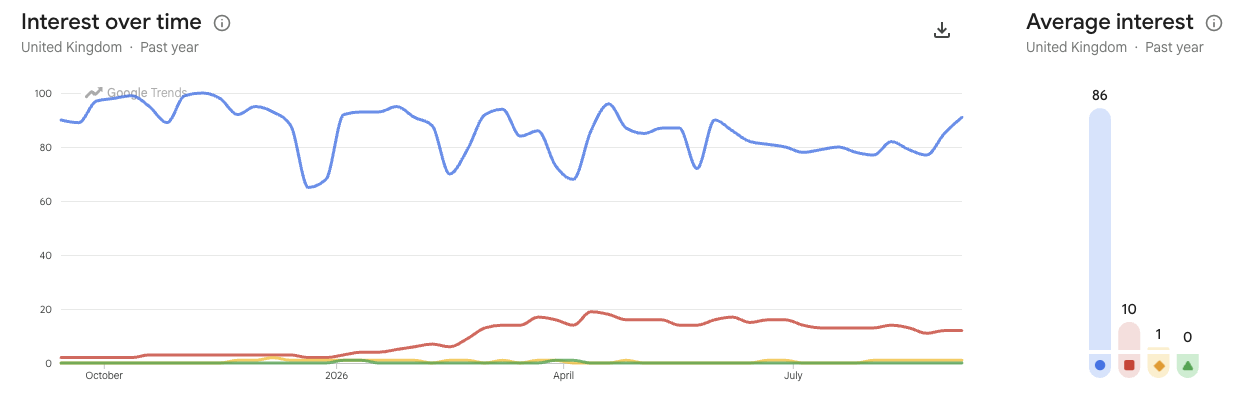
So I did something unglamorous but genuinely revealing. I opened Google Trends, typed in the four biggest AI assistants, set the region to GB, and pulled the past 12 months of UK search interest, 14 September 2025 to 13 September 2026. No PR spin, no investor decks, no benchmarks. Just what people in the UK are actually searching for. The results told a much starker story than I expected.
My own usage has shifted too. I’ve been running Claude daily for a while now, with a shared markdown file that keeps context consistent across projects, and Codex alongside it for heavier technical work. So I have skin in the game here, and I’m genuinely curious about where Grok fits into all of this. Let’s get into the data.
ChatGPT Isn’t Just Winning, It’s Not Close
The headline number is stark, more stark than I expected going in. Over the past 12 months, ChatGPT averaged a Google Trends interest score of 86 in the UK. For context, Google Trends scores are relative, not absolute, with 100 being the peak search interest for a given term in the period. ChatGPT has been near the top almost every single week.
Claude came in a distant second at 10. Gemini and Grok were barely registering, at 1 and 0 respectively. Worldwide, the picture is nearly identical: ChatGPT at 81, Claude at 7, Gemini at 1, Grok at 0. If anything, ChatGPT and Claude both do marginally better in the UK specifically than they do globally.
This isn’t a two-horse race, or a photo finish for second place. It’s ChatGPT, then a significant drop to Claude, then a much bigger drop again to Gemini and Grok, who are close enough to each other that there’s no meaningful gap between them in UK search terms.
This is roughly consistent with what third-party research shows on actual user numbers. ChatGPT crossed 1 billion monthly active users globally in June 2026, and UK data suggests somewhere in the region of 32 million UK visitors per month, which works out to roughly 46% of the population accessing it at some point. That said, there’s a conflicting survey figure of 22% for regular self-reported use. Both are probably right in their own way: a lot of people have tried it, fewer use it consistently. Worth keeping in mind when you see big adoption statistics thrown around. There’s some useful context on real-world AI adoption in AI Tools That Actually Make Family Life Easier in 2026 .
Why “The Gap Is Closing” Doesn’t Hold Up
It’s tempting to read search interest as a race that’s tightening, because that’s the story most tech coverage wants to tell. The UK numbers don’t back it up. A score of 10 next to ChatGPT’s 86 isn’t a rival closing in, it’s a distant second that would need to multiply its search interest several times over just to get within touching distance.
Gemini and Grok are further back again, at 1 and 0, close enough to each other that there’s no meaningful gap worth discussing between them in UK search terms. That’s worth sitting with for a moment, because Gemini in particular gets talked about in the press as a genuine ChatGPT rival. The search interest data doesn’t reflect that story here, not over the past twelve months.
Claude is the only one of the three challengers with a real, if distant, foothold. Whether that 10 represents steady growth across the year or a flatter line I can’t say from a single 12-month average, that would need the week-by-week breakdown rather than the headline number, but as a level, second place clearly belongs to Claude right now.
The Breakout Terms Tell You What’s Coming Next
Google Trends also surfaces “breakout” and “rising” search queries within each platform’s broader topic, and once I pulled the real figures, this turned out to be more revealing than the headline numbers.
For ChatGPT, the standout breakout term is “how to use chatgpt effectively”, up 2,150% over the period. That’s a healthy signal in its own right: people aren’t just curious about the tool, they’re trying to get better at using the one they’ve already adopted. That’s what mainstream, embedded usage looks like.
For Claude, it’s “claude cowork”, a breakout of over 5,000%. That’s significant. It suggests people aren’t just searching for Claude as a chatbot to talk to, they’re looking for it as a collaborator, something you work alongside rather than just query. That matches my own experience closely. I keep a shared markdown file that acts as a persistent context layer across Claude sessions, with a Claude.md and an Agent.md file that both point back to my own source file, so any update I make flows through everywhere. It’s the kind of workflow that only makes sense once you’ve started treating an AI assistant as a genuine working partner rather than a fancy search engine.
For Gemini, it’s “gemini 3 pro”, also a breakout of over 5,000%, real curiosity about Google’s newest model specifically, even if that curiosity isn’t yet showing up in Gemini’s overall UK search interest against ChatGPT.
And then there’s Grok. Its breakout term is “grok video moderated due to uk laws”, also peaking at over 5,000%. That’s not enthusiast chatter about a new feature or model, it’s a moderation controversy, and it points at something worth sitting with. Grok sits at essentially 0 in UK search interest, a rounding error next to ChatGPT’s 86, and yet it attracts a level of press coverage that doesn’t match how few people in the UK are actually searching for it. I don’t think that’s entirely a coincidence, though I’d stop short of calling it proof of a specific political motive. Moderation and content controversies are inherently newsworthy regardless of a product’s actual market share, and Grok’s ownership and public profile probably invite more scrutiny than a product with 0% UK search interest would otherwise attract on its own merits. Whether there’s a political dimension to that scrutiny specifically is a fair question to ask. I can’t answer it from search data alone, but the mismatch between the coverage Grok gets and the UK usage behind it is real, and worth noticing next time a Grok story does the rounds.
The AI search landscape is shifting in a way that’s relevant to families too. If you’ve got kids using AI for schoolwork, and the research suggests most UK secondary-age students are already using AI tools for schoolwork , then understanding which tools are gaining traction matters for knowing what’s going to be around and supported in two years’ time.
What Each Platform Actually Does Well
It’s worth being clear about where each assistant genuinely earns its place in 2026, because the pricing is almost identical across three of the four, even though the UK search interest gap between them is enormous.
ChatGPT remains the safest all-rounder. It’s the default for a reason: versatile, well-supported, and constantly updated. The Plus subscription sits at $20/month, which translates to roughly £16 to £17 depending on the exchange rate.
Claude is where I spend most of my daily working time. It handles long-form writing and nuanced reasoning better than anything else I’ve used, and the persistent context approach I’ve built around markdown files makes it genuinely powerful for ongoing projects. Claude Pro is also nominally $20/month, but UK users pay in dollars, and with exchange rates and potential foreign transaction fees, the real cost is closer to £19.50 to £21.00 per month. Worth knowing before you sign up. It’s genuinely useful for AI-assisted family budgeting too, if you give it the right context upfront.
Gemini makes most sense if you’re already living in Google Workspace. The integration with Gmail, Docs, and Sheets is the real value proposition, not the raw model performance, and it may explain why its search interest lags so far behind its actual user base. Google AI Pro is priced at $19.99/month, roughly £19.
Grok has one genuinely unique advantage: real-time access to live X data. If you’re doing social media monitoring or need up-to-the-minute trend awareness, that’s legitimately useful. But at $30/month (around £24), it’s priced notably above the competition, and the UK search data suggests most users haven’t found a compelling enough reason to even look.
| Platform | Best For | Monthly Price (approx. GBP) | UK Search Avg (Trends) |
|---|---|---|---|
| ChatGPT | General purpose, versatility | £16–17 | 86 |
| Claude | Long-form writing, reasoning, workflow | £19.50–21 | 10 |
| Gemini | Google Workspace users | ~£19 | 1 |
| Grok | Real-time X data, social content | ~£24 | 0 |
Hype Cycle Check
LIKELY TO LAST: ChatGPT’s dominance isn’t going anywhere fast. A billion monthly active users and near-universal brand recognition gives it enormous structural inertia, and the UK search gap is wider than most coverage assumes.
WATCH CLOSELY: Claude is the only one of the three challengers showing any real foothold in UK search interest, even from a low base. Whether that becomes a genuine climb or plateaus at “distant second” is the thing worth tracking over the next few quarters, not whether it catches ChatGPT any time soon.
VAPOURWARE RISK: Gemini and Grok both. Gemini has the Google Workspace distribution advantage that Grok doesn’t, so its risk profile is different, but neither is currently showing up in UK search interest in a way that matches the coverage either gets. For Grok specifically, £24/month for a product with essentially no UK search interest is a difficult commercial position. I’m genuinely watching it, but watching is the right word.
What This Means for CES 2027
If UK search interest stays anywhere close to its current shape into early 2027, the CES floor conversation looks a bit different to how I’d have framed it a few weeks ago. ChatGPT’s position as the AI name regular consumers recognise isn’t under serious threat yet. Claude is the one with a plausible, if distant, path to becoming a more mainstream household name off the back of steady rather than explosive growth. Gemini and Grok would need a real shift in the UK numbers before I’d make the same claim about either of them.
That doesn’t mean CES 2027 won’t see plenty of hardware and product integrations built around multiple AI backends, brands hedge regardless of search data. But the “powered by AI” badge on every product becomes much more meaningful when the audience actually recognises the name behind it, and right now that’s overwhelmingly one name. Having been to CES enough times to know how the floor shifts from year to year, I’ll be watching particularly for any Grok hardware integrations, because that feels like the move xAI needs to make to shift those UK numbers at all.
What to Watch
- Claude’s coworking integrations. The “claude cowork” breakout term suggests collaborative workflow tooling is the next frontier, and it’s the clearest signal of where Claude’s distant-second position might actually grow from. Watch for third-party integrations and enterprise deals that push this further into professional settings.
- Gemini’s new model interest. The “gemini 3 pro” breakout term points to real curiosity about Google’s newest release, even though it isn’t translating into overall search interest yet. If Google converts that curiosity into everyday use, the search gap could close faster than the current numbers suggest.
- Grok’s pricing strategy. Sitting well above its competitors while holding effectively no UK search interest is unsustainable long-term. Either the price comes down or the feature set has to become dramatically more compelling.
- The coverage-to-usage gap. Grok’s press attention relative to its near-zero UK search interest is worth watching in its own right. If that gap persists or widens, it says as much about how AI stories get chosen for coverage as it does about Grok itself.
If you want to keep up with exactly this kind of data-driven, family-friendly tech analysis rather than the usual hype, the Tech Dads Life newsletter is where I share stuff before it hits the blog. Sign up at techdadslife.beehiiv.com and I’ll see you in the inbox.