TECHDADSLIFE.COM | 3D Printing | CES 2026
Creality has been a complicated brand to follow. For years they were the go-to recommendation for budget-conscious tinkerers - the Ender series became the default answer to “what should I buy as my first printer?” But the tinkering part was non-negotiable. You were buying a capable machine that needed patience, community knowledge, and a reasonable tolerance for troubleshooting.
In 2026, Creality appears to be making a deliberate pivot. CES proved it. The SPARKX i7 took home the Best 3D Printer Innovation Award at CES 2026, and it is the kind of machine that would not have come from Creality two or three years ago. This is a company that has studied what Bambu Lab did to the market and responded with genuine ambition.
Here is what they showed, and what it means.
The SPARKX i7: Best 3D Printer at CES 2026
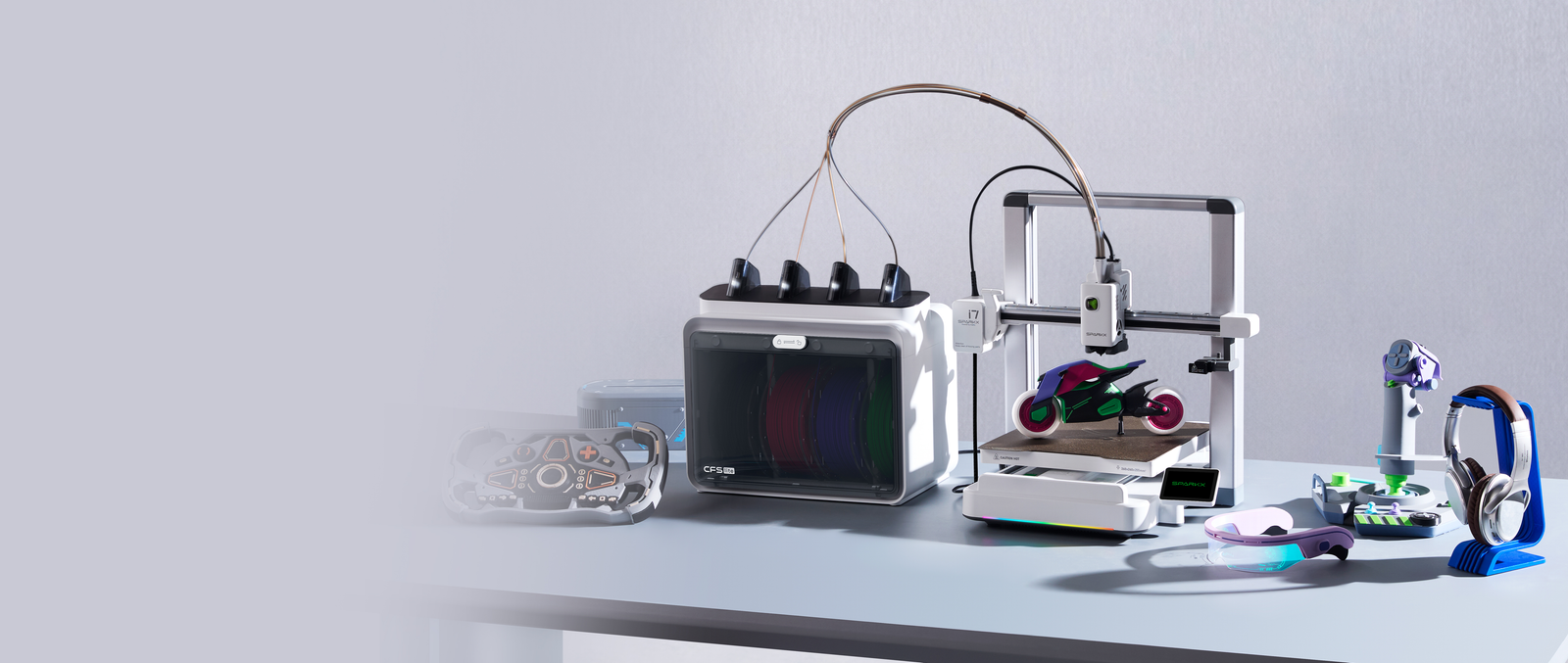
The SPARKX i7 is Creality’s flagship AI-integrated multicolour printer. It won the CES 2026 Best 3D Printer Innovation Award, which is a meaningful signal - CES attracts hundreds of 3D printing entries and the panel is not easily impressed.
The core pitch of the SPARKX i7 is AI-assisted multicolour printing. The machine uses computer vision and machine learning during the print process to monitor colour transitions, detect potential clogging or purge failures, and automatically adjust parameters to maintain print quality across complex multicolour jobs. In theory, this means fewer failed prints on ambitious multicolour projects.
The AI integration extends to the slicing software. Creality’s Creality Print 5.0, which accompanied the SPARKX i7 launch, includes an AI colour mapping assistant that analyses your model and suggests optimal colour split points, purge tower sizing, and AMS loading sequences. For someone new to multicolour printing, this kind of guided setup is genuinely useful.
Build volume is generous, the chamber is enclosed for temperature stability, and the motion system has been rebuilt compared to the previous generation. Full pricing and availability had not been confirmed at time of writing, but based on CES positioning, expect it to sit above the Ender-3 V4 and compete directly with the Bambu Lab P2S territory.
The Ender-3 V4: The Budget King Gets an Overhaul
Alongside the SPARKX announcement, Creality quietly updated the machine that built the brand. The Ender-3 V4 is a significant step forward from the V3 SE and KE variants - the generation most people know.
Key changes: fully automatic bed levelling using a contact probe rather than the fiddly manual knobs of older generations, direct drive extruder as standard (previously only available on the SE and KE variants), and a colour touchscreen that actually works without lag. The V4 is still a Cartesian printer in the traditional Ender style, which means it is not as fast as CoreXY machines like the Bambu or Creality’s own SPARKX, but the trade-off is a larger build volume at an accessible price.
At around £200 to £250 in most UK retailers, the Ender-3 V4 continues to represent the best value entry point into 3D printing for someone who does not mind learning the craft properly. It rewards patience and punishes impatience - that has always been the Ender way, and the V4 is the most refined version of it.
The Sermoon P1: 3D Scanner Built In
The Sermoon P1 is the most unusual product Creality showed in 2026, and arguably the most interesting for the tinkerer market.
It combines a 3D printer with an integrated 3D scanner. The scanner sits above the print bed and can digitise real-world objects before printing copies of them. The accuracy is not professional-grade, but for home use cases - duplicating a broken part, capturing a rough shape to refine in software, or introducing kids to the concept of scan-to-print - it is a compelling combination in a single unit.
It is a product that probably will not sell in huge volume, but its existence says something about how Creality is thinking about differentiating from Bambu. Rather than competing purely on print quality and ecosystem (where Bambu has a significant lead), they are exploring form factors and use-cases that Bambu has not addressed.
The Ecosystem Play: Filament Maker M1 and Shredder R1
The most forward-looking part of Creality’s 2026 lineup is not a printer at all.
The Filament Maker M1 is a compact desktop machine that produces 3D printing filament from pellet feedstock. Pellets are significantly cheaper per kilogram than spooled filament, and a filament maker at an accessible price point makes the economics of 3D printing fundamentally different for high-volume users.
Paired with the Shredder R1 - which grinds failed prints, support structures, and scrap filament back into pellets - Creality is pitching a closed-loop recycling ecosystem. Print something, it fails or becomes obsolete, shred it, make new filament, print again.
In practice, the filament quality from consumer-grade makers is variable, and colour management (particularly getting consistent hue-matched filament from mixed-colour scrap) remains an unsolved problem. But the environmental and economic story is compelling, and if Creality can get the quality consistent enough for functional parts, it changes the running cost calculation for serious users.
Creality vs Bambu in 2026: The Real Comparison
It is impossible to cover Creality’s 2026 lineup without addressing the Bambu Lab question. Bambu disrupted the market with the X1 Carbon and P1S by offering enclosed, fast, high-reliability machines with excellent software - at prices that felt aggressive for the capability on offer. Creality’s traditional budget market found itself squeezed.
What CES 2026 shows is that Creality has found their response strategy. Not to race Bambu to the same destination, but to own adjacent territory.
| Creality SPARKX i7 | Bambu Lab P2S | |
|---|---|---|
| Approach | AI-assisted multicolour | Polished ecosystem + speed |
| Best For | Ambitious multicolour projects | Reliable all-round printing |
| Community | Creality Cloud + large DIY community | MakerWorld |
| Tinkering Required | Some | Minimal |
| Software | Creality Print 5.0 | Bambu Studio |
Neither is universally better. Bambu gives you a more polished, less fiddly experience. Creality gives you more room to customise, upgrade, and modify - and the SPARKX i7 is the most technically ambitious machine they have ever made.
The Tech Dad Take
| What I Think |
|---|
| I have a Bambu in the garage and have been very happy with it. But the Creality SPARKX i7 has put Creality back on my radar in a way that nothing from them has for a couple of years. The CES award is not just marketing - it reflects genuine engineering progress. The Filament Maker and Shredder combination is the product that interests me most long-term. The idea of a home filament recycling loop is one of those concepts that seemed futuristic two years ago and is now becoming practically achievable. Watch that space. |
Creality’s full 2026 lineup is available to explore at creality.com . For the Ender-3 V4, Amazon UK typically has competitive pricing and next-day availability.
Are you a Creality convert or a Bambu loyalist? I am curious how people feel about the brand evolution - find me on X / Twitter .
Where Creality Now Sits in a Real Home Workshop
I have been using a Bambu P2S as my daily driver for several months, and the honest reason I had largely stopped tracking Creality’s releases was that the experience gap had become too wide to ignore. The Bambu just works, every time, with no calibration anxiety and no community forum deep-dive required to resolve a stringing problem on a Tuesday evening.
The SPARKX i7 and the broader 2026 lineup represent the first time in a while that Creality has given me genuine reason to revisit that position.
The key shift is not speed or material compatibility - it is the AI calibration. The reason Bambu earned its reputation was not being first with enclosed printing or multi-material; it was removing the human error variable from the calibration process. Creality’s AI-assisted approach on the SPARKX i7 is addressing the same problem from a different angle. If it works as well in practice as it does on paper, it closes the biggest gap between the two brands.
Who should still choose Creality in 2026:
If you want to modify, upgrade, and tinker with your machine - Creality’s open ecosystem and large community mod library makes that far easier. The SPARKX i7 is a sophisticated machine but it is also a platform that experienced makers will be able to push in directions Bambu’s more closed ecosystem does not allow.
If cost is the primary constraint - the Ender-3 V4 at around £160 to £180 remains the entry point for anyone who wants a capable FDM printer without a Bambu-tier investment. It requires more involvement than the P2S but it is a legitimate machine, not a false economy.
If you are already in the Creality ecosystem - your existing knowledge, slicer settings, and community resources transfer. Switching ecosystems carries a real learning cost that the spec sheet does not show.
The filament recycling question: The Creality Filament Maker and Shredder combination is the product I am most curious about for home use. The idea of grinding failed prints and support structures back into usable filament has been a compelling concept for years. What Creality has built is the first commercially accessible version of that loop at a reasonable price point. I have not tested it, and I want to see independent assessments of the filament quality before drawing conclusions. But if it works, it changes the economics of home printing in a meaningful way - and it is the kind of product that will be on the CES floor again in 2027 in a more mature form.