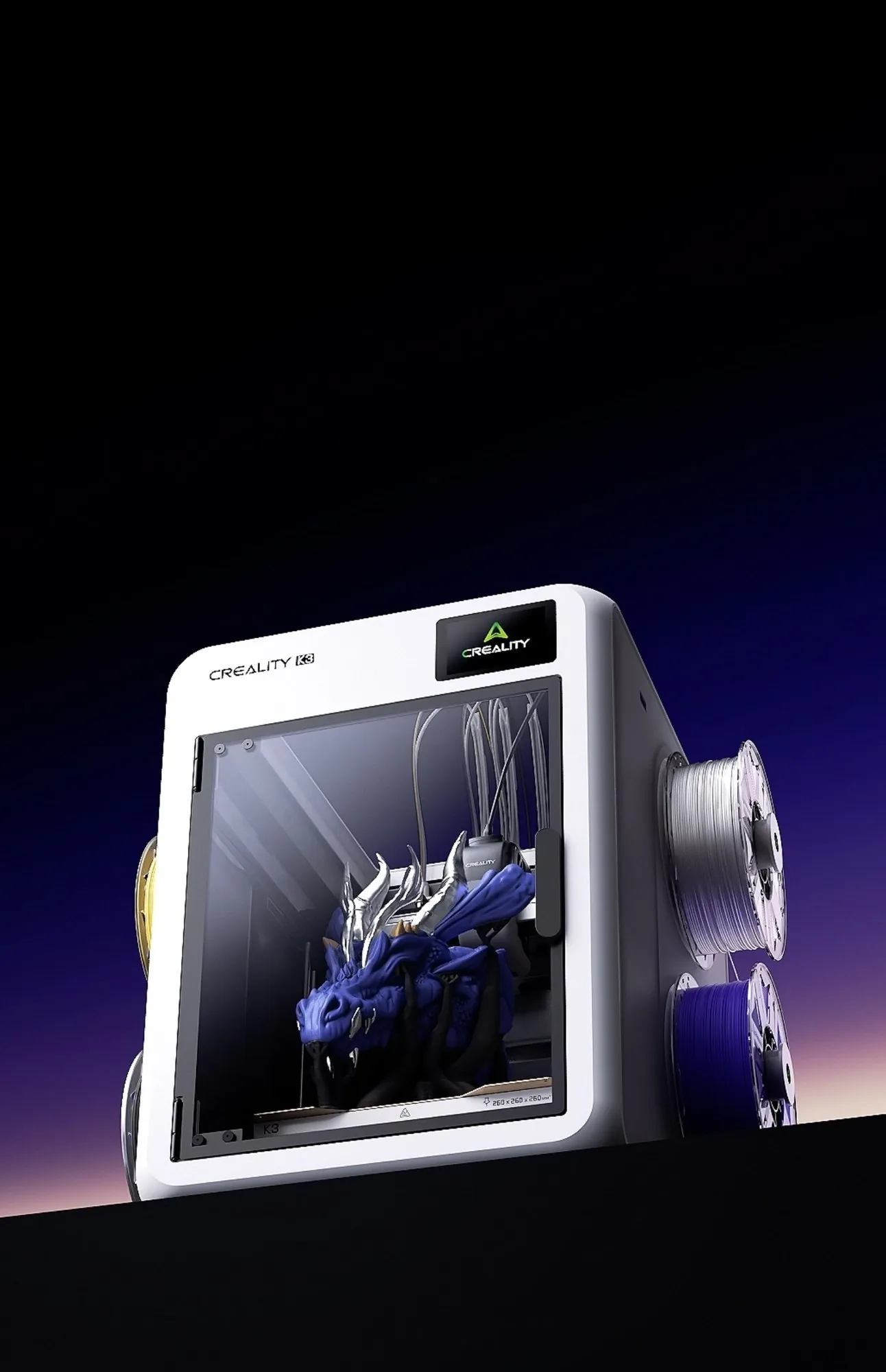
First impression only. The Creality K3 has not launched at the time of writing, and no independent hands-on testing has taken place. All performance figures in this article are Creality’s own manufacturer claims and have not been independently verified.
Submitted: 11 October 2026
The scene
If you have spent any time with a multicolour 3D printer, you will already know the filament purge problem. Every time the printer switches from one colour to another, it has to flush the old colour out of the nozzle before printing cleanly with the new one. That flushed plastic has to go somewhere, and it usually goes into a purge tower printed alongside your model, which you throw straight in the bin when the print finishes.
The maths on this is genuinely grim . On a complex multicolour print, purge waste can eat 15 to 25 per cent of your total filament. A default flush on something like a Bambu X1C runs around 8 grams per colour swap. Do 40 swaps on a detailed print and you have wasted 320 grams of filament before you even look at the finished part. That is not a flaw in any one brand’s system. It is simply what happens when one nozzle has to handle every colour .
The Creality K3 is built around the idea that swapping the nozzle entirely, rather than purging through it, is a better answer to that problem.
First impression
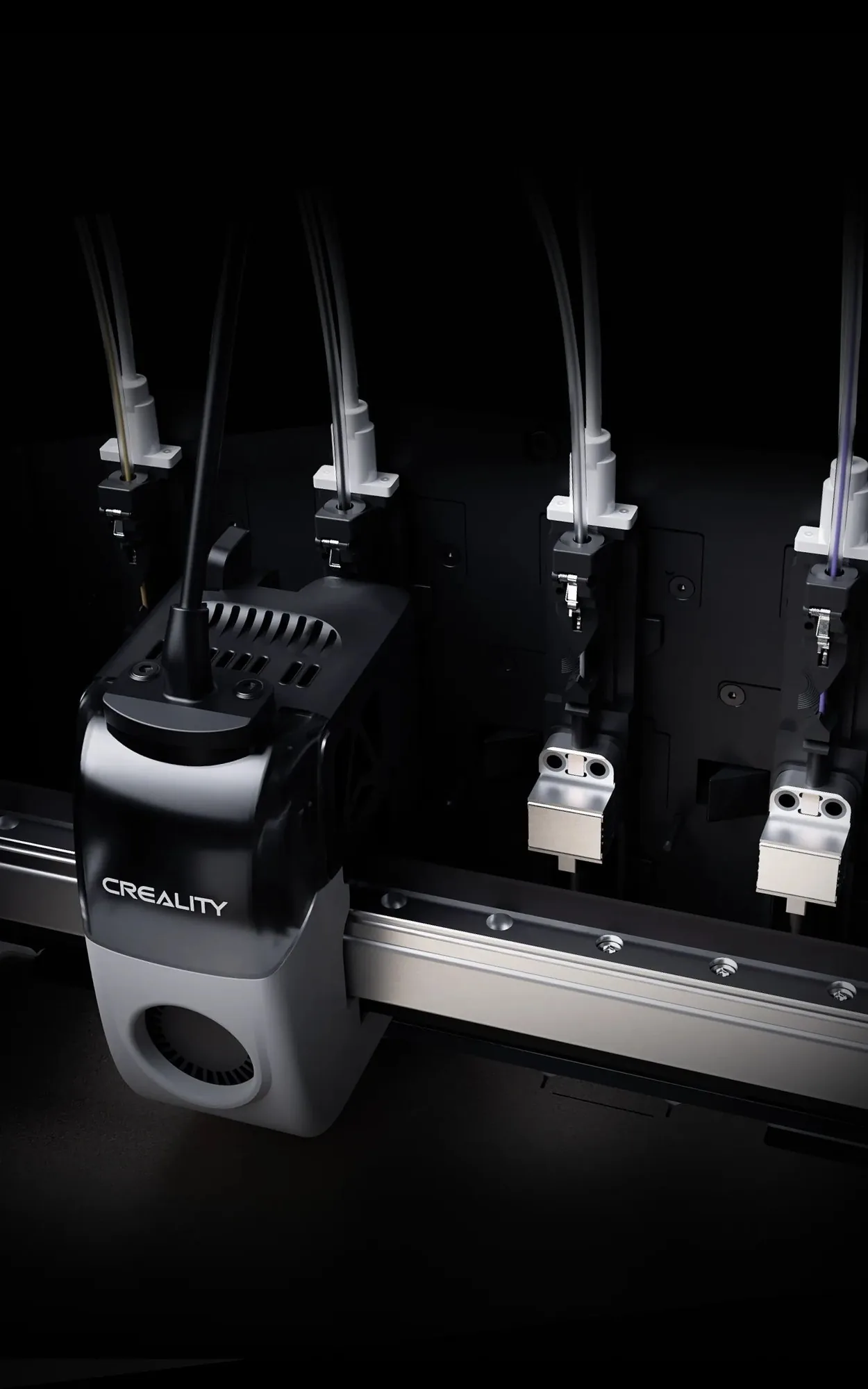
Creality announced the K3 on 1 June 2026 and showed working units at IFA 2026 in Berlin, where it picked up an IFA Innovation Award. The machine is built around a system Creality calls KliTek , and the core idea is straightforward: instead of one nozzle that serves all materials, the K3 carries four independent nozzle assemblies parked at the rear of the build chamber. Each one holds its own filament, heater and tube. When the printer needs to switch colour or material, the toolhead moves to the back, docks onto the new nozzle assembly, and returns to printing.
Creality says that swap takes 4.8 seconds , with a full material change completed in 15 seconds. Because each channel feeds its own material and the old nozzle is simply parked rather than flushed, there is no purge tower and no waste filament to bin. The claimed result is multicolour printing up to five times faster with up to 85 per cent less filament consumed on a colour-change job. Those are Creality’s numbers, and independent benchmarks do not exist yet, so treat them as targets rather than guarantees.
What KliTek is not is a full toolhead swap. Each nozzle assembly weighs roughly a fifth of a complete toolhead and preheats before it drops in, which is how Creality keeps the swap time so short. An eddy-current sensor finds each nozzle’s centre to set the offset automatically, with Creality quoting repositioning accuracy under 25 microns. There are 37 sensors across the machine in total, 12 of them dedicated to nozzle changes alone.
What stood out
The TPU story is what caught my attention, and it is worth explaining why.
TPU is a soft, flexible filament used for things like phone cases, gaskets, flexible joints and wearable prints. It is enormously useful, but printing it reliably is a genuine headache on most printers . The problem is the filament path. On a printer where the motor sits away from the print head, flexible filament has a long tube to travel through, and soft material buckles, compresses and coils inside that tube rather than feeding cleanly. TPU 95A can be coaxed through with slow speeds, but anything softer than 87A is nearly impossible to print reliably on that kind of setup . Most multicolour systems make this worse, not better.
Creality claims the K3 handles TPU as soft as 80A Shore hardness and can combine rigid and flexible TPU in a single print. The mechanism it credits is an S-Drive push-pull feeding system that works with the flexible filament rather than fighting it through the tube. Flow rate claims are 3 mm³/s with TPU 85A and 15 mm³/s with TPU 95A , which Creality says is up to seven times faster than the 2 to 3 mm³/s typical of other printers handling flexible materials. Again, manufacturer claims only, but if even a fraction of that holds up under independent testing, it would meaningfully change what is practical on a desktop printer.
Beyond TPU, a few other details from the official spec page are worth noting. The K3 uses a CoreXY motion system with a 260 x 260 x 260 mm build volume, a 300 °C hotend and a 100 °C heated bed. It supports swapping between 0.4 mm and 0.8 mm nozzles within a single print, so you can use the fine nozzle for outer walls and the larger one for fast infill. The standard box includes four spool slots and four 0.4 mm brass-tipped nozzles.
If you want more background on what makes filament choice so consequential for home printing projects, the best 3D printing filaments guide for 2026 covers the trade-offs across material types in more detail.
What is still unknown
Quite a lot, honestly. The K3 has no confirmed retail price. Creality’s own pricing history puts the K1 Max at $759 and the K2 Plus at $999, and third-party analysts estimate the K3 somewhere between $899 and $1,199 USD , but that is speculation rather than fact. No independent reviewer has published hands-on data. There is no word yet on a mixed nozzle-size kit beyond the four 0.4 mm brass-tipped nozzles included in the box. And while Creality has shown working units producing multicolour parts at IFA, the real test will come when machines land with independent reviewers and the headline claims meet ordinary print room conditions.
For context on where Creality sits in a competitive field right now, my earlier piece on Creality’s 2026 printer lineup covers the broader direction the brand has been taking this year.
What is next
Creality has pre-orders open with a $50 deposit and is targeting an October 2026 launch window, though no specific shipping date has been confirmed beyond that. I will be watching for the first independent reviews closely, particularly any that test the TPU claims and the real-world nozzle swap accuracy under sustained use. When hands-on data exists, I will follow up with a proper assessment. For now, the K3 is an interesting machine on paper, built around a problem that anyone who has watched a purge tower grow knows is real. Whether the solution works as described is still an open question.