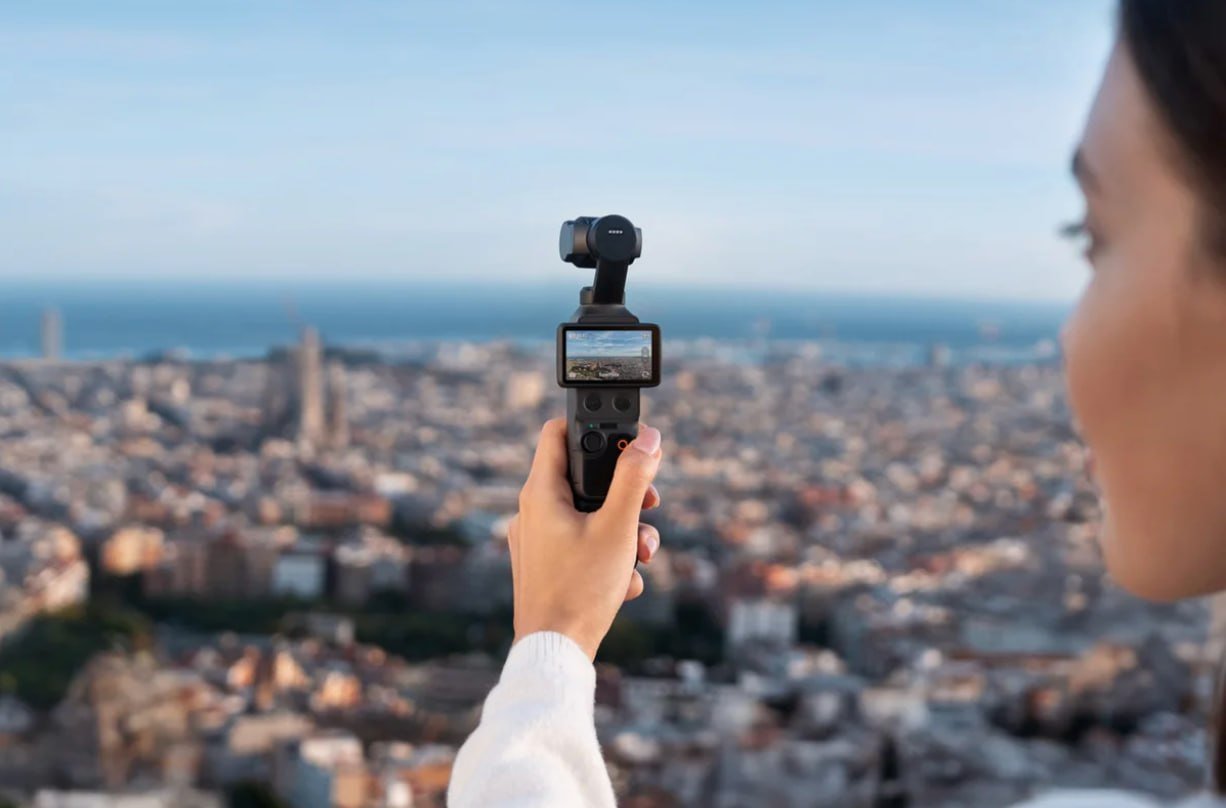
The wait is over. DJI dropped the Osmo Pocket 4 on 16th April 2026, and I’ve been all over it since launch day. There had been rumours circulating since the middle of last year, with a lot of speculation that DJI might rush it out ahead of the ongoing US restrictions on their products. Whether that played any part in the timing or not, the camera is here, it’s available now in the UK, and the specs are genuinely impressive.
I already own the Osmo Pocket 3 and use it constantly with my setup, so I had a very clear benchmark going in. Here’s my honest first look.
First Impressions
The Pocket 4 is immediately recognisable as a Pocket camera, but DJI has clearly put in the work. The physical design feels more considered this time around. Two new buttons sit beneath the touchscreen, a dedicated zoom button and a customisable button, and there’s a 5D joystick for quick gimbal and zoom control. That’s a meaningful quality-of-life upgrade over the Pocket 3.
The gimbal arm now has a magnetic surface with electronic contacts for pairing accessories, which is how the fill light in the Creator Combo attaches. It’s a neat system. Nothing feels cheap or bolted on.
What really catches the eye on paper, though, is what’s under the hood.
The Demo
The headline spec is the 1-inch CMOS sensor, same physical size as the Pocket 3, but DJI has pushed the frame rate ceiling up dramatically. We’re talking 4K at up to 240fps. That is slow-motion capability that would have sat comfortably in a cinema camera a few years ago. Worth noting: 4K/240fps is only available in normal colour mode, not D-Log, so if you’re planning to grade in post you’ll want to plan your shots around that.
The dynamic range sits at 14 stops with 10-bit D-Log, the aperture is a brighter f/2.0, and there are six built-in Film Tones including a Fuji-inspired CC Film mode, a classic colour negative NC Film mode, Pastel, Warm Tone, Movie, and Retro. For run-and-gun shooting where you don’t want to be fussing with LUTs, that’s genuinely useful.
Storage is another big leap. Built-in capacity is 107GB, which translates to around 220 minutes of 4K/60fps footage or roughly 600 minutes at 1080p/24fps. There’s also microSD support if you need more. Transfer speeds have jumped from USB 2.0 on the Pocket 3 to USB 3.1 at up to 800MB/s. That’s a huge practical improvement when you’re offloading a full day’s footage.
The zoom is listed as 2x lossless, with the ability to go up to 4x when needed (just know that 4x is not lossless). There’s a dedicated zoom button for quick switching between 1x and 2x, which is a nice touch. ActiveTrack has moved to version 7.0, which can track subjects even at 4x zoom. Add Dynamic Framing, Spotlight Follow, and gesture controls including palm detection, and this is starting to feel like a proper filmmaker’s tool in a tiny body.
Audio has had a serious rethink too. OsmoAudio 4-Channel Output means the Pocket 4 can connect directly to DJI Mic transmitters and record four channels simultaneously. Spatial Audio and Audio Zoom are also on board, with the sound field adjusting as you zoom.
On the photography side, DJI has bumped the resolution from 9.4MP to 37MP using an optimised algorithm interpolation. That’s a significant jump for anyone who wants stills as well as video from the same pocket-sized device.
Early Verdict
LIKELY TO LAST: The Pocket 4 is a real generational step forward. The sensor, frame rate ceiling, storage, transfer speeds, and audio overhaul all address real-world limitations of the Pocket 3. This isn’t a spec-sheet refresh. It feels like DJI took genuine user feedback and acted on it.
WATCH CLOSELY: Battery life claims of up to 240 minutes at 1080p/24fps sound excellent on paper, with an 80% charge achievable in just 18 minutes. Real-world shooting rarely happens at 1080p/24fps though. How the battery holds up at 4K with ActiveTrack running is the test that matters.
VAPOURWARE RISK: N/A. It’s available now, in the UK, today.
Watch This Space
A few things I still need to work through before I can give this a full recommendation:
- Real-world battery life at 4K shooting. The 240-minute figure is at 1080p/24fps. Useful to know, less useful for how most people will actually use it.
- The Battery Handle situation. The Pocket 3 Creator Combo included the Battery Handle. The Pocket 4 Creator Combo does not. The separately available Battery Handle has been bumped to 1080mAh, but if you plan on full-day shoots, budget for the extra cost.
- Creator Combo vs Standard. At first glance, £104 extra for the Creator Combo sounds steep, but when you factor in that it includes the DJI Mic 3 Transmitter (pre-linked to the camera), a wide-angle lens, fill light, mini tripod, and carrying bag, buying those separately would cost considerably more. Most people will find the Creator Combo better value than it looks.
- D-Log grading in practice. 14 stops sounds great. I want to see what the footage actually looks like in high-contrast outdoor conditions before I start telling people to shoot D-Log on holiday.
Here’s the breakdown on UK pricing:
- Essential Combo, £429 (camera, cable, handle with 1/4" thread, portable carrying pouch)
- Standard Combo , £445 (adds gimbal clamp and wrist strap)
- Creator Combo , £549 (adds DJI Mic 3 Transmitter, wide-angle lens, fill light, mini tripod, and carrying bag)
If you’re serious about content creation, the Creator Combo is the one I’d point you towards. Just remember to budget for the Battery Handle separately if you’re planning long shooting days.
I’ll be running the Pocket 4 through its paces properly over the coming weeks. If you want to know when the full review drops, sign up to the Tech Dads Life newsletter at techdadslife.beehiiv.com and I’ll have it in your inbox the moment it’s live.
Should You Upgrade From the Pocket 3?
I have been asking myself this since launch day. Here is where I have landed.
If you are using your Pocket 3 primarily for family video - holidays, birthdays, school events, general life documentation - the Pocket 3 is not holding you back. The image quality is still excellent, the stabilisation is among the best in the class, and the practical difference between a 4K/60fps camera and a 4K/240fps camera is invisible for most home footage. The upgrade does not make your memories look better.
If you are producing content for an audience - YouTube, Instagram Reels, TikTok, any platform where production quality is part of the value - the Pocket 4’s improvements are more meaningful. The 4K/240fps slow-motion headroom, the cleaner multi-channel audio via OsmoAudio, the improved D-Log grading latitude, and the dramatically faster transfer speeds all matter when you are working at volume. If the Pocket 3 is currently your primary production tool, the upgrade case is solid.
The number that gives me most pause about upgrading is the storage improvement: 107GB built-in versus 32GB on the Pocket 3. If you have ever run out of storage mid-shoot and missed something - and I have, twice, on family trips - that alone changes the equation.
The Creator Combo question: The £549 Creator Combo is better value than it looks. The DJI Mic 3 Transmitter pre-linked to the camera is the headline inclusion, and buying it separately would cost you £189. Add the wide-angle lens, fill light, and bag and the bundle value is real. If you are going to buy any of those accessories, buy the Combo. If you genuinely only need the camera and handle, the Standard Combo at £445 is the sensible call.
My plan: I am going to run the Pocket 3 through the rest of spring and wait for a proper full review of the Pocket 4 in summer conditions before deciding. The specs are compelling, but real-world battery life at 4K with tracking running and real-world D-Log grading are the things I need to see in practice before I commit. I will publish a full comparison once I have had both side by side.
If the Pocket 4 is your first Osmo, there is no hesitation - it is the best camera in its class. Just add the Battery Handle to the budget if you are planning full-day shoots.