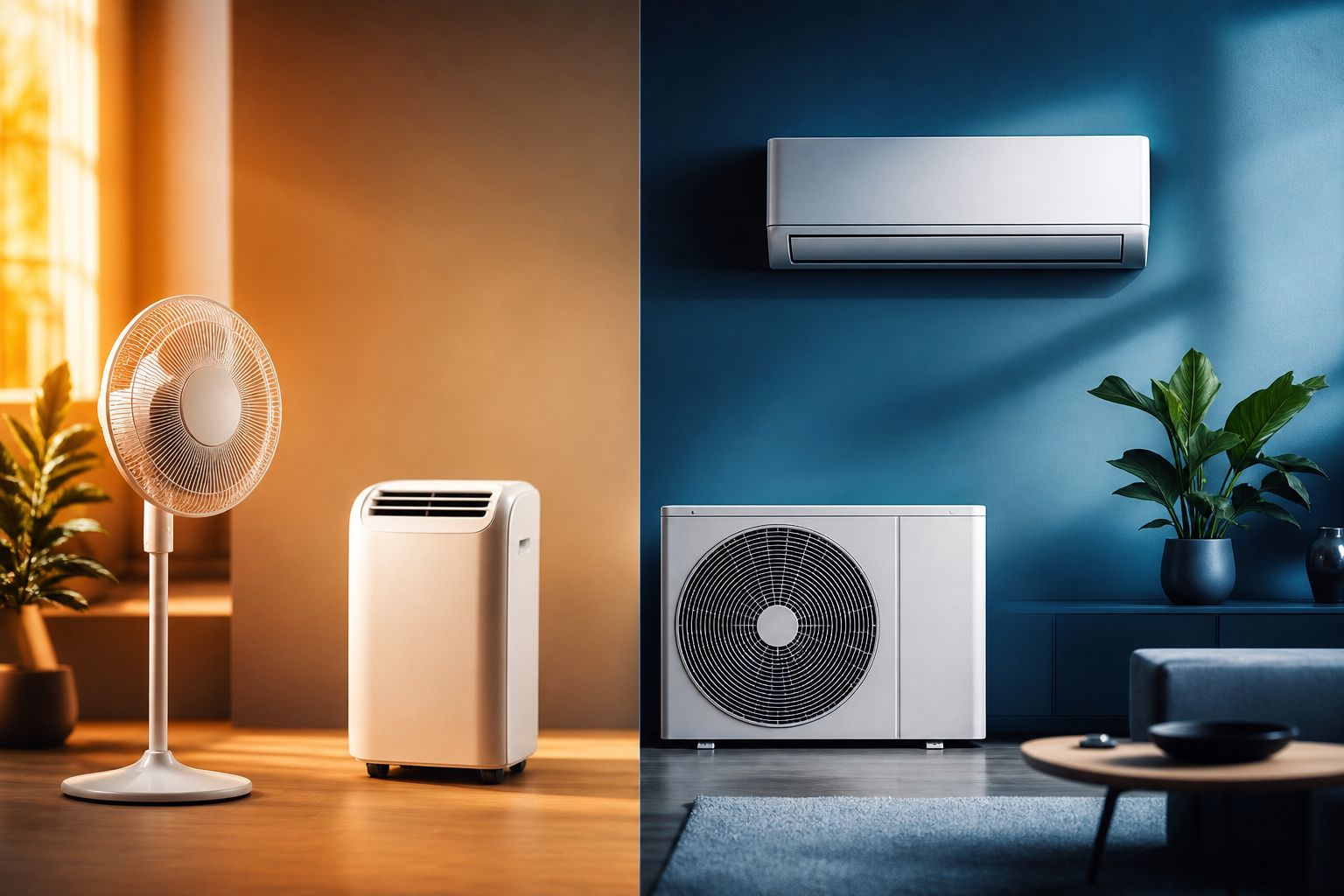
Every summer it’s the same story. A week of proper heat arrives, the news starts talking about record temperatures, and suddenly everyone’s panic-buying air conditioning units from Amazon at midnight. I get it. When your bedroom is sitting at 29°C at 11pm and sleep is impossible, you’ll click anything. But that panic is exactly what leads people to spend several hundred pounds on a unit that doesn’t do what they think it does, runs up a shocking electricity bill, and ends up in the garage by September.
This year the stakes feel higher than usual. As of late June 2026, parts of England are forecast to hit 40°C. Summer 2025 was officially the hottest on record since Met Office records began, and experts now reckon summers that hot are roughly 70 times more likely than they were before climate change took hold. Over 4 million UK households had some form of air conditioning by 2025, more than double the figure from just three years earlier. This isn’t a luxury question any more. For families with young kids, elderly relatives, or anyone in a poorly ventilated top-floor flat, it’s becoming a genuine health question.
So let’s cut through the noise. Before you buy anything, here’s what you actually need to know.
Do you even need aircon at all?
Honestly, maybe not. UK homes weren’t designed for air conditioning, and if yours is well-insulated, north-facing, and shaded by trees, a decent fan and some good blinds might genuinely be enough. Fans don’t actually lower air temperature. They just move air around, which makes you feel cooler through evaporation. Once indoor temperatures stay stubbornly high, especially overnight when there’s no relief coming in from outside, fans hit their limit.
The Energy Saving Trust is clear: passive cooling should be your first line of defence. Reflective blinds, window film, closing curtains on south and west-facing windows during the day, and improving night-time ventilation can make a dramatic difference before you spend a penny on compressors. If you’ve got a west-facing bedroom that’s unbearable by 8pm even after all that, then yes, you probably need something with a compressor. If you’re regularly seeing rooms above 26°C for days on end, and the Climate Change Committee says 20% of UK homes already exceed that in summer, then aircon is worth serious consideration.
Understand efficiency ratings before you spend anything
This is where most people go wrong. Air conditioning units carry an EER (Energy Efficiency Ratio) rating, and a higher number means less electricity for the same amount of cooling. A good split system achieves an EER of 3.5 to 5.0. A typical single-duct portable unit manages 2.0 to 2.5. That gap means a portable unit can cost roughly twice as much to run for less actual cooling.
What makes this worse is that the EER figure on a portable unit’s energy label is measured in a sealed test room with no air infiltration. In a real room, a single-duct portable creates negative pressure as it vents hot air outside through its duct, which pulls warm outside air back in to replace it, directly undermining the cooling effect. Independent testing consistently finds that single-duct portables deliver only 50 to 65% of their stated cooling capacity in real conditions. A power-hungry portable can cost 30 to 40p per hour to run. That adds up quickly over a two-week heatwave.
Know the difference between portable, split, and dual-duct units
Portable single-duct units are what most people buy, and they’re the most misunderstood. They cost around £350 to £650, require no installation beyond plugging in and fitting a duct through a slightly open window, and are the only realistic option for renters who can’t touch their walls. They work, just not as well as their specs suggest. They’re also loud, typically generating 52 to 58 dB in the room because the entire unit, compressor included, sits right next to you. Lifespan is around 5 to 8 years.
Portable dual-duct units solve the negative pressure problem by drawing outdoor air for the condenser through a second duct, meaning their rated efficiency is largely achievable in practice. The running cost difference between a single-duct and a dual-duct portable can be £100 to £150 per summer, so if you’re renting and portable is your only option, it’s worth spending a bit more upfront to get a dual-duct model.
Wall-mounted split systems are the proper solution if you own your home and are serious about cooling. The indoor unit sits on the wall and runs quietly at 19 to 42 dB. The condenser unit sits outside and shifts all the heat out there. They use 30 to 50% less electricity than portables for the same cooling output. At current electricity prices, a modern split system running for around eight hours a day typically costs between £1.10 and £2.70 per day depending on size and efficiency. The downside is cost and disruption: supply and installation of a single-room 12,000 BTU system typically runs between £1,580 and £2,300 according to Checkatrade. The refrigerant connection must be completed by a certified F-Gas engineer under UK law, so this is not a DIY job.
Watch out for the gotchas that nobody mentions in the product listing
Planning permission is the one that catches people out most often. For most detached and semi-detached homes, fitting an outdoor condenser unit falls under permitted development rights, meaning you don’t need planning permission. There are exceptions for listed buildings, flats, and some conservation areas though, so always check with your local authority before ordering anything. Flats also face the practical problem of where to put the outdoor unit at all, which is why renters in flats are often stuck with portables regardless.
Running costs deserve a proper calculation, not a guess. Factor in the unit’s EER rating, your local electricity cost, and how many hours per day you’re realistically going to run it. A cheap unit with a poor EER can end up costing significantly more over its lifetime than a pricier, efficient model.
The picks
Meaco 9,000 BTU Single-Duct Portable (approx. £350): The best of the budget portables. Quieter than most, reasonably compact, and from a brand that takes efficiency seriously. Good for renters in smaller rooms who need a plug-and-go option with no permanent installation. Pro: No installation needed. Con: Single-duct negative pressure penalty still applies.
De’Longhi Pinguino Dual-Duct Portable (approx. £550–£650): The dual-duct design genuinely changes the efficiency picture compared to single-duct units. Bulkier, but for a renter who wants the best possible portable performance, this is where I’d spend the money. Pro: Rated efficiency is actually achievable in real conditions. Con: Large footprint and more complex window kit to set up.
Mitsubishi Electric MSZ-AP25VGK Split System (approx. £1,800–£2,300 installed): The benchmark for wall-mounted splits in the UK. Whisper-quiet indoor unit, excellent inverter efficiency, and Mitsubishi’s reliability record is hard to argue with. If you own your home and plan to be there for years, this is the sensible long-term spend. Pro: Genuinely efficient, barely audible indoors, heats in winter too. Con: Installation cost and F-Gas engineer required.
Daikin Perfera Single-Room Split (approx. £1,600–£2,200 installed): Daikin’s reputation for efficiency and longevity is well-earned. The Perfera range includes heating mode, making it useful year-round, and the energy ratings are among the best available for a residential unit. Pro: Outstanding efficiency rating, quality build. Con: Premium price point.
Panasonic CS-Z25ZKEW Split System (approx. £1,500–£2,000 installed): A strong alternative at the slightly lower end of the split-system price range. Good efficiency, reliable, and Panasonic’s nanoe-X air purification technology is a genuine bonus for families with allergies. Pro: Competitive price, air purification included. Con: Less well-known brand name in the AC space than Mitsubishi or Daikin.
Quick comparison
| Model | Price (GBP) | Best For | Verdict |
|---|---|---|---|
| Meaco 9,000 BTU Portable | ~£350 | Renters, small rooms | Decent budget portable, but buy dual-duct if you can stretch |
| De’Longhi Pinguino Dual-Duct | ~£600 | Renters wanting real efficiency | Best portable money can buy right now |
| Mitsubishi MSZ-AP25VGK | ~£2,000 installed | Homeowners, long-term cooling | The benchmark. Worth every penny if you’ll use it for years |
| Daikin Perfera | ~£1,900 installed | Efficiency-first homeowners | Superb ratings, year-round usefulness |
| Panasonic CS-Z25ZKEW | ~£1,750 installed | Homeowners on a tighter budget | Solid, reliable, good value in the split-system bracket |
Bottom line
If you’re renting and can’t touch the walls, buy a dual-duct portable and accept its limitations. The extra £150 to £200 over a single-duct model will pay itself back in running costs quickly, and you’ll actually get the cooling you’re paying for.
If you own your home, have experienced two or more unbearable summers, and you’re planning to stay put, a wall-mounted split system is the right answer. The upfront cost is real, but the efficiency gap over a portable is enormous, and modern split systems also heat in winter, which means your investment works twelve months a year. Get three quotes, confirm permitted development rules with your council, and insist on an F-Gas certified engineer for the installation.
Whatever you buy, start with the passive measures first. Close the blinds, add window film to south-facing glass, and ventilate properly overnight. Done well, that combination alone can drop indoor temperatures by several degrees, and it costs almost nothing.
Want more honest, no-nonsense tech advice for family life? I send out a weekly newsletter with exactly that, no PR fluff, no sponsored gushing. Sign up at techdadslife.beehiiv.com and I’ll see you in your inbox.