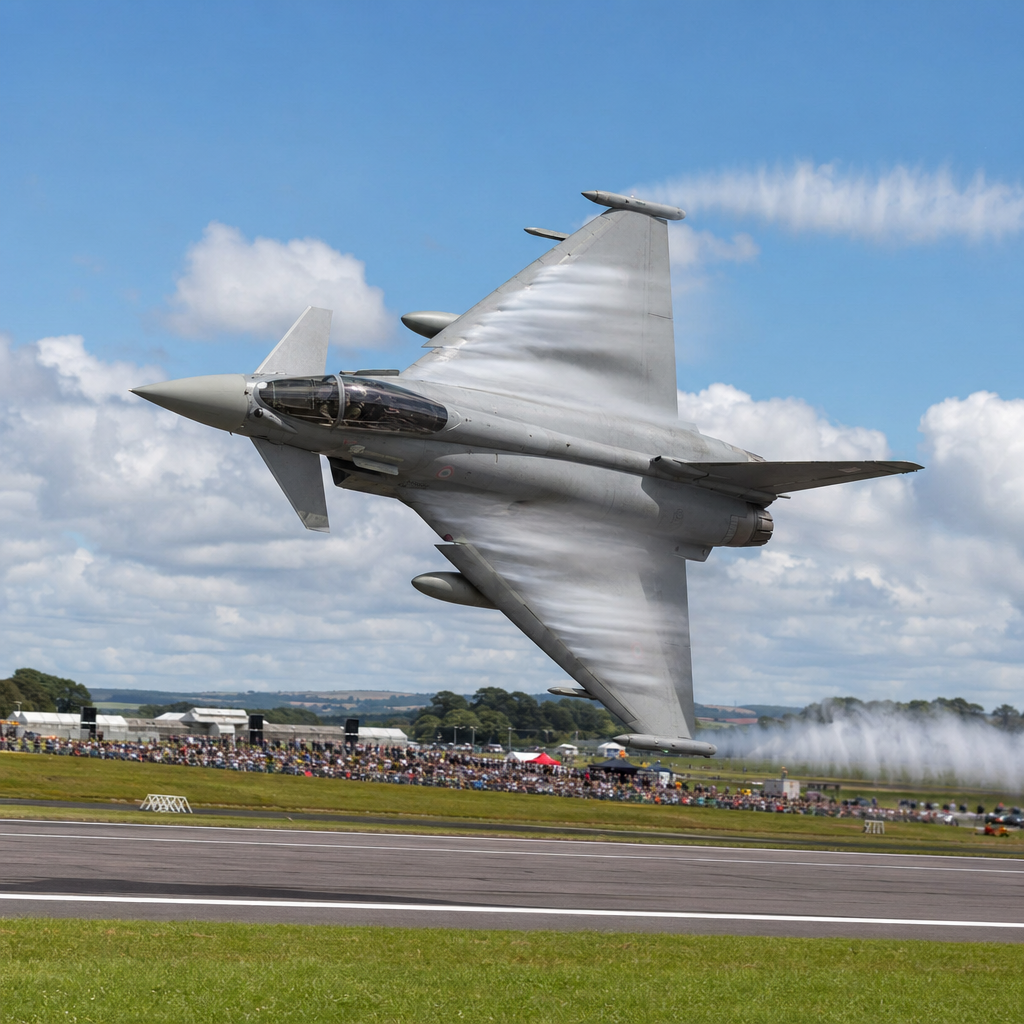
There’s something quite special about living just down the road from one of the most significant aviation events on the planet. I work hybrid, so I make a point of keeping the two show weeks as working from home time. There is practice week first, then the main event the week after. Partly because I genuinely love it, and partly because trying to get a seat on the train during show week is its own kind of an extreme sport. Instead I sit at my desk, attempting to sound professional on calls while an F16, F18, F22 or other beast of the sky is screaming past the window or a Boeing is having a go at something approaching a vertical takeoff. Every two years the whole town transforms, the roads get busier, the skies get considerably louder, and you can feel the excitement building for weeks beforehand. The Farnborough International Airshow is coming back in July 2026, and honestly, it never gets old.
I’ve been fascinated by things that fly for as long as I can remember. Growing up in the bushes of Africa, I used to build model planes from balsa wood kits, but these days I’ve graduated to building drones and RC planes from scratch in the garage (right next to the 3D printer, naturally). Getting my CAA commercial drone licence was one of those personal milestones that reminded me why aviation still gives me a buzz. So having one of the world’s greatest airshows practically on my doorstep? That’s the kind of luck I don’t take for granted.
If you’ve never been, or you’re thinking about taking the family this year, here’s everything you need to know. Dates, tickets, what to expect, and a look back at how a patch of Hampshire became the global stage for aerospace innovation.
The Dates and How to Get There
The 2026 Farnborough International Airshow runs from 20 to 24 July 2026 at the Farnborough International Exhibition & Conference Centre in Hampshire. It’s a five-day event, but here’s the important bit for families: Monday to Thursday are trade-only days. Children under 16 aren’t allowed on site during the trade days at all. The public day is Friday 24 July, branded as “Pioneers of Tomorrow,” and that’s the one to put in your calendar if you’re planning a family visit.
Getting there is straightforward if you know the options. By rail, London Waterloo to Farnborough takes around 35 minutes, and there are free shuttle buses running between the show and Farnborough Main, Aldershot, and North Camp stations. If you’re coming from further afield, the M3 gives you easy road access, and both Heathrow and Gatwick airports are relatively close. I’d strongly recommend the train if you can manage it. Parking needs to be pre-booked (no pay-on-the-day option), and even then you’re looking at a shuttle ride from the car park off Ively Road. Save yourself the stress.
One thing worth flagging: security is tight. You’ll may need a passport or UK driving licence alongside your e-badge to get in. It’s reported to be a fully cashless site too, so leave the coins at home. And if you’re tempted to fly a drone anywhere near the venue, don’t. The CAA enforces a restricted zone, and any UAV will be confiscated. As someone who holds a drone licence, trust me, it’s not worth the risk.
Tickets and What You’ll Pay
Prices change depending on when you buy, so the figures below are a guide - always check the official Farnborough Airshow website for current pricing before booking.
For trade visitors, passes start from approximately £59 plus VAT, and early booking is strongly encouraged. These sell out, and given that the 2024 show attracted over 100,000 visitors, demand for 2026 is expected to be even higher.
For families, the Pioneers of Tomorrow public day on Friday 24 July is where the real value lies. Adult tickets are typically in the region of £35–£45 depending on when you book - early bird pricing is cheaper so don’t leave it late. Here’s the genuinely brilliant part though: entry is free for under 21s, students, and apprentices. If you’ve got kids of any age, that’s an incredible deal for a world-class day out.
A word of caution. Pioneers of Tomorrow passes are limited, and the organisers have made it clear they can’t guarantee passes will be available at the gate on the day. Register and book in advance. Don’t leave it to chance.
| Detail | Information |
|---|---|
| Dates | 20–24 July 2026 |
| Public Day | Friday 24 July (Pioneers of Tomorrow) |
| Trade Passes | From approx. £59 + VAT (check official site) |
| Public Day Adults | Approx. £35–£45 depending on when you book |
| Under 21s / Students | Free |
| Parking | Pre-book only, approx. £25–£35/day (check official site) |
| Payment On Site | Cashless only |
| ID Required | Passport or UK driving licence |
What to Expect in 2026: The Biggest Show Yet
The organisers aren’t being shy about this one. The 2026 airshow is being billed as the largest and most ambitious in the event’s 78-year history. Exhibitor space across exhibition halls and chalets sold out a full 12 months in advance, with a waiting list of more than 50 organisations still hoping for a spot. A brand-new sixth exhibition hall has been added to cope with the demand. Twenty-six international pavilions are confirmed, including India, Japan, Australia, Mexico, Brazil, and Switzerland.
To put the scale in perspective, the 2024 show welcomed 1,427 exhibitors, attracted 100,358 visitors, hosted 423 official delegations, and generated a staggering $105.8 billion (approximately £84 billion) in commercial aircraft and engine orders. Those aren’t small numbers. This is where the global aerospace industry comes to do business, and 2026 is set to be even bigger.
New for 2026 is The Enterprise Gateway, a three-day programme running from 21 to 23 July alongside the Business Connections Exchange. It’s aimed at smaller businesses and entrepreneurs, offering expert-led workshops, keynote sessions, mentoring, live pitching opportunities, and guidance on procurement, regulation, exports, and funding. If you run a tech business with any connection to aerospace or defence, this is worth investigating.
For families visiting on the public day, Pioneers of Tomorrow is genuinely well put together. It’s a dedicated STEM day with aircraft on display both on the ground and in the air, flight simulators, virtual and augmented reality experiences, “Beat The Pilot” reaction competitions, “Run Your Own Airport” strategy games, and photo opportunities. Exhibitors are designated as “Champions of Tomorrow” and focus specifically on demonstrating career opportunities in the sector to young people. It’s the kind of day that can spark a lifelong interest.
Flying display details for 2026 haven’t been announced yet and will be released closer to the event. It’s worth noting that fast jet displays have become rarer at Farnborough in recent years due to surrounding land development reducing the safe flying space available for aerobatics. You’ll still see impressive aircraft in the air, but temper expectations if you’re hoping for the low-level jet displays of decades past.
A Brief History: From Balloon School to Billion-Dollar Deals
Here’s something most people don’t realise: Farnborough is the oldest active airfield in the United Kingdom. The British Army’s Balloon School was established here in 1905, and on 5 October 1908, Samuel Cody made the UK’s first powered flight right here in “British Army Aeroplane No 1.” That’s over a century of aviation history rooted in this one Hampshire town. I drive past the site regularly. It still gives me a moment of quiet appreciation.
The airshow itself grew from the Society of British Aircraft Constructors (SBAC), formed in 1916. The SBAC originally exhibited static aircraft at Olympia in London before moving to RAF Hendon and then Hatfield to accommodate flying displays. These exhibitions were halted during the Second World War, but interest surged once hostilities ended. The SBAC shows returned in 1946, initially taking place at the Handley Page Airfield at Radlett.
Farnborough presented the SBAC with the perfect home. The area’s rich aviation heritage combined with excellent technical attributes for staging a large-scale flying event. The airshow found its permanent home here and has been running biennially ever since, growing from a primarily British industry showcase into one of the two most important aerospace trade events in the world, alternating years with the Paris Air Show at Le Bourget.
Over the decades, Farnborough has been the stage for some of the most memorable moments in aviation history. The RAF’s Black Arrows performed a 22-aircraft formation loop in 1958, a world record that still raises eyebrows today. Concorde appeared at the show. The Airbus A380 made its flypast debut in 2006 while still in flight testing. The Lockheed Martin F-35 Lightning II finally showed up in 2016 after delays that frustrated everyone watching. Each of those moments happened right here. That’s the weight of history this event carries.
What started as an industry trade show has evolved into something much broader. Today, Farnborough is where new aircraft are unveiled, defence contracts are announced, sustainable aviation technologies are debuted, and the next generation of engineers get inspired. It’s a remarkable trajectory for an airfield that started with balloons.
What to Watch at Farnborough 2026
- Flying display announcements. The full programme hasn’t been released yet. Follow the official Farnborough International Airshow channels for updates on which aircraft will be displaying. These announcements typically generate huge excitement.
- Sustainable aviation technology. With the industry under pressure to decarbonise, expect significant announcements around electric and hydrogen-powered aircraft, sustainable fuels, and efficiency innovations.
- eVTOL and urban air mobility. Several companies are racing towards certification of electric air taxis. Farnborough 2026 could be where we see some of these aircraft in person for the first time.
- Defence and space. Geopolitical tensions continue to drive defence spending. Expect major contract announcements and new platform reveals across the week.
- Enterprise Gateway. New for 2026 and aimed at smaller tech businesses - worth watching to see if it becomes a genuine launchpad or just another networking event.
Gear Worth Having for the Day
If you’re heading to the public day, a few bits of kit will make the experience significantly better. Good binoculars are essential for the flying displays, a power bank will keep your phone alive for photos and videos all day, sunscreen is non-negotiable for a July outdoor event, a decent daypack keeps your hands free, and ear protection for younger children is genuinely important. Those jet engines aren’t quiet, even from a distance.
The Farnborough International Airshow is one of those events that reminds you just how extraordinary human engineering can be. It’s right here in Hampshire, it’s affordable for families, and the 2026 edition is shaping up to be the biggest yet. Whether you’re an aviation enthusiast, a tech-curious parent, or you just want to show your kids something that might change the way they think about their future, Friday 24 July is the date.
I’ll be there. Probably with binoculars in one hand and a very average coffee in the other.
If you want updates on the Farnborough Airshow and more tech content for real families, subscribe to the Tech Dads Life newsletter . No spam, no nonsense, just useful tech written by a dad who actually uses the stuff.