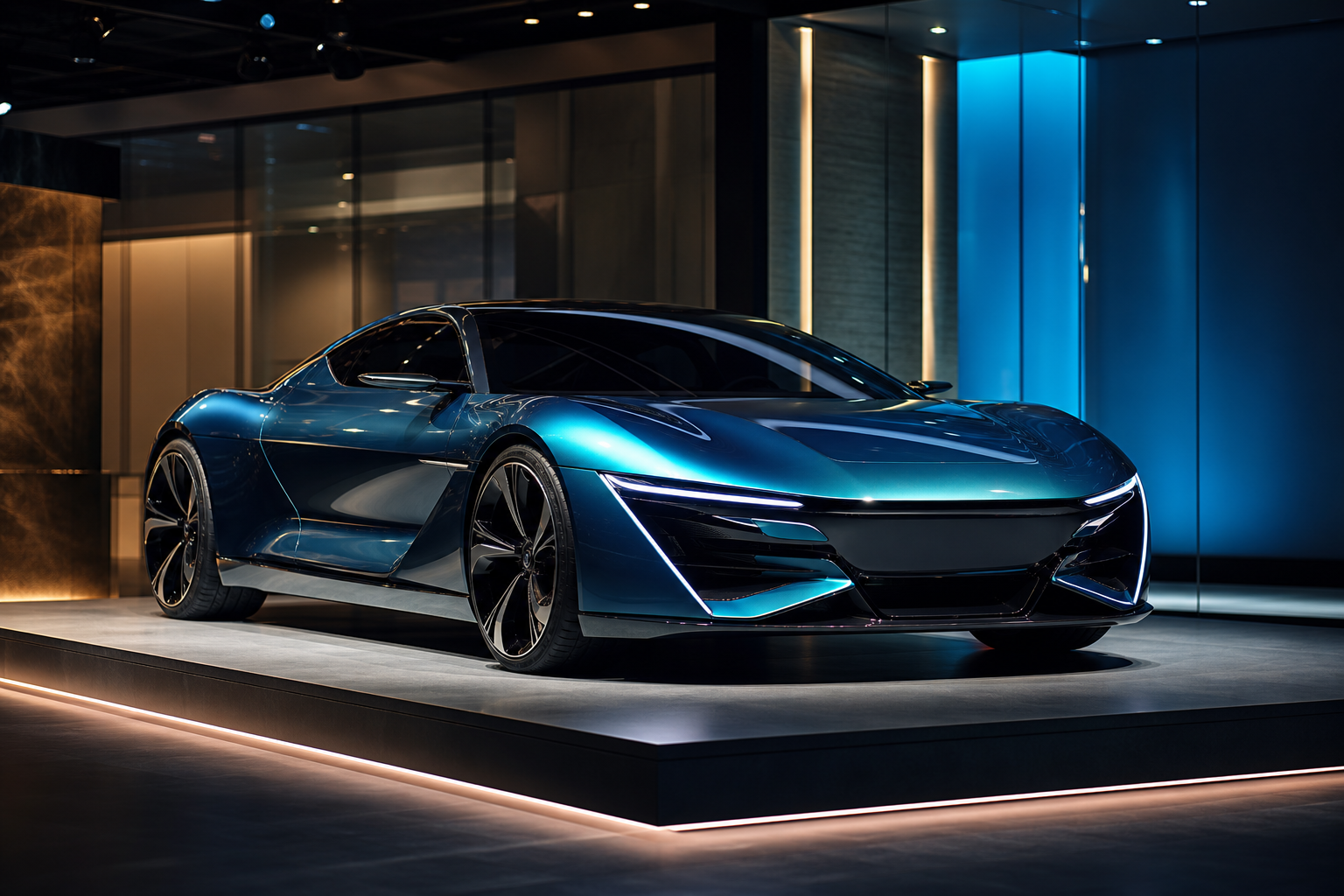
I had a bit of a moment standing outside the Honourable Artillery Company gardens a couple of weeks ago, watching the London Concours crowd drift past a pair of 1930s Alfa Romeo 8Cs. These cars are almost a century old, and they still stop people dead in their tracks. Perfect proportions, sculpted bodywork, every line doing exactly what it needs to do. No computer helped design them. No algorithm ran stress simulations overnight. A handful of human beings sat down with pencils and clay and made something genuinely beautiful.
And yet, on the drive home, I kept thinking about the Czinger 21C. A car that no human being could have designed alone, not because the ambition wasn’t there, but because the engineering problem is simply too complex. That tension stayed with me. The past and the future, parked about ten metres apart in my head.
What Actually Happened at London Concours This Year
London Concours 2026 was the 10th edition of the event, and it ran from the 9th to the 11th of June at the Honourable Artillery Company in central London. Over three days, it brought together more than 130 exceptional cars across nine concours classes, with rotating showcases, live stage talks, and a dedicated Supercar Day that drew some genuinely extraordinary machinery. Tuesday was a spotlight on Porsche, running from early icons through to modern performance. There was also a collaboration with the Goodwood Road Racing Club to bring an Alfa Romeo line-up, including a 1972 Montreal once owned by Simon Le Bon of Duran Duran, one of fewer than 200 right-hand-drive examples ever built. Whatever Simon was doing in the ’70s, his taste in cars was impeccable.
The event is a reminder of why car design matters as a craft. These aren’t just machines. They’re objects people fall in love with. And that’s the lens through which the AI conversation gets genuinely interesting.
Generative Design, What It Actually Means
The phrase “AI-designed car” sounds like something from a sci-fi film, but in practice it starts somewhere surprisingly unglamorous: a structural component that’s too heavy, or a manufacturing process that wastes material.
Generative design works by feeding an AI system a set of constraints. Reduce the weight by 40%, maintain structural integrity under specific load conditions, stay within current manufacturing tolerances. The software then explores thousands of possible shapes and structures simultaneously. The results often look strange at first glance: organic, almost bone-like forms that no human designer would have sketched. But they work. A 40% weight reduction in hours rather than months is the kind of figure that gets an engineering team’s attention fast.
Kia has been exploring this seriously. Beginning in 2022, Kia Global Design spent a year working with Autodesk Research to develop a prototype AI tool specifically for wheel concept design. The goal was to train the tool to work the way human designers do, generating ideas quickly rather than replacing the creative process. As Kia’s senior researcher Voho Seo, who led the project, put it: “Creating the initial idea is the most painful part for designers. I thought it would be great to have AI help us generate a lot of images quickly.” That’s a refreshingly honest framing. It’s not AI replacing designers. It’s AI doing the exhausting part so designers can do the interesting part.
BMW, meanwhile, is developing new driver assistance systems for its 2026 “Neue Klasse” vehicles using cloud-based AI through Amazon Web Services. Volkswagen Group has also been openly investing in AI-driven production transformation. The technology is moving quickly through the mainstream.
The Czinger 21C, Where It Gets Extraordinary
If you want to see where all of this is heading at its most extreme, look at the Czinger 21C. It’s the most compelling real-world example of what AI-driven generative design can actually produce.
The 21C is described by its makers as the first vehicle to be digitally engineered from the ground up using generative AI. Chassis, suspension, structural frames, all of it. The AI determined what G-forces would play a role in the car’s performance, ran the simulations, and arrived at the appropriate shape, size, and weight for each component. Those components were then 3D printed. No metal was wasted, because the design process had already optimised for exactly what material was needed, exactly where it was needed.
CEO Kevin Czinger has explained it clearly: “Imagine that you can take a design, generate that design, run it through all of the engineering simulations necessary, and then be able to print that design. That means that you’re only putting material where it’s required, so it can be far lighter, far stronger, far more durable.”
The numbers back this up. Czinger’s manufacturing arm, Divergent, uses what it calls the Divergent Adaptive Production System, which uses 30% less energy and between 20 and 40% fewer materials than conventional car manufacturing. The team has filed over 600 patents across AI-driven generative design, 3D-printed components, and robotic assembly. They’re now making parts for Aston Martin, Mercedes, and more than 30 aerospace companies.
Only 80 units of the 21C are being made. The base price is approximately $2.35 million (roughly £1.85 million at current exchange rates, though that figure will shift with the market). It’s claimed production records at Austin’s F1 circuit and shattered the production car hillclimb record at the Goodwood Festival of Speed. Performance as a proof of concept doesn’t get much cleaner than that.
How This Shows Up in Everyday Cars
The 21C is a showcase piece, but the technology filters down. Every time a manufacturer uses generative design to shave weight off a structural bracket, or AI simulation to test aerodynamics without building a physical prototype first, that translates into cars that are lighter, safer, and more efficient. For families buying a family car, an electric SUV for example, this matters. Better range, lower running costs, improved crash performance. It’s not glamorous, but it’s real.
There’s also an environmental angle worth acknowledging. Designing components virtually before committing to physical manufacture means less waste, fewer prototypes scrapped, and shorter development cycles. The Divergent approach, where you only put material where it’s structurally required, is genuinely different from how cars have been made for the past century.
Should You Care Right Now?
Honestly, yes, but not because you need to do anything about it. You should care because the cars arriving in showrooms over the next five to ten years will be shaped, literally and figuratively, by what companies like Czinger and Kia and BMW are doing with AI right now. If you’re buying electric, that lighter, stronger structure being developed today will translate into a better car by the time you’re ready to buy.
If You Want to Go Deeper
The best entry point is free. Autodesk has a generative design explainer on their website that shows the process visually. It’s worth ten minutes of your time if you want to understand what these bone-like structural forms actually are and why they look the way they do. Czinger’s own videos of the 21C being manufactured are also genuinely fascinating viewing. And if events like London Concours are your thing, mark the 2027 edition in your calendar now. It’s one of those rare occasions where you can stand next to cars that represent every era of automotive design in one place, and the contrast between what was possible then and what’s possible now hits differently in person.
If you enjoyed this and want more on tech, cars, and the bits in between, come and join the newsletter. I write over at techdadslife.beehiiv.com and it lands in your inbox without the algorithm getting in the way. Worth a look.