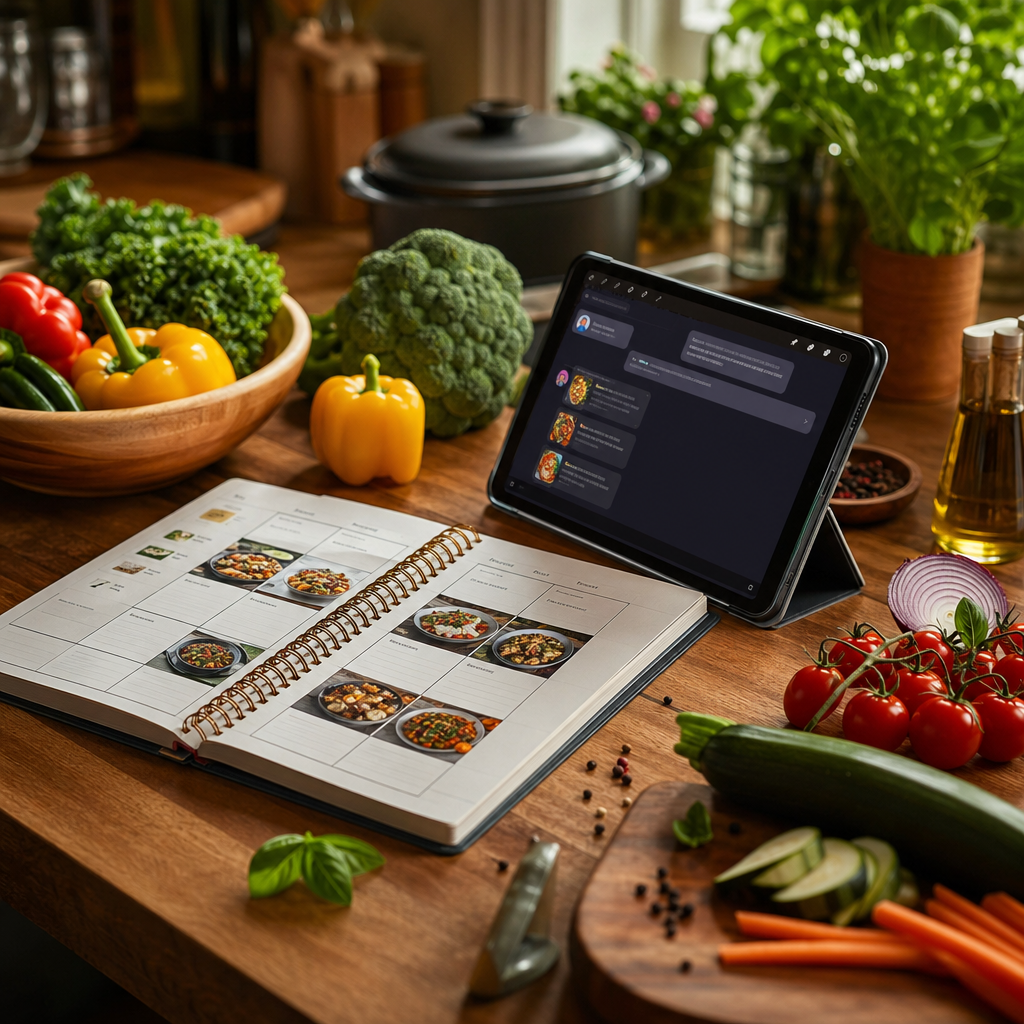
It started, as these things often do, with a Wednesday evening standoff. The fridge was full of ingredients that didn’t go together, the kids were hungry, and I was standing in the kitchen like a contestant on some dystopian cooking show where the mystery box is just “stuff you bought on autopilot.” That was about four months ago. Since then, I’ve been experimenting with using AI to plan our family meals, specifically ChatGPT and Claude, to see whether these tools can genuinely take the mental load out of feeding a family of five. I went in optimistic. I came out with a more nuanced view. And ultimately, I landed on a solution that’s far simpler than any of them. But let me walk you through the journey, because there’s genuinely useful stuff in here, even if the destination surprised me.
For context, we’re not a fussy family, but we’re not simple either. Five people, different schedules, a budget that matters, and the usual mix of preferences and outright refusals that every parent knows. The average UK family of four spends somewhere between £400 and £700 a month on food when you factor in groceries, top-up shops, and the odd meal out. For a family of five with a teenager who eats like a horse, we’re firmly in that range. Anything that reduces waste or stops me panic-buying a second jar of cumin I already own is worth investigating.
The Experiment: ChatGPT, Claude, and a Lot of Prompting
I started with ChatGPT on the free tier, which costs nothing and is perfectly capable for this kind of task. Later I also tested Claude, which I find tends to be more thoughtful with longer, structured outputs. Both have their strengths, and I’ll be honest about what each did well and where they fell short.
The key lesson I learned early is that vague prompts produce useless results. Asking “give me a weekly meal plan” gets you the AI equivalent of a generic cookbook index. The magic is in being specific. Here’s an actual prompt I used with ChatGPT that produced genuinely useful output:
“Create a 5-day weeknight dinner plan for a UK family of 5 (two adults, three teenagers). Budget is around £60-70 for the week’s dinners. One person doesn’t like mushrooms. Cooking time must be under 45 minutes per meal. We have a slow cooker and an air fryer. Maximise ingredient overlap between meals to reduce waste. Include a shopping list at the end, grouped by supermarket aisle.”
That prompt, right there, changed the game. The output gave me five meals where the chicken bought for Monday’s fajitas also covered Wednesday’s stir-fry. The peppers crossed over between two dishes. The shopping list was grouped sensibly. It wasn’t perfect, but it was a genuinely solid starting point that would have taken me 30 minutes to plan manually.
Claude, for its part, was better at explaining why it chose certain meals and offering substitutions. When I asked it to account for leftovers and suggest a lunch option using Monday’s dinner surplus, it handled that more naturally than ChatGPT did. Different tools, different strengths.
What Actually Works Well
Let me give credit where it’s due. There are three areas where AI meal planning genuinely delivered value.
Variety. Left to my own devices, I rotate through about twelve meals. We all do it. AI broke that cycle immediately. It suggested a Korean beef bowl that went down surprisingly well with the fussiest eater in the house. It recommended a one-tray Mediterranean chicken dish I’d never have thought of. The variety alone made the first few weeks feel like a minor revelation.
Reduced mental load. This is the big one for any parent. The question “what’s for dinner?” carries more cognitive weight than non-parents realise. Having a plan generated in 30 seconds, even one that needs tweaking, removes that daily decision fatigue. I’d refine the output in a couple of minutes rather than starting from scratch, and that’s a genuine win.
Ingredient overlap and waste reduction. When you prompt correctly, AI is brilliant at this. UK households waste roughly £1,000 worth of edible food per year for a family of four, according to WRAP’s 2025 figures. That’s approximately 140 meals thrown away. Much of that comes from buying ingredients for one recipe and never using the rest. A well-prompted AI plan connects meals together so that half a bag of spinach bought for Tuesday doesn’t rot by Friday. Over a month, I noticed we were throwing away noticeably less.
Where It Falls Apart (The Honest Bit)
Now for the reality check, because if I painted this as some seamless life hack, I’d be lying.
The kids reject stuff. AI doesn’t know your family. It doesn’t know that your teenager decided three weeks ago that he suddenly hates rice. It doesn’t know about the phase where everything needs to be “clean eating” but also taste like something from Nando’s. You can front-load preferences into your prompt, but kids change their minds on a weekly basis, and no language model can keep up with the shifting politics of a teenager’s palate.
Repetition creeps in fast. By week three, I started seeing the same patterns. Stir-fry appeared with suspicious frequency. The grain bowls blurred together. ChatGPT on the free tier doesn’t maintain memory between sessions, so every Monday I was essentially starting fresh, re-explaining who we are and what we like. ChatGPT Plus at around £20 a month offers better memory and model access, and there’s a newer Go tier at roughly £6.50 a month ($8) that gives limited access to more advanced reasoning. But paying a monthly subscription specifically for meal planning felt like overkill.
Shopping list accuracy is hit and miss. The AI assumes your kitchen is empty. It’ll tell you to buy olive oil, salt, and garlic every single week. It doesn’t know you’ve got half a bag of frozen peas or that you bulk-bought rice last month. I spent almost as long editing the shopping list as I would have spent writing one from scratch.
Nutritional information is unreliable. I asked both tools to estimate calories and macros for a couple of meals. The numbers were, to put it politely, creative. One nutrition professional described AI macro calculations as “completely and utterly off.” If precise nutrition tracking matters to you, stick with a dedicated app like MyFitnessPal and use AI purely for ideas.
Comparison: AI Meal Planning Tools at a Glance
| Feature | ChatGPT (Free) | ChatGPT Plus (~£20/mo) | Claude (Free) | Dedicated Meal Apps |
|---|---|---|---|---|
| Cost | Free | ~£20/month | Free | £0–£10/month |
| Customisation | High (prompt-dependent) | High + memory | High | Moderate (template-based) |
| Shopping list | Basic, needs editing | Better, still imperfect | Good structure | Often integrated with stores |
| Learns your family | No | Partial (memory feature) | No | Some do over time |
| Recipe variety | Excellent | Excellent | Excellent | Limited to database |
| Nutritional accuracy | Poor | Poor | Poor | Generally better |
| Waste reduction | Good if prompted well | Good if prompted well | Good if prompted well | Varies |
The Hype Cycle Check
LIKELY TO LAST: AI as a brainstorming tool for meal ideas and recipe inspiration. This is genuinely useful and will only improve as models get better at personalisation. The underlying capability is solid.
WATCH CLOSELY: Memory and personalisation features in tools like ChatGPT Plus. If these evolve to truly “know” your family’s preferences across weeks and months, the value proposition changes significantly. We’re not there yet, but it’s heading in the right direction.
VAPOURWARE RISK: The idea that AI will fully automate family meal planning end-to-end, from plan to shopping list to nutritional balance, without human editing. Families are chaotic, preferences shift constantly, and pantry inventory is a moving target. Full automation is a long way off, if it ever arrives.
What This Means for CES 2027
I’ll be watching CES 2027 closely for smart kitchen integrations that connect AI meal planning with actual kitchen hardware. Samsung and LG have both been pushing smart fridge concepts for years, and the missing piece has always been software that’s actually useful rather than gimmicky. If someone cracks a system where your fridge inventory feeds directly into an AI meal planner that generates a shopping list sent to your Tesco or Sainsbury’s app, that’s a genuine game-changer. I’ve been to CES enough times to know that most “smart kitchen” demos are more sizzle than steak (pun fully intended), but the underlying tech is getting closer. Expect to see at least two or three companies pitching AI-powered meal ecosystems. I’ll be the one at the back asking whether it works for a family where one child has decided they’re vegetarian this week but probably won’t be by Thursday.
What to Watch
ChatGPT’s memory evolution. OpenAI keeps improving how ChatGPT retains context across conversations. If this extends to genuinely learning household food preferences over months, it becomes dramatically more useful for families.
Supermarket AI integrations. Tesco, Sainsbury’s, and Ocado are all investing in AI. Watch for partnerships where meal planning tools connect directly to grocery delivery, eliminating the manual shopping list step entirely.
Smart kitchen inventory tracking. Barcode scanning, weight-sensing shelves, and camera-based fridge monitoring are all in development. The company that makes pantry tracking effortless will solve the biggest gap in AI meal planning.
UK food waste policy impact. With the Simpler Recycling rollout now requiring weekly separate food waste collections across England since March 2026, backed by £295 million in government funding, households are more aware of waste than ever. Expect meal planning tools to lean into this angle heavily.
The Honest Verdict: A Shared Google Calendar Won
Here’s where I land after four months of testing. AI is a brilliant brainstorming partner for meal ideas. It genuinely introduced variety we wouldn’t have found otherwise, and when prompted well, it’s smart about ingredient overlap. I’ll keep using it for inspiration, probably once or twice a month when I feel stuck in a rut.
But for the actual week-to-week planning? The solution that stuck is embarrassingly simple. We set up a shared Google Calendar called “Family Meals.” It’s linked to all our phones. Anyone in the family can add to it. The calendar sends alerts, so everyone knows what’s coming and nobody asks “what’s for dinner?” at 5pm.
It costs nothing. It takes seconds. Everyone has buy-in because everyone contributes. And crucially, it accounts for the one thing AI simply cannot replicate: the fact that my family are actual humans who change their minds, have bad days, and sometimes just want beans on toast. No prompt engineering can match the value of your teenager voluntarily typing “can we have tacos Wednesday” into a shared calendar.
AI gave us the inspiration. The calendar gives us the system. Together, they’ve genuinely cut our food waste, reduced the mental load, and mostly eliminated the nightly dinner negotiation. I’d call that a win, even if it’s not the futuristic AI-powered kitchen I expected.
If you found this useful, I write about practical tech for families every week. No jargon, no hype, just honest experience from someone who actually uses this stuff at home. Subscribe to the Tech Dads Life newsletter at techdadslife.beehiiv.com and get it straight to your inbox. I promise it’s more reliable than AI-generated nutritional information.