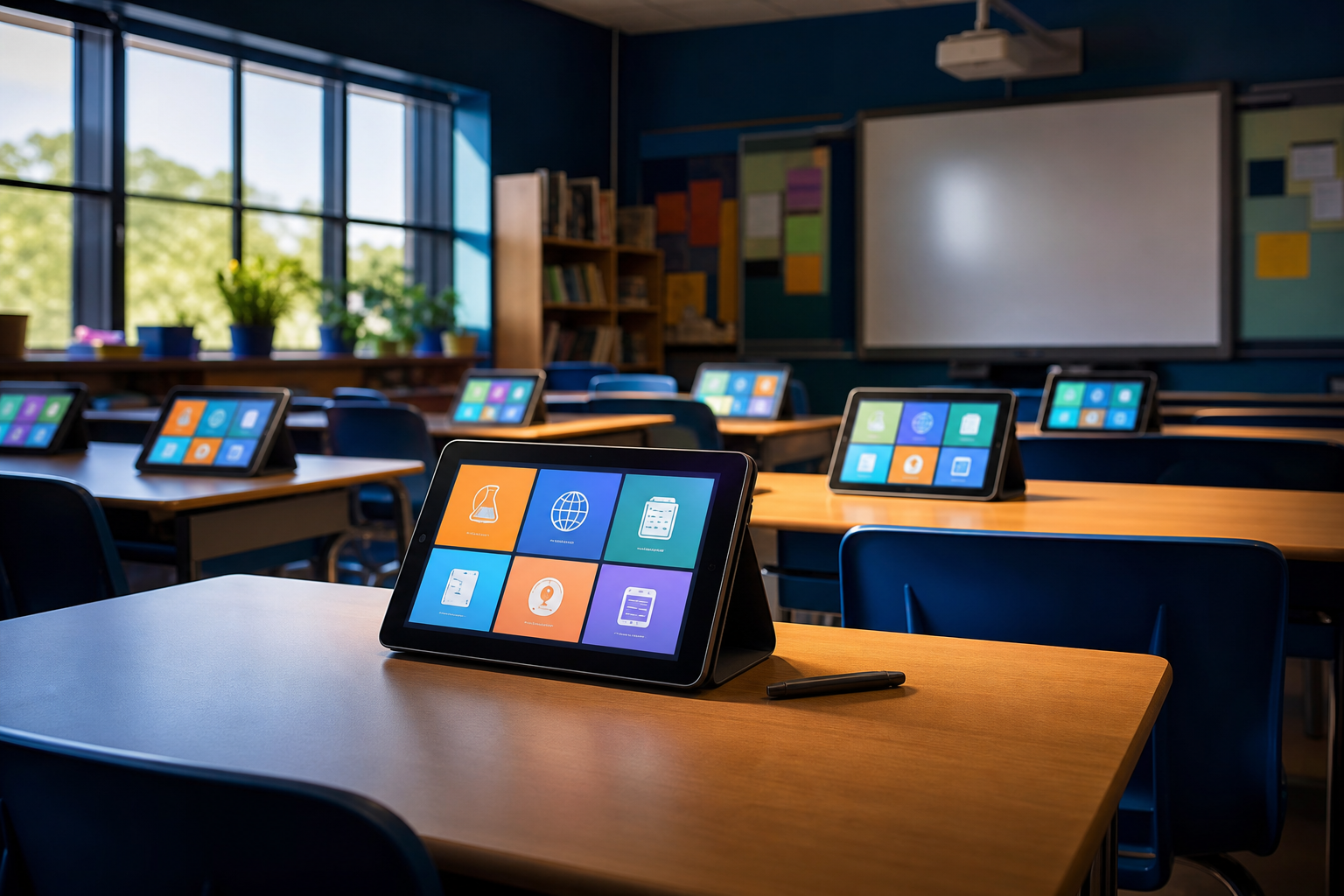
My 13-year-old came home a few weeks ago and casually mentioned that his teacher had used an AI tool to create the worksheet he’d been working on in class. He said it like it was completely unremarkable. And I suppose, to him, it is. Meanwhile, I’m sitting there thinking about the fact that when I was at school, the height of classroom technology was an overhead projector and a teacher who knew how to use it without setting the acetate on fire.
AI in schools is no longer a future conversation. It’s happening right now, in classrooms across the UK, and whether you’re enthusiastic, nervous, or somewhere in between, it’s worth understanding what’s actually going on. Not the headlines, not the panic, but the practical reality of how schools are adopting these tools, how kids are using them (and yes, misusing them), and what parents genuinely need to know.
I’ve dug into the research so you don’t have to. Here’s where things actually stand in 2026.
What Teachers Are Actually Doing With AI
Let’s start with the adults in the room. A 2025 Twinkl survey of 6,500 UK teachers found that 60% are now using AI tools for work purposes. That’s up from 31% in 2023, which is a remarkable jump in a short space of time. Secondary school teachers are leading the charge, with adoption running at roughly double the rate of primary teachers.
But here’s the thing that caught my attention. 76% of those teachers report receiving no formal training in AI use. So six in ten teachers are using these tools, but three quarters of them are essentially figuring it out as they go. That’s not a criticism of teachers, who are, as ever, doing a remarkable job with limited support. It’s a gap that needs addressing urgently.
So what are they actually using it for? Based on an Ofsted report covering 21 early-adopter schools and colleges published in mid-2025, the most common applications are exactly what you’d expect from time-pressured professionals: lesson planning, creating classroom resources, drafting parent communications, and marking support. Some government-funded prototype tools are specifically designed to help teachers assess handwritten work, including English essays, modern language writing, and even geography students’ hand-drawn maps and diagrams. Developers estimate some of these tools could reduce the time spent on formative assessment by up to 50%.
One thing that stood out to me from the research is how schools are using AI for genuinely inclusive purposes. One school was translating resources for students whose first language isn’t English. Another was converting lessons into podcasts for young carers who struggle to attend regularly. That’s not hype. That’s practical, thoughtful use of technology to reach kids who might otherwise fall through the cracks.
Almost every early-adopter school in the Ofsted research had a designated staff “AI champion”, someone who understood the tools and helped colleagues get up to speed. A sensible approach, and honestly one that most organisations adopting new technology could learn from.
How Students Are Using AI (And Where It Gets Complicated)
If you think teachers are adopting AI quickly, wait until you see the student numbers. According to the National Literacy Trust, the percentage of 13 to 18-year-olds who had used generative AI jumped from 37% in 2023 to 77% in 2024. By 2025 that figure had settled slightly to around 66%, but the more telling statistic is this: the proportion using it regularly, meaning weekly or more, rose from 31% to 46% over the same period. Fewer students are dabbling and more are making it a core part of how they work.
The most common uses are asking questions (61%), help with homework (61%), and entertainment (53%). When you look at it that way, it’s not entirely different from how adults use AI. The difference is that these are students in the middle of forming study habits, developing critical thinking skills, and working towards qualifications.
Which brings us to the uncomfortable bit. One in four young people admitted to “just copying” AI outputs when using it for homework, up from around one in five the year before. That’s a significant and growing minority. Now, it’s important to be clear here: the more dramatic cheating statistics doing the rounds, about thousands of cases being investigated, relate to university students rather than school pupils. The situation at secondary school level is less documented but clearly worth watching.
The Joint Council for Qualifications has published guidance on AI use in assessments, and schools are being advised to supervise AI use closely, use tools with appropriate safety and filtering features, and enforce age restrictions. Many of the popular AI tools carry an 18+ age rating, which raises its own set of questions about how widely that’s being enforced.
What Parents Think (And Whether It Matches Reality)
A Survation poll of over 1,200 UK parents from late 2025 found that 53% have concerns about AI use in their children’s education. The top worries were child safety and wellbeing (54%), data privacy (51%), and the risk of AI reducing teacher autonomy and professional judgement (44%).
Those are all legitimate concerns and none of them should be dismissed. At the same time, the data suggests parents broadly trust educators to make these decisions. When asked who should lead on AI in education, 38% of parents ranked educators first, well ahead of government at 18% and EdTech companies at just 7%. Across political lines, more than eight in ten Conservative voters and over seven in ten Reform voters said they trust educators to get this right.
On the question of whether primary schools should teach appropriate AI use or focus on preventing AI use, just over half of those surveyed by YouGov were in favour of teaching kids to use it properly. Only about one in five thought prevention was the better approach. The direction of travel seems clear, even if the map isn’t fully drawn yet.
My own view, for what it’s worth, is that keeping kids away from AI entirely is a losing battle. The tools are already part of how they work and play, and pretending otherwise helps nobody. What matters is whether they understand what it is, what it can’t do, and where the line is between using a tool and letting a tool do your thinking for you.
What Data Is Actually Being Collected (And Who Has It)
If you take one thing away from the surveys above, it’s that parents’ data privacy worries are well-founded, and worth understanding properly rather than just feeling vaguely uneasy about. When your child interacts with an AI learning platform, data is being generated, sometimes a lot of it.
At a basic level, these platforms collect performance data: what questions your child got right, what they got wrong, how long they spent on each task, and how their performance trends over time. Most parents would consider that fairly reasonable. But some platforms go further, collecting behavioural data like how often a child pauses or changes an answer, and using natural language processing to analyse written responses, meaning the AI is reading and interpreting your child’s writing in ways that go beyond a simple spelling check.
In the UK, schools must comply with UK GDPR and the Data Protection Act 2018. Any AI tool processing children’s data should have a Data Protection Impact Assessment (DPIA) completed, and the school should be able to tell you what data is collected, where it’s stored, and who can access it. The Information Commissioner’s Office has published guidance specifically on AI in education, worth a read if you want the formal picture.
Here’s a practical comparison of some of the most common AI education tools and what’s known about their data practices:
| Tool | Type | Data Collected | Data Stored Where | Parent Dashboard |
|---|---|---|---|---|
| Century Tech | Adaptive learning | Performance, time on task, learning gaps | UK servers | Yes |
| Sparx Maths | Adaptive maths | Performance, completion rates, time data | UK servers | Limited |
| Khanmigo (Khan Academy) | AI tutor/chatbot | Conversations, performance, engagement | US servers | Yes |
| Graide | AI marking | Written responses, grades, feedback | UK servers | No (teacher-facing) |
| MagicSchool AI | Teacher toolkit | Varies (primarily teacher-side) | US servers | No |
The honest truth is that many schools have adopted these tools faster than their privacy documentation has kept up. That’s not necessarily malicious, it’s a resourcing problem, but it does mean parents need to be proactive.
Questions worth asking at the next parents’ evening
You don’t need to storm in waving a GDPR printout. These are reasonable, non-confrontational questions any parent can ask, and in my experience the answers are usually more reassuring than the “nobody told me” irritation that prompts the question in the first place:
- What AI tools is the school currently using, and for what purposes? Ask for a list, you might be surprised how many are in play.
- Has a Data Protection Impact Assessment been completed for each tool? In the UK this is a legal requirement for high-risk processing, which AI tools involving children’s data almost certainly qualifies as.
- Where is my child’s data stored, and is it shared with third parties? Some platforms use anonymised data to train their own models. Whether you’re comfortable with that is a personal call, but you should know about it.
- Can I see what data has been collected on my child? Under UK GDPR you have a right to a Subject Access Request.
- How are teachers being trained to use these tools? An AI marking tool is only as useful as the teacher who reviews its output.
- Is there an opt-out option? Some schools offer this, some don’t. The existence of an opt-out tells you something about how thoughtfully the school has considered parental choice, even if you don’t end up using it.
The Comparison: How Different Schools Are Approaching AI
| Approach | Who’s Doing It | Benefit | Risk |
|---|---|---|---|
| AI for teacher admin only | Many primary schools | Reduces workload | Students see no change |
| AI for personalised resources | Early adopter secondaries | Inclusion, differentiation | Requires skilled staff |
| AI in the classroom, student-facing | Select secondaries and FE | Real-world skills | Misuse and cheating risk |
| AI-generated assessment tools | Government prototype schools | Faster feedback | Over-reliance, quality concerns |
| No AI policy in place | Some schools | Avoids short-term risk | Falls behind, no guidance for students |
Hype Cycle Check
LIKELY TO LAST: AI-assisted lesson planning and resource creation. This is already saving teachers real time, and that efficiency is hard to walk back once embedded. The tools will get better, training will (eventually) catch up, and this becomes standard practice.
WATCH CLOSELY: AI-based assessment and marking tools. The potential is significant, and the early results from prototype programmes are promising. But accuracy, fairness, and teacher oversight are all critical questions that need proper long-term evaluation before anyone should be relying on these heavily.
VAPOURWARE RISK: Fully autonomous AI tutoring systems that replace direct teacher interaction. The vision of every student having a personalised AI tutor sounds appealing, but the infrastructure, the training, the safeguarding requirements, and frankly the evidence base aren’t there yet. This might come eventually, but it’s further away than the marketing suggests.
CES Angle: What This Means for CES 2027
Having been to CES more times than I care to count, I can tell you that EdTech has always had a presence at the show, but it’s rarely been centre stage. That’s changing. Given how fast AI in education has moved between 2023 and 2026, I’d expect CES 2027 to feature a much more prominent EdTech AI section, with tools aimed squarely at the school market rather than just higher education and corporate training. The UK policy landscape, including the government-backed prototype tools and the Ofsted early adopter programme, gives British suppliers something credible to take to Las Vegas. Worth watching who shows up with what.
What to Watch
The DfE’s AI in education roadmap. The government has been moving on this, but clear national guidance for schools remains inconsistent. Watch for any formal policy update that sets out what schools are expected to do, rather than just what’s possible.
The cheating gap at secondary level. Universities are already tracking AI misuse case by case. Secondary schools are less systematic. How awarding bodies and exam boards respond to AI-generated coursework in GCSE and A Level submissions will be one of the defining education stories of the next couple of years.
Teacher training provision. With 76% of AI-using teachers saying they’ve had no formal training, the question of who provides that training, and whether it becomes a funded entitlement, is going to become politically unavoidable.
Age restrictions on AI tools. Many platforms used by teenagers carry 18+ ratings. Whether schools, parents, or platforms themselves take meaningful steps to enforce this, or whether it remains a politely ignored technicality, is worth monitoring closely.
If you want to stay on top of stories like this, including practical guides for parents navigating AI, tech, and everything that comes with raising kids in a digital world, sign up for the Tech Dads Life newsletter over at techdadslife.beehiiv.com . No spam, no filler. Just useful stuff, delivered when it matters.