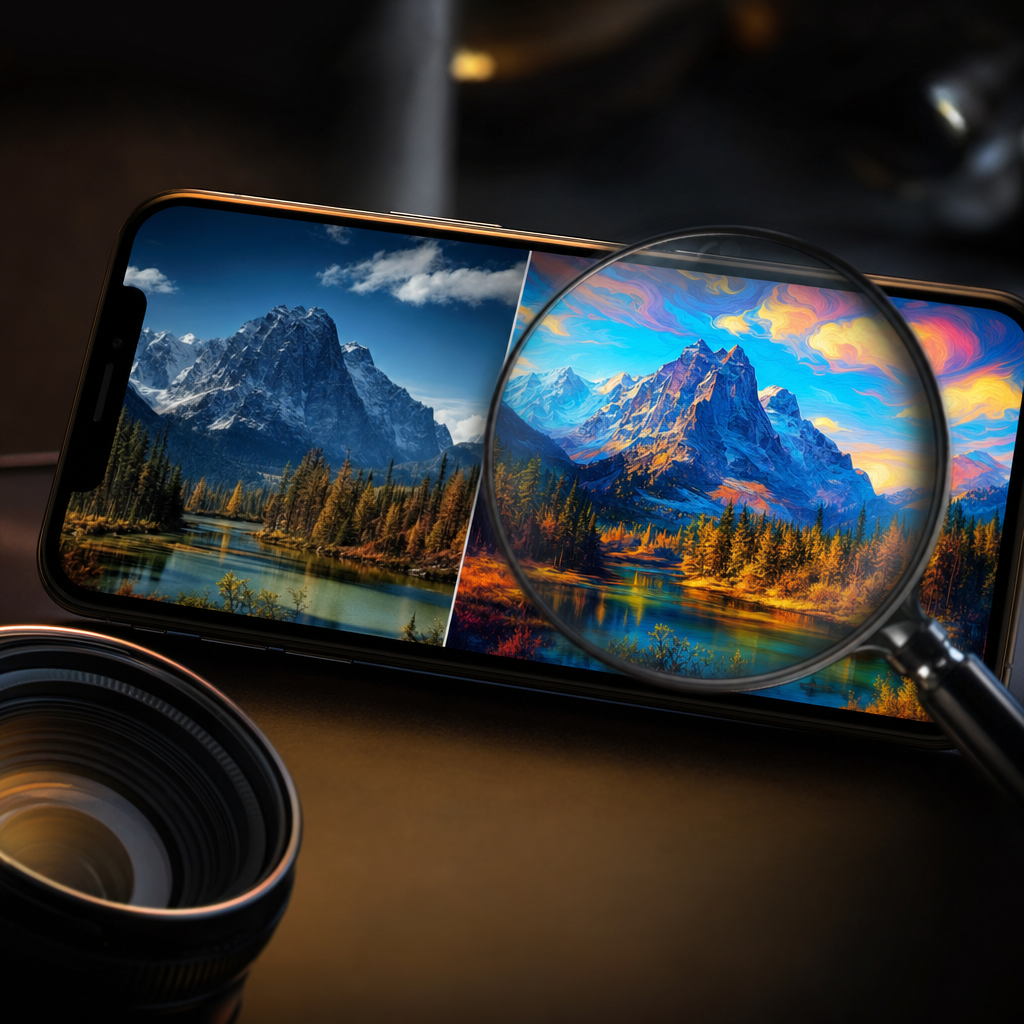
There’s a moment that sticks with me. My 17-year-old showed me an article he’d found while researching something for school, completely convinced it was legitimate. It looked fine on the surface. Clean layout, confident writing, no obvious errors. But something about it felt hollow, as though it had been written by someone who knew all the right words but had never actually lived through any of it. That nagging feeling turned out to be correct. It was AI-generated from top to bottom, and it contained several claims that were either misleading or flat-out wrong.
That’s the problem with a lot of AI content in 2025. It doesn’t look broken. It looks polished. And that’s exactly what makes it dangerous, particularly for young people who are still developing the critical instincts that help adults sniff out rubbish. In November 2024, the volume of AI-generated articles published online surpassed the volume of human-written ones. A separate analysis of nearly a million new web pages published in April 2025 found that 74.2% contained detectable AI content. This is not a niche concern anymore. It’s the internet your kids are growing up in.
Before We Start: Why This Matters More Than You Think
Before we get into the practical tips, it’s worth understanding just how widespread this is. Ofcom research found that 50% of UK children aged 8 to 15 had seen at least one deepfake in the six months before they were surveyed. Over 500,000 deepfake videos were shared online in 2024 alone. Meanwhile, research suggests that humans can only correctly identify AI-generated text about 24% of the time. Even adults who consider themselves reasonably tech-savvy are getting it wrong most of the time. The goal here isn’t to make anyone paranoid. It’s to give parents and teenagers a practical toolkit for thinking more clearly about what they read, watch, and share.
Step 1: Spotting AI-Generated Text
Check the Author First
This sounds obvious, but it’s the single most effective thing you can do. AI-generated articles often have no named author, or they credit a vague entity like “Staff Writer” or “Editorial Team” with no verifiable biography. Before trusting an article, ask yourself: who wrote this? Can I verify that person exists? Do they have a track record in this subject?
Genuine journalism and expert writing tends to be anchored in real people with real histories. If you can’t find a name, be very suspicious.
Look at How It’s Written, Not Just What It Says
AI text has tells, even if they’re subtle. Here’s what to watch for:
- Over-polished tone with no personality. AI writing tends to be grammatically impeccable but oddly flat. There’s rarely a moment where the writer’s actual voice comes through, because there isn’t one.
- No specific personal experience. Human writers naturally reference things they’ve seen, done, or lived through. AI can’t do this authentically. If an article about parenting never once sounds like it was written by a parent, that’s a signal.
- Suspiciously consistent rhythm. Real writing varies in pace. Sentences get short for emphasis. Then longer and more reflective when explaining something complicated. AI tends to write in an unnervingly consistent, rolling cadence that rarely changes gear.
- Certain buzzwords. AI models have well-documented verbal tics. The word “delve” became notorious after ChatGPT’s launch, appearing far more often than any human writer would naturally use it. Words like “crucial,” “foster,” “leverage,” and “it’s worth noting” are similarly overused. This changes over time as people catch on, but it’s still a useful signal.
Ask: Are There Any Real Sources?
AI-generated content often makes confident claims without citing anyone. Real investigative or informational writing names sources, links to studies, or references specific organisations. If an article is full of assertions but thin on references, treat it accordingly.
Step 2: Spotting AI-Generated Images
The Old Advice Is Already Out of Date
A couple of years ago, the advice was simple: look at the hands. AI models used to struggle badly with fingers, producing nightmare images with six digits or fused hands. Those errors helped expose deepfakes like the viral “Trump arrest” images in 2023. But by 2025, the major image generators have largely fixed this. Hands are no longer a reliable detector. Text in images is going the same way. AI protest signs used to display garbled nonsense, but some current models now produce clean, readable typography.
Don’t rely on these tests. They’ll give you a false sense of security.
What Actually Works: Texture and Lighting
The tells that remain reliable are subtler, but they’re still there if you know where to look.
Zoom in on skin. Real photographs have natural chaos in them. Skin has pores, tiny hairs, slight blemishes, texture that changes with the light. AI-generated skin often looks unnaturally smooth, almost like it’s been polished to a finish. At full resolution, it can look more like a wax figure than a real person. Zoom in to 100% and look closely at the face and neck.
Check the lighting consistency. In a real photograph, the light source affects everything in the frame the same way. In AI images, you’ll sometimes see shadows that don’t add up, or one part of the image lit differently from another without any logical reason. It can be subtle, but once you see it, you can’t unsee it.
Look at backgrounds and edges. AI sometimes gets sloppy around the edges of complex objects or where a person meets the background. Look for blurring that doesn’t make sense, or strange texture discontinuities.
Reverse Image Search
If you’re unsure about an image, right-click it and run a reverse image search through Google Images or TinEye. This can show you whether the same image has appeared elsewhere with different context, which is a strong indicator of manipulation or misuse.
Step 3: Spotting Deepfake Videos
Deepfake video is where this gets genuinely unsettling. The technology has improved dramatically, but it still has failure points.
Watch the Eyes and Mouth
Blinking. Human beings blink naturally and irregularly. Deepfake algorithms often struggle with this and produce either no blinking at all or oddly timed blinks. Watch the eyes carefully, especially during longer clips.
Lip sync. AI-generated audio laid over a manipulated face often doesn’t sync perfectly. The mouth movements and the sounds can be fractionally off, particularly on tricky consonants. Your brain registers this even before you consciously identify it, which is why deepfakes sometimes just feel wrong.
Listen for Pacing Problems
Deepfake voices generated in real time often have awkward pauses, strange rhythms, or an oddly synthetic quality to certain vowels or consonants. If the person sounds slightly robotic, or if there are unnaturally long silences mid-sentence, trust that instinct and investigate further.
The Pressure Test
This one is especially important for teenagers to understand. Scammers increasingly use deepfakes of people in apparent distress, or posing as authority figures, to create panic and trigger fast decisions. If a video is urging you to act immediately, share personal information, or send money, the urgency itself is a red flag. Real emergencies have real verification routes. Stop, pause, and verify through a completely separate channel before doing anything.
If You’re Still Not Sure
A few additional options worth knowing about:
AI detection tools like Originality.ai or GPTZero exist and can help flag likely AI text, though none of them are perfect. Use them as one data point, not a verdict.
Check the publication date and context. AI content farms often publish at volume and speed. If an article was published the same day as a news event and reads like a summary of other summaries, that’s a pattern worth noting.
Teach the “who benefits” question. Encourage your kids to ask why this content exists. Who made it? What do they want you to believe or do? That question alone cuts through a lot of noise.
Wrapping Up
None of this is about becoming cynical about everything online. The internet is still full of brilliant, honest, useful content made by real people. But the volume of synthetic content has crossed a threshold where passive consumption is no longer enough. The skills in this guide, checking authors, scrutinising textures, listening for audio oddities, questioning urgency, are genuinely learnable habits. Run through them with your kids a few times and they’ll start doing it automatically.
If you’ve tried these tips and you’re still uncertain about a specific piece of content, drop me a message through the site. I read everything and I’ll do my best to help.
Want more practical guides like this one delivered straight to your inbox? I send a weekly newsletter packed with real-world tech advice for families, without the jargon and without the waffle. Sign up at techdadslife.beehiiv.com and join the growing Tech Dads Life community. It’s free, it’s friendly, and I promise it’s written by a human.