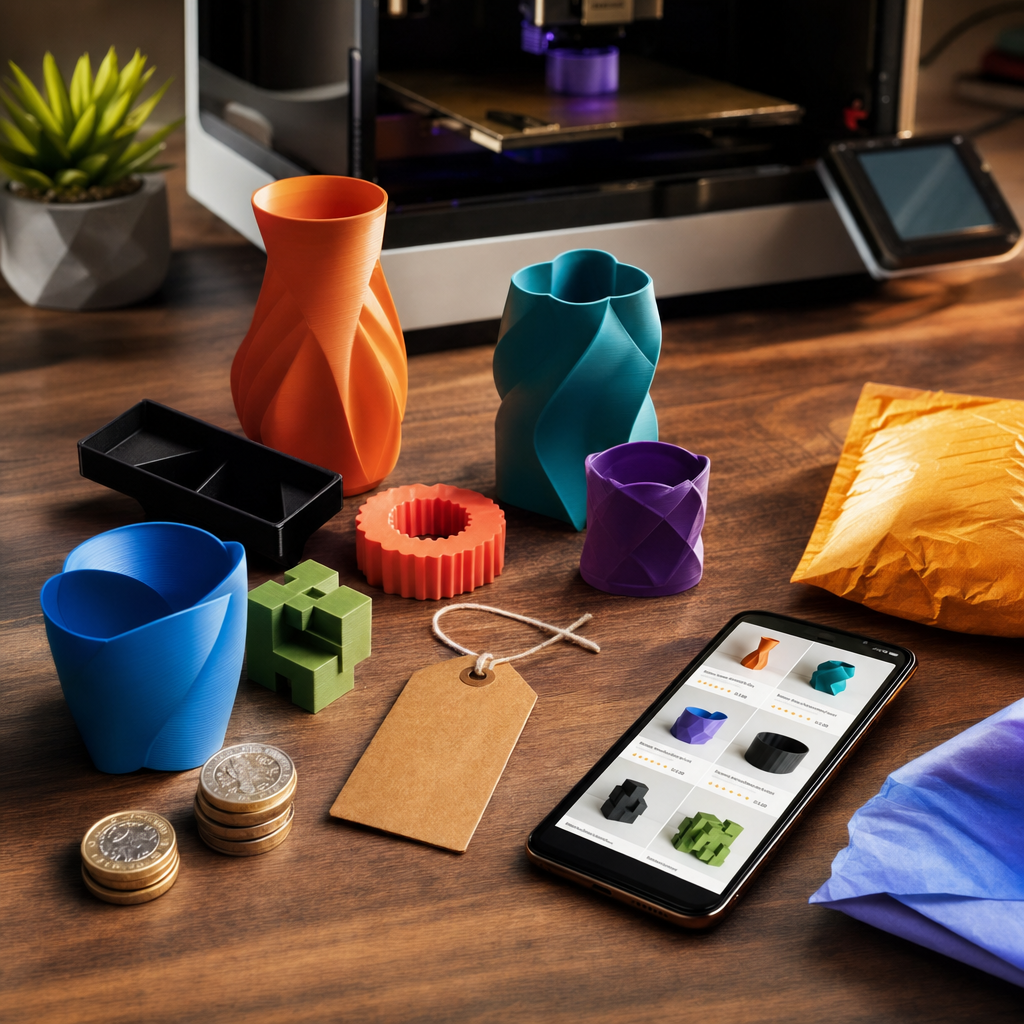
I’ll be honest with you, for a long time the Bambu Lab P1S sat in my garage doing what 3D printers mostly do in hobbyist households: printing things nobody strictly needed. Miniatures, cable clips, replacement brackets for things that weren’t actually broken. It was brilliant fun, but at some point my very pragmatic brain started asking a slightly uncomfortable question: could this thing actually pay for itself?
That question sent me down a rabbit hole of Etsy fee calculators, MakerWorld creator dashboards, and more HMRC guidance pages than any normal person should voluntarily read. What I found was genuinely encouraging, but also more complicated than the “just list it on Etsy and watch the money roll in” advice you see floating around on YouTube. This guide is what I wish I’d had at the start. It covers where to sell, how to price, what actually moves, and what the taxman expects from you. In that order.
Before You Start: A Few Things Worth Sorting First
Before you list a single item, there are two non-negotiables. First, check that any model you’re printing is licensed for commercial use. Printing a popular miniature from a free file and selling it for profit is likely a copyright infringement, regardless of how it’s marketed. Stick to your own designs, or models with an explicit commercial licence attached. Second, give some thought to your legal status as a seller. In the UK, if you’re trading regularly with the intent to make a profit, HMRC considers that a business activity, even if it’s a side hustle done at weekends. More on that in a moment.
Step 1: Choose Where You’re Actually Going to Sell
Etsy UK
Etsy is the obvious starting point, and for good reason. It has an established UK marketplace, millions of buyers who already expect to find handmade and custom items there, and it handles payments in GBP natively. Setting up a shop is relatively straightforward.
What isn’t immediately obvious is the fee structure, which deserves careful attention before you price anything.
Here’s how it breaks down for UK sellers in 2026:
- Listing fee: £0.15 per item, active for four months or until sold
- Transaction fee: 6.5% of the total order value, including shipping
- Payment processing fee: approximately 4% + £0.20 per transaction (one source lists this as £0.30, so check Etsy’s own fee page directly before launching, as minor rounding differences exist between third-party calculators)
On top of that, Etsy charges VAT on its own service fees. If you’re not VAT-registered, that VAT is simply an additional cost you absorb. It won’t be reclaimable.
There’s also the Offsite Ads programme to be aware of. If your Etsy shop earns below approximately £5,785 in a year (converted from Etsy’s $10,000 USD threshold), you can opt out of it. Above that threshold, you’re automatically enrolled and Etsy takes 12% of any sale it generates through its external advertising. Factor this in: if a sale comes through an Offsite Ad, your effective total fee rate for that transaction can push into the 22–27% range once all charges are combined.
The practical upshot of all this is that pricing below £10 per item on Etsy is genuinely tricky. The fixed-element fees take a disproportionately large slice of smaller sales. If your print costs £2 in filament and takes 45 minutes to produce, it might feel like a £7 selling price is fine, but after Etsy’s fees, your margin can disappear surprisingly fast. Use an Etsy fee calculator before you commit to any pricing.
One additional note: Etsy’s algorithm now favours shops that update inventory regularly and dispatch quickly. Consistent new listings and fast fulfilment help your visibility.
MakerWorld (Bambu Lab’s Platform)
MakerWorld is a different proposition entirely, and one that’s particularly worth understanding if you design your own models. It’s Bambu Lab’s model-sharing platform, and it offers creators three distinct routes to earn money.
Route A: BOM Commission Incentives. If you upload a model and link products in the Bill of Materials section (things like specific filament, screws, or components), you can earn 3–15% commission on purchases made through those links. Some creators have reportedly earned over $1,000 (around £790) per month through this route alone, though MakerWorld is clear that this isn’t typical or guaranteed.
Route B: Commercial Licence Memberships. This is the more structured creator income route. Once you have at least 200 followers and 600 prints on the platform, and no rule violations in the previous 90 days, you can offer a commercial licence membership to other users. This means people who want to print and sell your designs pay you a monthly subscription to do so legally. You set the price, anything from $3 to $300 per month, and MakerWorld takes a 10% platform fee. Payments currently run through PayPal, so both you and your subscribers need accounts.
Route C: Crowdfunding. MakerWorld also supports project crowdfunding. If your project hits its funding goal, MakerWorld takes 10% of the total raised, and Stripe (the payment processor) takes an additional 3–8% depending on your country. Worth checking the UK-specific Stripe rates before you plan a campaign around specific numbers.
MakerWorld also launched a Creator Copyright Protection Programme in 2026, giving designers a single reporting entry point if they spot their work being used without permission. It’s not a silver bullet, but it’s a meaningful step.
Amazon Handmade and Facebook Marketplace
Worth a brief mention. Amazon Handmade gives you access to a much larger buyer pool, but the competition is fierce and the application process to get approved as a handmade seller takes some effort. Facebook Marketplace is genuinely useful for local sales. No postage headaches, cash in hand, and surprisingly good for one-off or bulky items like custom signs or organisers. It pairs well with Etsy rather than replacing it.
Step 2: Work Out What to Actually Print and Sell
This is where a lot of people get stuck, staring at a full spool of PLA and no idea what buyers actually want. Based on what’s consistently performing well in 2026, these are the categories worth focusing on:
Personalised lithophanes. Photos transformed into 3D-printed light panels. They’re genuinely impressive, emotionally resonant, and the personalisation element means every order is unique. Strong gift market.
Kitchen gadgets. Bag clips, custom measuring spoons, citrus juicers, spice jar lids. Practical items that people actually use and replace.
Wall art and signage. Custom nameplates, geometric wall art, family name signs. High perceived value relative to material cost if the design is strong.
Pet accessories. Name tags, treat dispensers, feeding station organisers. The UK pet market is enormous and buyers in this space tend to be repeat customers.
Replacement parts. Hard-to-find components for appliances, furniture, or tools. This niche has some of the most loyal buyers you’ll find. Someone who genuinely needs a specific part will pay well for it and leave a glowing review.
The common thread across all of these is personalisation. The ability to offer custom text, colours, or dimensions is one of the biggest competitive advantages a 3D printer gives you over mass-market alternatives. Around a third of all Etsy transactions involve personalised items, so there’s clearly an appetite for it.
Step 3: Price Properly
Pricing is where well-intentioned hobbyists consistently undersell themselves. A sensible starting framework:
Material cost (filament used, plus a small buffer for failed prints) + electricity + your time (at a rate you’d actually accept) + platform fees + packaging and postage = minimum acceptable price. Then add your margin on top.
Research what comparable items actually sell for, not just what they’re listed at. Sold listings on Etsy are visible and give you a much more honest picture of the market than asking prices. Don’t anchor to the cheapest seller. Competing purely on price against someone with a faster machine or lower material costs is a race you won’t enjoy winning.
Step 4: Understand Your HMRC Obligations
This section matters, and I won’t dress it up. In the UK, if you’re selling regularly and with the intention to make a profit, HMRC classifies that as a trading activity. You’ll need to register as self-employed and submit a Self Assessment tax return for any tax year in which your trading income exceeds your trading allowance.
The trading allowance is currently £1,000 per tax year. If your gross income from selling prints stays below that, you don’t need to report it. Once you go above it, you do, even if your net profit after costs is quite small.
Keep records from day one: material costs, electricity, platform fees, packaging, equipment you’ve bought for the business. These are legitimate expenses that reduce your taxable profit. HMRC’s own guidance on the trading allowance is the place to start, and if you’re unsure, a conversation with an accountant who handles sole traders is genuinely worth the cost.
VAT registration is only required once your turnover hits the current threshold, so that’s unlikely to be an immediate concern for most new sellers. Check the latest VAT threshold on the HMRC website, as it can change with each Budget.
If It’s Not Going as Expected
Low traffic to your Etsy listings: Etsy SEO is a genuine discipline. Make sure your titles and tags use the exact phrases buyers search for, not what you’d call the item yourself. “Personalised dog name tag 3D printed” will outperform “custom pet tag” every time.
Printing costs eating your margin: Review your slicer settings. Infill percentage and wall count have a big impact on filament use and print time, and therefore cost. Not every item needs 20% infill.
Designs getting copied: If you’re on MakerWorld, use the Creator Copyright Protection Programme to report misuse. On Etsy, report listings that use your product photography without permission. Document everything.
You’re Ready to Start
Getting your first sale is more satisfying than I expected, genuinely. Once your pricing is solid, your listings are optimised, and your HMRC obligations are squared away, there’s nothing stopping you from turning a hobby into something that at least pays for the filament, and possibly quite a bit more.
If any of this raises questions specific to your setup, drop me a message. I’m happy to dig into the details.
Want more practical guides like this? Join the Tech Dads Life newsletter. It goes out regularly and covers exactly this kind of real-world tech content without the fluff. Sign up at https://techdadslife.beehiiv.com/ and I’ll see you in your inbox.