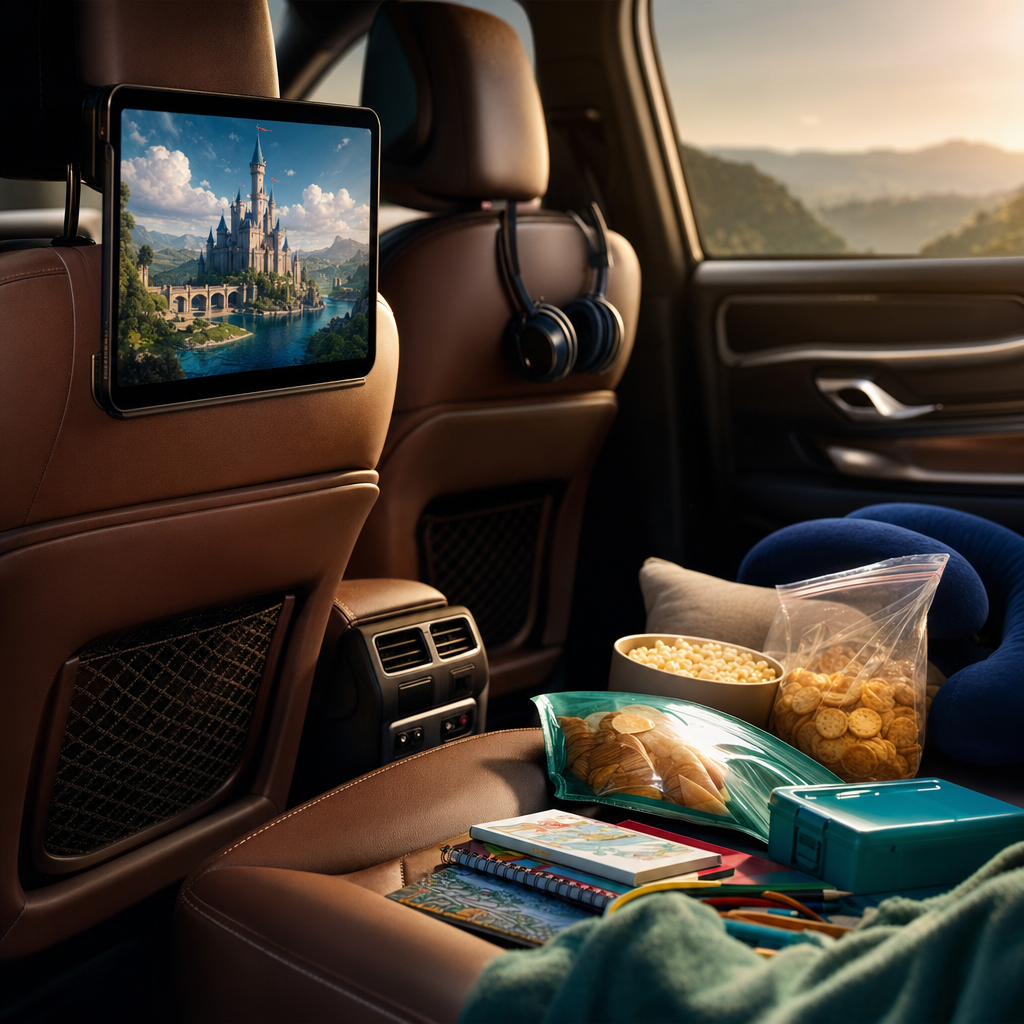
Let me be honest with you. The first time I did the Edinburgh run, I thought I had it nailed. Snacks? Packed. Tablets? Charged. Departure time? Planned. What I had not accounted for was the sheer, relentless nature of seven-plus hours in a car with children who collectively have the patience of a Golden Retriever at a treat factory. We made it, just about, but I came home having learned more in one journey than in all the parenting books I had never read. I have done that run more than once since then. Each time, I get slightly better at it. This is what I know now.
Before You Start Planning Anything Else
A word before we get into the good stuff. None of this advice works if you turn up exhausted on the morning of departure. Long car journeys with kids are a marathon, not a sprint, and they start the night before. Get your bags in the car the evening before. Get yourself to bed early. Everything else flows from that. Also, if anyone in the car is prone to motion sickness, read the motion sickness section before you decide on your entertainment strategy, because tablets and windows do not always mix.
Step One: Pick Your Departure Time Wisely
This is the single biggest lever you have, and most people underestimate it.
The Edinburgh run from the south of England is approximately 400 miles and, without stops, roughly 7.5 to 8 hours of driving. With a family in tow, you should budget 9 to 10 hours door to door. That is a long time. Your departure time choice shapes the entire day.
The early morning strategy is my personal favourite. You transfer the kids from bed to car seat still in their pyjamas, often before they are even properly awake. The roads are quiet. The kids fall back asleep. If you leave at 5am, you can sometimes knock out two or three hours of the journey before anyone even asks what is for breakfast. It sounds brutal on paper, but in practice it is the smoothest option I have found.
The overnight drive is another option some parents swear by. Roads are quieter, kids tend to sleep through a large portion of it, and they arrive at the destination rested. The trade-off is that the driver needs to be completely rested before setting off, and you really should not be doing this solo without someone awake in the passenger seat to keep you alert.
Daytime driving works too, but you need to plan around traffic. Leave early enough to be through busy areas before the roads fill up, and plan your route around any known events that could cause congestion.
Step Two: Plan Your Rest Stops Like a General
The Highway Code recommends a minimum break of at least 15 minutes for every two hours of driving. That is driver safety guidance, not a suggestion you can skip because you are running late. On a family journey, this naturally tends to happen anyway, but the key is making those stops count.
The best rest stops are not motorway services. Motorway services are fine in a pinch, but if you can time a stop to coincide with a playground, a park, or a green space near a market town, you get something far more valuable: kids who have actually burned energy. A 20-minute blast around a playground at the halfway point can reset the entire mood of the car. They run, they eat, they breathe actual air, and you get to stand up and feel your legs again. Plan these stops into the route before you leave, not while you are already driving.
Also consider timing a stop around a meal. You save money on overpriced motorway food, everyone gets a proper sit-down moment, and the legs-stretch problem is solved at the same time.
Step Three: Sort the Screen Time Strategy
Right, this is where I have to be a bit nuanced with you, because the answer is not simply “load up the tablets and let them get on with it.”
Tablets, phones, and portable DVD players are a genuine tool for keeping older kids occupied on long journeys. I am not here to lecture anyone about screen time on a one-off trip. But there are two things worth knowing.
First, NHS-aligned guidance on general screen time recommends no screens at all for under-twos, and under an hour a day for children aged two to five. For primary school-aged children it becomes more flexible, though non-educational screen time is generally advised to stay under two hours a day. On a long journey, you will likely go over that, and that is a practical parenting decision that only you can make.
Second, and this is the one people miss, screens and motion sickness do not mix. If your child is prone to feeling sick in the car, giving them a tablet to watch a film could make things significantly worse. The reason is that looking at something the brain expects to stay still, like a screen, while the body is in motion causes that classic sensory conflict that triggers nausea. For kids who are susceptible, the advice is to look ahead through the windscreen towards the horizon, not down at a screen.
So screens are one tool, not the default. If your child is fine with tablets in the car, great. Make sure the devices are charged, bring the chargers anyway, and sort out headphones for everyone. A cheap set of volume-limiting headphones designed for children is worth every penny on a long run.
Step Four: Have a Solid Back-Up Plan for Screen-Free Time
Even if screens work for your kids, you will probably need something else for at least part of the journey. Audiobooks are brilliant, particularly dramatised ones for younger children. The whole family can follow the same story without anyone needing to look at anything. Podcasts work for older kids. Classic games like 20 Questions, the number plate game, and I Spy still work, because they always have.
For younger children who are not great with screens, a small activity bag prepared before you leave can buy you a surprising amount of time. Colouring books, sticker sets, simple puzzles. Keep them out of sight before the journey and bring them out one at a time rather than all at once. The novelty is part of the value.
Step Five: Handle Snacks Carefully
Here is a bit of guidance that surprised me when I looked into it. The NCT advises caution around giving children snacks while a car is moving, primarily because of the choking risk and the difficulty of responding quickly, and because drivers reaching back to hand things out creates its own hazard. This applies more directly to young children and toddlers than to older kids.
My practical approach is to sort a proper snack or meal before we leave, pack snacks in the seat pocket within easy reach for older kids to grab themselves, and pull over properly if anyone needs something. Motorway services exist for this reason.
If anyone is prone to motion sickness, give them a light, carb-based snack before setting off rather than on the move. Cereal or crackers before departure. Avoid heavy or rich food on the day of travel.
Step Six: Be Ready for Motion Sickness
Children between about 3 and 12 are the most likely age group to experience motion sickness, and it is genuinely miserable when it kicks in. The key thing is that once nausea starts, there is very little you can do other than stop the car. Prevention is everything.
Keep to motorways and wide roads wherever you can, because winding country roads are one of the main triggers. Make sure the child can see out of the window. Fresh air helps, so crack a window if conditions allow.
For medication, hyoscine (sometimes known as scopolamine) is generally considered effective and comes in forms suitable for children. Kwells Kids tablets are one example, suitable for children aged four and over. However, always speak to a pharmacist or GP before giving your child any motion sickness medication. Do not wing it on dosage or suitability.
If It Still Goes Wrong
Sometimes you do everything right and it still falls apart. That is parenting. If the journey is going badly, the best thing you can do is stop earlier than you planned, get everyone out of the car, and reset. A 20-minute unscheduled stop is worth far more than pushing through and arriving as a family of frayed nerves. There is no prize for not stopping.
Long journeys with kids are survivable, and with a decent plan they can actually be memorable in a good way. Lock in your departure time the night before, plan your stops before you leave, and do not rely entirely on screens. That is genuinely most of it. If you have a specific scenario I have not covered here, feel free to reach out through the site and I will do my best to help.
And if you want more practical family tech and life advice like this, straight to your inbox, come and join the Tech Dads Life newsletter community over at techdadslife.beehiiv.com . No spam, no fluff. Just the good stuff, when it is ready.