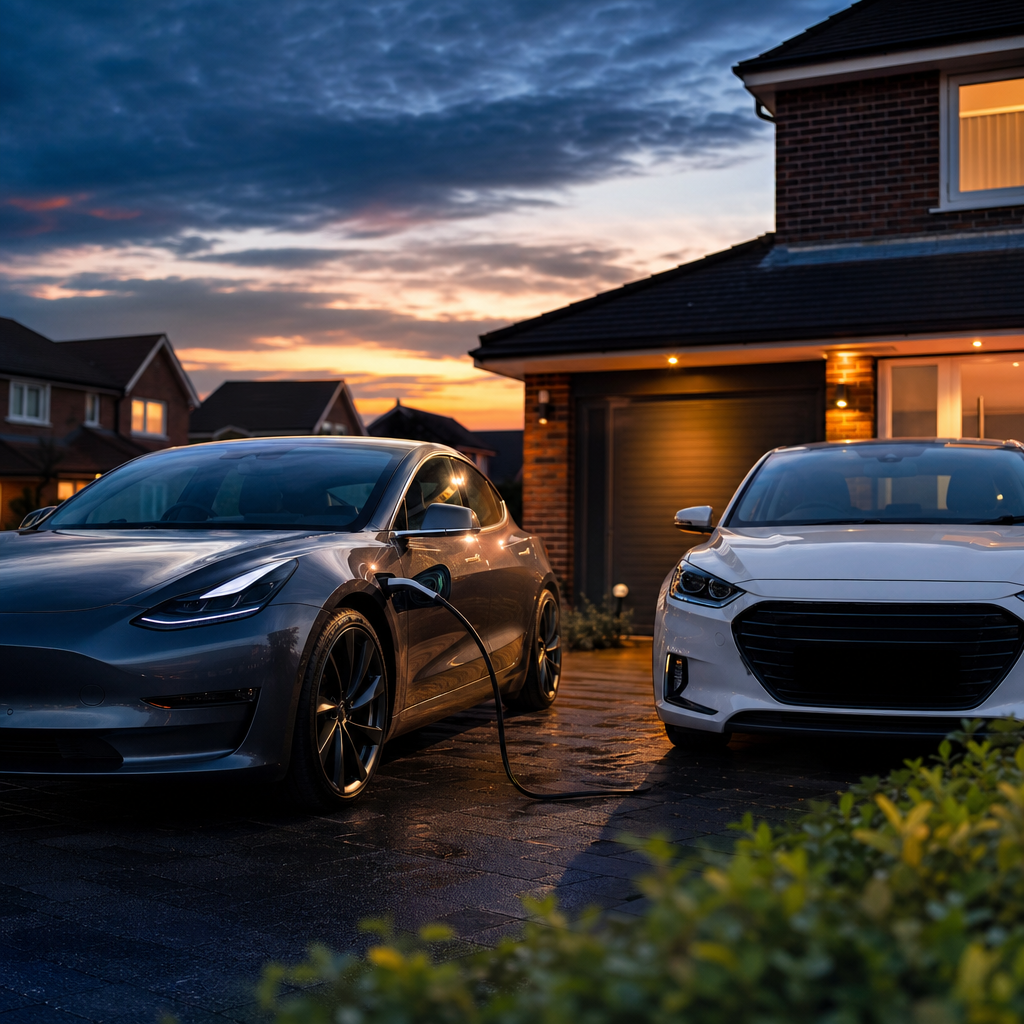
A few weeks ago, I drove the family up to Alton Towers. That’s about 180 miles each way from Hampshire, the kind of trip that would have had me sweating about range a couple of years ago. But honestly? The night before, I plugged in the Tesla, set it to charge to 100% on our cheap overnight rate, and went to bed. The next morning, I typed in the destination, and the car told me exactly where to stop and for how long. By the time I’d found a loo and grabbed a coffee to go, the car had already topped itself up at a Supercharger. Same thing on the way home. No stress, no drama, no white-knuckle staring at the battery percentage. Just a normal family day out.
Now, I know that’s my experience with a Tesla and the Supercharger network. Other EVs and other networks might not be quite so seamless just yet. And I also know that plenty of families are still genuinely torn between going fully electric, dipping a toe in with a hybrid, or landing somewhere in the middle with a plug-in hybrid. It’s a fair question, and in 2026 the answer isn’t one-size-fits-all. So let’s break it down properly, with real numbers, real-world experience, and zero manufacturer fluff.
HEV, PHEV, BEV: What Do They Actually Mean?
Before we get into costs and range, let’s clear up the jargon. There are three main types of electrified car on sale right now, and they’re genuinely very different beasts.
HEV (Hybrid Electric Vehicle) is your “self-charging” hybrid. Think Toyota Corolla or Renault Clio E-Tech. These have a small battery that charges itself from the petrol engine and regenerative braking. You never plug them in. They’ll run on electric power for very short bursts, usually under a mile at low speeds, but they’re fundamentally petrol cars with an electric assist. They’re brilliant for fuel economy in town, returning up to 56–69mpg depending on the model, but they’re not zero-emission in any meaningful sense.
PHEV (Plug-in Hybrid Electric Vehicle) has a bigger battery you charge from a plug, giving you somewhere between 30 and 75 miles of pure electric range. After that, the petrol engine kicks in and you’re running as a conventional hybrid. The idea is you do your daily commute on electric and have petrol for longer trips. In theory, it’s the best of both worlds. In practice, there’s a catch I’ll get to shortly.
BEV (Battery Electric Vehicle) is fully electric. No petrol engine, no exhaust pipe, no backup. Just a battery, an electric motor, and a plug. The average range in 2026 is around 300 miles, and some models like the new BMW iX3 are claiming up to 500 miles. This is what I drive, a Tesla Model 3 Long Range, and it’s been our family car since 2022.
The Real Cost Conversation
Here’s where it gets interesting, and where a lot of the online debate misses the point entirely. The cost equation for each type depends massively on one thing: where you charge.
If you have a driveway or garage and can charge at home on an off-peak electricity tariff, a BEV is an absolute no-brainer for running costs. The current Ofgem price cap puts standard electricity at 24.67p per kWh, but dedicated EV tariffs like EDF’s GoElectric will charge you as little as 6.99p per kWh overnight. That works out to roughly 2.7p per mile. Let that sink in. A petrol car doing 35mpg at current fuel prices costs about 21p per mile. You’re looking at running your car for roughly an eighth of the fuel cost.
However, and this is a big however, if you can’t charge at home and you’re relying entirely on public chargers, things get pricier. Public rapid chargers typically cost 20–25p per mile, which narrows the gap with petrol considerably. It’s still cheaper, but the savings aren’t the jaw-dropping difference you get with home charging.
Here’s a surprise from the research that caught my eye. A recent analysis by the Energy and Climate Intelligence Unit found that the UK’s ten best-selling PHEVs have recommended retail prices averaging £4,150 more than an equivalent BEV. That’s right, plug-in hybrids are actually around 10% more expensive to buy than their fully electric counterparts. On top of that, real-world testing shows these PHEVs consume 490% more fuel than manufacturers claim. If you’re buying a PHEV thinking it’s the cheaper, safer option, you might want to revisit those sums.
| Factor | HEV (Self-Charging Hybrid) | PHEV (Plug-in Hybrid) | BEV (Full Electric ) |
|---|---|---|---|
| Purchase Price (typical) | £24,000–£35,000 | £35,000–£50,000 | £12,000–£50,000+ |
| Fuel/Energy Cost per Mile | 8–12p (petrol) | 3–12p (mixed) | 2.7–8p (home) / 20–25p (public) |
| Electric-Only Range | Under 1 mile | 30–75 miles | 200–500 miles |
| Home Charging Required? | No | Yes (for best results) | Yes (for best savings) |
| Road Tax (VED) | Standard rate | Standard rate | £0 first year, then standard |
| Maintenance Costs | Standard | Higher (two systems) | Lower (fewer moving parts) |
| BIK Tax (Company Car) | 20%+ | 5–9% | 2–3% |
For company car drivers especially, the BIK tax difference alone makes a BEV the obvious choice. At 2–3% benefit-in-kind versus 20%+ for a conventional hybrid, the monthly tax saving can be hundreds of pounds. It’s no surprise that 82% of new zero-emission cars registered in 2025 went to company or fleet keepers.
Range Anxiety: Is It Still a Thing?
I’m going to be honest here. When we first got the Tesla in 2022, I did have a little voice in the back of my head on longer trips. Will we make it? What if the charger’s broken? Those worries have almost completely evaporated.
The UK now has over 119,000 EV chargers across more than 46,000 locations. Ultra-rapid chargers (150kW and above) grew by 40% in 2025 alone. Modern EVs with decent navigation, like our Tesla, will plan your route, tell you exactly which charger to stop at, how long to charge for, and have you back on the road before the kids have finished arguing about whose turn it is to pick the playlist.
That Alton Towers trip is a perfect example. 180 miles each way, one brief stop in each direction, and the charging was done before the coffee was. The car handles all the thinking. I genuinely found it less stressful than the old days of watching the petrol gauge and trying to find a services that didn’t charge £1.70 a litre.
That said, I should be fair. The Tesla Supercharger network is arguably the best in the UK. If you’re driving a different brand and relying on the public network from providers like BP Pulse, Gridserve, or Ionity, the experience can be more mixed. Broken chargers, confusing apps, and the odd queue are still part of the landscape, though it’s improving fast. The regional disparity is real too. London has 338 public chargers per 100,000 people, roughly double the national average. If you’re in a rural area, planning ahead still matters more.
For winter driving, expect to lose 15–30% of your range in cold weather. That’s just physics, and it applies to every EV. It doesn’t mean you’ll be stranded. It just means a 300-mile car becomes a 210–255-mile car on a bitter January morning. Plan accordingly, and you’ll be fine.
Boot Space, Family Practicality, and the Stuff That Actually Matters
Here’s something the spec sheets don’t always tell you. Because BEVs don’t need a transmission tunnel, exhaust system, or fuel tank in the traditional sense, many of them have genuinely excellent interior space. Our Tesla Model 3 has a massive boot plus a front trunk (frunk) that’s perfect for chucking wet wellies in. Many electric SUVs and estates offer boot space that matches or beats their petrol equivalents.
PHEVs, on the other hand, often sacrifice boot space to accommodate both a battery pack and a fuel tank. If you’re regularly loading up for family holidays or cramming in camping gear, check the boot capacity carefully. Some PHEVs lose 100 litres or more compared to their non-hybrid siblings.
Standard hybrids generally don’t suffer this problem as much because their batteries are smaller, but they also don’t give you meaningful electric driving.
Recommended Models by Category
Best HEVs for Families:
- Toyota Corolla Hybrid (from £32,615), reliable, proven, up to 56.5mpg
- Renault Clio E-Tech Hybrid (from £24,395), brilliant around town, up to 68.9mpg
Best PHEVs for Families (if you must):
- Chery Tiggo 8 Super Hybrid (from £42,845), 40 miles electric range, seven seats available
- Kia Sportage PHEV, practical, well-equipped, decent electric range
Best BEVs for Families:
- Tesla Model 3, exceptional charging network, great tech, solid range
- BYD Seal, competitive pricing, impressive range and spec
- Kia EV6, spacious, rapid charging, excellent family car
- Dacia Spring (from £12,240), if budget is the absolute priority, the cheapest EV on sale
Hype Cycle Check
LIKELY TO LAST: Home charging on cheap overnight tariffs as the most cost-effective way to run any vehicle. The infrastructure is built, smart tariffs are competitive, and this only gets better as more providers enter the market. BEVs as the dominant new car technology within five years is looking increasingly certain.
WATCH CLOSELY: Public charging reliability and pricing. It’s getting better, but consistency across networks still varies. Also watch the used EV market. As lease returns flood in, secondhand BEV prices are dropping, which could make 2026–2027 a brilliant time to buy a used electric car .
VAPOURWARE RISK: The idea that PHEVs are a genuine long-term “best of both worlds” solution. The data on real-world fuel consumption is damning. For many owners, PHEVs end up being expensive, heavy petrol cars that rarely get plugged in. Unless you’re disciplined about charging daily, the economics don’t stack up.
What This Means for CES 2027
Having attended CES more times than I care to count, I’ve watched the automotive halls shift dramatically over the past few years. I expect CES 2027 to double down on a few themes. First, vehicle-to-home (V2H) and vehicle-to-grid (V2G) tech, where your car battery powers your house during peak rates. Second, ultra-fast charging announcements pushing towards consistent 350kW+ speeds. Third, affordable EVs from Chinese and emerging manufacturers targeting the sub-£20,000 bracket. The hybrid conversation at CES is increasingly quiet. The industry has picked its direction, even if consumers are still catching up.
What to Watch
- Cross-pavement charging regulations, new proposals to bring cable channels under permitted development could be a game-changer for terraced houses and renters without driveways. This could unlock home charging for millions of UK households.
- Used EV prices, with hundreds of thousands of lease vehicles due back, the secondhand market is about to get very interesting. Budget-conscious families should keep their eyes on 2–3 year old models coming off fleet contracts.
- The ZEV mandate squeeze, manufacturers need to hit 33% BEV sales in 2026. They’re currently tracking at around 22–23%. Expect aggressive discounts and deals in the second half of the year as brands push to meet targets or face fines.
- Battery technology leaps, solid-state and silicon-anode batteries are moving from lab to production. When they arrive at scale, range anxiety becomes a relic of the past.
Your Decision Framework
Here’s how I’d think about it, honestly.
Buy a BEV if: you can charge at home (driveway, garage, or dedicated charger), you want the lowest running costs, and you’re comfortable with the upfront price. For company car drivers, it’s almost certainly the right call regardless. If you do regular long trips, choose a model with a strong charging network.
Consider an HEV if: you genuinely can’t charge at home, you do mostly short urban journeys, and you want better fuel economy than a pure petrol car without any charging faff. It’s a sensible, if unexciting, stepping stone.
Think very carefully before buying a PHEV: unless you commit to plugging it in every single night and your daily commute fits within the electric range, you’re likely paying more for a heavier car that drinks more petrol than advertised. The numbers increasingly don’t add up.
From personal experience, making the switch to full electric has been one of the best decisions we’ve made as a family. The running costs are genuinely transformative when you’re charging overnight at home. And the driving experience? Smooth, quiet, instant torque that still makes me grin four years later. I won’t pretend it’s perfect for everyone right now, but for a huge number of UK families, 2026 is the year where BEV makes more sense than anything else on the road.
📬 Want more honest, real-world tech advice for families? I write about this stuff every week. No jargon, no sponsored fluff, just what actually works. Sign up for the Tech Dads Life newsletter at techdadslife.beehiiv.com and get it straight to your inbox.