
What Happened
On 22 September 2026, OpenAI released two new models: GPT-6 Sol and GPT-6 Luna. The announcement came just 19 days after the launch of GPT-6 Astra, OpenAI’s most powerful model to date, and was confirmed by both OpenAI’s own release page and independently by TechCrunch and VentureBeat .
GPT-6 Sol sits in the middle of the GPT-6 family: a balanced model aimed at complex, multistep tasks, particularly coding and agentic work where you need a model to reason through several steps before giving you an answer. GPT-6 Luna is the lightweight option, designed for faster, simpler tasks at the lowest cost in the GPT-6 range. Notably, there is no GPT-6 Terra in this release, which means the three-tier structure from the GPT-5.6 family (Sol, Terra, Luna) has been simplified to two tiers.
The headline number is the price. GPT-6 Sol comes in at $2 per million input tokens and $10 per million output tokens, exactly half what GPT-5.6 Sol cost. GPT-6 Luna is $0.10 input and $0.50 output, also roughly half its predecessor. OpenAI told The New Stack that improvements in caching and inference are behind the reduction, and that the GPT-5.6 pricing was always intended as promotional. These are now the standard prices, not introductory ones.
On availability, GPT-6 Sol is live in ChatGPT Work and Codex for most paid accounts, in the API, and across GitHub Copilot Pro+, Max, Business, and Enterprise plans. GPT-6 Luna is available more broadly, including the desktop app and ChatGPT Free and Go tiers, as well as Copilot Pro plans, as confirmed by the GitHub Changelog .
OpenAI also published internal factuality figures: GPT-6 Sol’s error rate on their own testing is roughly half that of GPT-5.6 Sol at equivalent settings, for example 5.1% against 10.8% at high effort. OpenAI cautions that this evaluation deliberately selects error-inducing conversations and is not meant to represent typical usage.
Why It Matters (Analysis)
The cost reduction is the most straightforward win here. For anyone building on the API, or running large volumes of tasks through ChatGPT Work, paying half as much for a model that OpenAI claims is also more accurate is a meaningful improvement.
OpenAI’s benchmark claims are more interesting, and more complicated. On AutomationBench, OpenAI’s own business-workflow benchmark, the company says GPT-6 Sol at maximum effort (56.4%) beats Claude Opus 5’s best score (55.9%) for 40% of the cost. Those are significant cost-efficiency claims if they hold up.
However, the comparison to Anthropic’s models needs careful reading. OpenAI’s benchmarks compare GPT-6 Sol primarily against Claude Opus 5, not Claude Fable 5.1 at all effort tiers. On FrontierCode, OpenAI claims Sol matches Fable 5.1 at its xhigh setting (Fable’s lowest-scoring setting on that chart) at much lower cost: 49.3% for $2.14 against 48.7% for $9.27. But Fable 5.1 at its low-effort setting scores 49.8% for $2.38, which is cheaper than Sol and marginally higher. Claude Opus 5 at medium tops that chart at 53.4%. The framing matters.
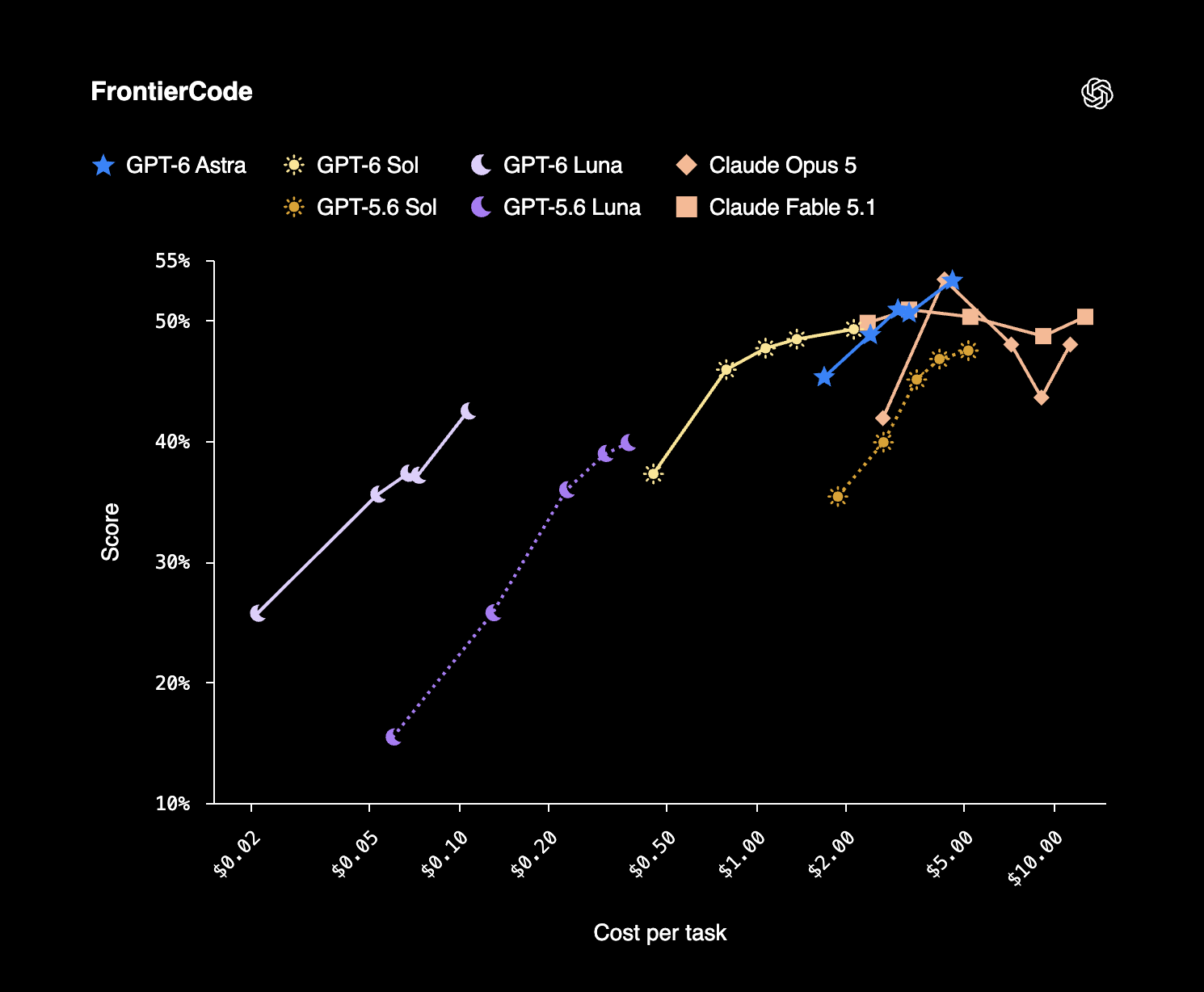
The bigger issue is timing. Anthropic released Claude Opus 5.5 on the same day, roughly 90 minutes before OpenAI shipped Sol and Luna. Every OpenAI benchmark chart compares against Opus 5, not Opus 5.5. On AutomationBench, the one benchmark both vendors report, Opus 5.5 scores 40.0% against Sol’s 33.2%. OpenAI’s charts simply did not include the newest Anthropic model. OpenAI also states that competitor results were taken from publicly available reports rather than being rerun in the same test environment, and that Fable 5 scores were used wherever no Fable 5.1 score existed.
Independent analysis from Digital Applied found that on two of the three coding and computer-use charts, GPT-5.6 Sol’s best score is actually higher than GPT-6 Sol’s. So while Sol and Luna are cheaper, the performance picture is not as uniformly improved as the headline claims suggest.
For context on the Anthropic side, Claude Fable 5.1 launched on 1 September 2026 , with Anthropic positioning it as its most advanced model for coding and knowledge work. Anthropic also says it costs around 25% less than Fable 5 for typical workloads. If you are comparing value across the top AI providers right now, you should be reading the ChatGPT vs Claude vs Gemini vs Grok comparison alongside the raw benchmark numbers.
What Is Still Unclear
No independent same-harness head-to-head between GPT-6 Sol and Claude Opus 5.5 has been published at the time of writing. That is the comparison that matters most right now, and we do not have it yet. OpenAI’s benchmarks were clearly prepared before Opus 5.5 shipped, which creates an obvious gap.
It is also unclear how the removal of the Terra tier from the GPT-6 family will affect users who relied on that middle-ground option in GPT-5.6. OpenAI has not explained publicly whether Sol now covers what Terra previously handled, or whether that use case is simply gone.
Pricing is quoted in US dollars. At current exchange rates, UK developers and businesses will want to calculate GBP equivalents before making direct comparisons with Anthropic’s pricing.
What to Watch Next
The obvious thing to wait for is independent benchmark testing that puts GPT-6 Sol and Claude Opus 5.5 through the same evaluation harness. Until that exists, the performance comparisons in OpenAI’s launch materials should be treated as indicative rather than definitive.
Also worth watching: whether Anthropic responds with updates to Fable 5.1 or Opus 5.5 pricing. Both labs are now competing hard on the cost-per-task metric rather than raw capability alone.
For developers already using the API, the Sol and Luna pricing changes are live now. It is worth reviewing whether a shift from GPT-5.6 Sol to GPT-6 Sol makes sense for your workload, particularly if factuality on complex tasks is a priority. If you use Claude’s API and have been tracking rate limits , this release adds another data point to the cost-and-capability picture worth keeping an eye on.