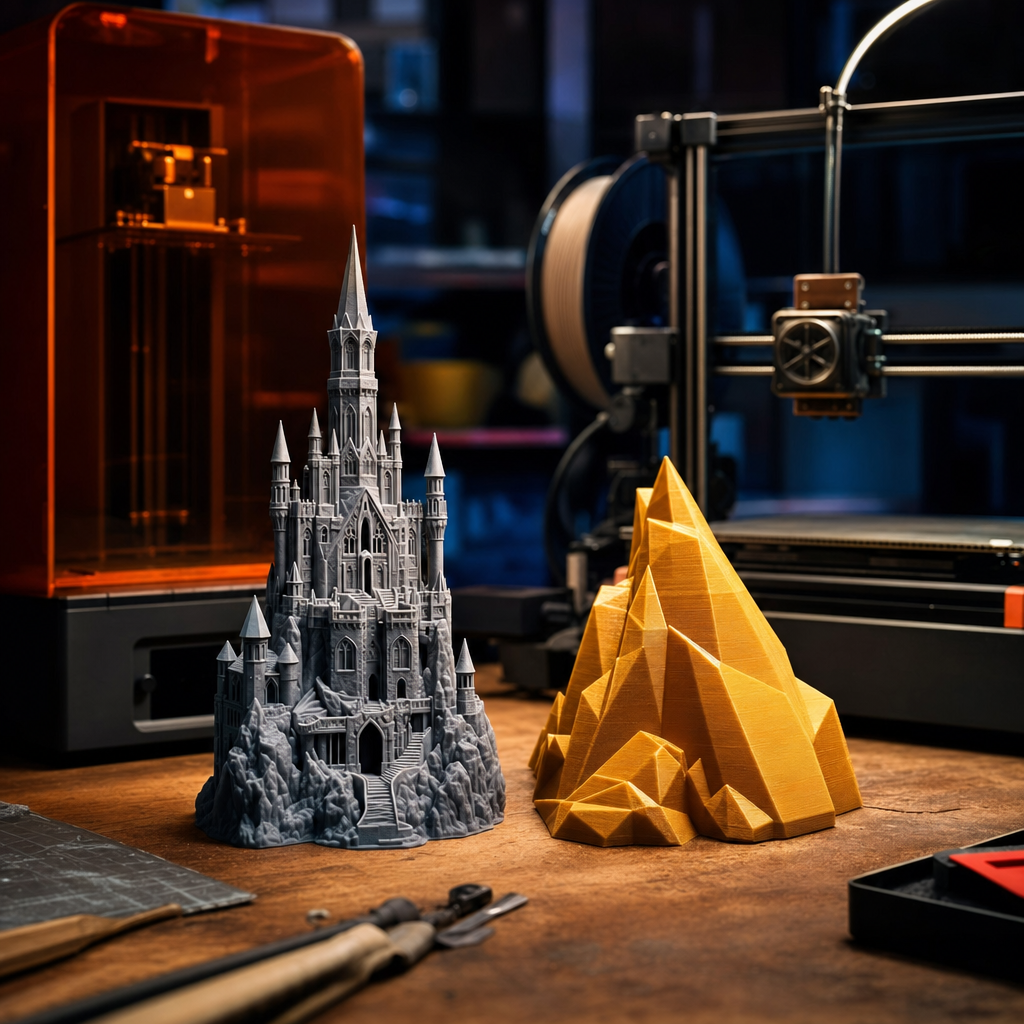
I’ll be honest with you: I’ve owned my Bambu Lab P1S for a while now, and before that I built a couple of Ender printers from kits, so I’ve spent a fair amount of time with filament printing. But every time I see someone post a photo of a resin-printed miniature or a piece of intricate jewellery, there’s a part of my brain that whispers “you need one of those.” The detail is genuinely jaw-dropping. The question is whether that detail is worth everything that comes with it, especially in a family home.
This is a question I get asked more than almost any other in the 3D printing space. Someone has decided they want a home printer, they’ve done about twenty minutes of research, and now they’re more confused than when they started. FDM? Resin? MSLA? What does any of it mean, and which one won’t end up as an expensive shelf ornament? I’m going to give you the honest answer, not the one that sells printers.
The short version is this: they’re both brilliant, they’re genuinely different tools, and the right choice depends entirely on what you want to make. Let me walk you through it properly.
How They Actually Work (Without the Boring Bit)
FDM printing, which stands for Fused Deposition Modelling, is the one most people picture when they think of a 3D printer. A spool of plastic filament feeds into a heated nozzle, melts, and gets deposited in layers onto a build plate. Layer by layer, bottom to top, until you have a physical object. It’s a bit like a very precise, very slow hot glue gun. The plastics used are typically PLA, PETG, or ABS, and they’re solid, workable materials with real-world strength.
Resin printing, specifically MSLA (Masked Stereolithography), works completely differently. Instead of melting plastic, it uses UV light to cure liquid resin. An LCD screen masks that light, creating each layer in seconds as the build plate lifts upward through a vat of liquid. The results are extraordinarily detailed, with layer heights as fine as 0.01mm compared to around 0.1mm for a typical FDM print. That’s not a small difference. That’s the difference between a Lego brick surface and something that looks machine-made.
Both technologies have matured enormously in the past few years, and you can get genuinely impressive results from budget options in both camps. But they are not interchangeable.
Print Quality, Strength, and What Each Is Actually Good For
On pure print quality and surface finish, resin wins. There’s no debate. Layer heights ten times finer than FDM means resin captures detail that filament printing simply cannot physically reproduce. If you want to print tabletop gaming miniatures, jewellery masters, dental models, or anything else where fine surface detail matters, resin is the only serious option. FDM prints have visible layer lines, particularly on curved surfaces, and while you can sand and finish them, you’re working harder to get there.
Flip that around and FDM wins clearly on strength and durability. Standard resin prints are brittle. Drop one on a hard floor and it shatters. A PLA or PETG print from an FDM machine handles the same impact without drama. For functional items like brackets, tool holders, cable clips, and replacement parts, FDM is the right call every time. Engineering resins exist and are improving in 2025, but they cost significantly more and still don’t match FDM for general toughness.
Build volume is another area where FDM wins comfortably. A budget FDM printer typically offers around 220x220x250mm of build space. Most resin printers top out at roughly 150x85x175mm. You can get larger format resin machines like the Elegoo Saturn series, but they’re a step up in cost. If you want to print something big, an FDM printer is almost always the practical choice.
The Mess, the Smell, and the Safety Conversation You Need to Have
This is the section I’d ask every new buyer to read twice, especially if kids are in the picture.
FDM printing is genuinely beginner-friendly. Load the filament, slice your model in the software, press print. PLA, the most common filament, is non-toxic and prints at relatively low temperatures. Failed prints waste plastic, but cleanup is just removing the print from the bed. The printer can sit in a corner of a home office or spare room with minimal fuss.
Resin is a different matter entirely, and the hobby community does not always communicate this clearly enough. Uncured resin contains acrylates and methacrylates, which are skin irritants and, more critically, sensitisers. Here’s why that distinction matters. Sensitisation is an immune system response. You might handle resin with bare hands for months without any obvious issue, and then your immune system decides it’s had enough. Once you’re sensitised, you’re sensitised. That reaction is typically lifelong, and future exposure can trigger serious responses. This is not a scare story. It’s the kind of thing that comes up repeatedly in communities of experienced resin printers who didn’t take precautions early on.
Every resin print session requires nitrile gloves (non-negotiable), proper ventilation, washing the print in isopropyl alcohol or water, UV curing to fully harden it, and careful disposal of contaminated materials. Budget an extra 20 to 30 minutes of post-processing per print regardless of print size. Water-washable resins are marketed as the safer option, and while they do replace IPA with water for cleanup, they contain the same hazardous acrylate compounds. That’s a common misconception worth clearing up.
If you have young children, a curious teenager, or a garage with poor airflow, you need to plan your resin setup carefully before you buy. It’s manageable, but it requires commitment to process. FDM asks far less of you.
Cost, Speed, and a Few Things Nobody Tells You
On initial purchase price, both technologies are now accessible. You can get a capable FDM printer or a decent resin printer without breaking the bank. The Bambu Lab machines have changed the FDM game significantly in terms of speed and reliability, but there are solid options well below that price point too.
Running costs favour FDM slightly. PLA filament is cheap, widely available, and stores easily. Resin is more expensive per litre and has a finite shelf life once opened. You also need to factor in IPA or water for washing, a UV curing station, and ongoing PPE supplies.
Speed is context-dependent. Resin cures entire layers simultaneously, so it excels at printing multiple small detailed objects in one batch. FDM is generally faster for single large objects. Modern high-speed FDM printers have closed the gap significantly in 2025, but when you factor in resin post-processing time, FDM often comes out ahead on total time from start to finished usable object.
One genuine advantage resin has in a home context is noise. FDM printers run fans and stepper motors that create a constant hum. Resin printers are much quieter because only the Z-axis motor moves during a print. If the printer lives near a bedroom or home office, that matters.
Head to Head: FDM vs Resin
| Category | FDM | Resin |
|---|---|---|
| Print detail | Good, visible layer lines | Excellent, near-invisible layers |
| Surface finish | Moderate (sandable) | Very smooth out of the machine |
| Strength | High, suitable for functional parts | Brittle standard resins, better engineering options at higher cost |
| Build volume | Large (budget printers 220x220mm+) | Small to medium (most under 150x85mm) |
| Ease of use | Beginner-friendly | Steeper learning curve, more process |
| Post-processing | Minimal | Significant (wash, cure, cleanup) |
| Safety | Low risk (PLA non-toxic) | Requires PPE and ventilation, always |
| Noise | Moderate to noisy | Quiet |
| Running cost | Low | Moderate |
| Best for | Functional parts, large models, beginners | Miniatures, jewellery, fine detail |
Hype Cycle Check
LIKELY TO LAST: FDM remains the backbone of home 3D printing. Filament materials continue to improve, machines are getting faster and more reliable, and the workflow is accessible to anyone. This technology is here for the long haul. High-detail resin printing for specialist applications like miniatures and dental or jewellery work is equally well-established and not going anywhere.
WATCH CLOSELY: Engineering resins are improving quickly in 2025. If that trajectory continues, resin’s brittleness limitation becomes less of a dealbreaker for functional printing. Worth tracking over the next 12 to 18 months.
VAPOURWARE RISK: Claims about “safe” resins that require no PPE or ventilation. The chemistry doesn’t support this yet. Until the acrylate compounds are genuinely replaced, scepticism is warranted.
CES 2027 Angle
Consumer 3D printing is edging toward the kitchen appliance category, and CES 2027 will likely accelerate that narrative. Expect to see FDM machines with fully automated filament handling and AI-assisted bed levelling presented as true plug-and-play devices. On the resin side, the interesting development to watch is enclosed all-in-one systems that handle washing and curing automatically with sealed waste containment, reducing the safety and mess barriers considerably. If a major manufacturer cracks genuinely self-contained resin printing with proper chemical isolation, it changes the home user calculus significantly.
What to Watch
- Enclosed all-in-one resin systems with integrated wash, cure, and sealed waste disposal. This is the development that would genuinely open resin printing to a wider home audience.
- Engineering resin development from Elegoo, Anycubic, and others. Tougher, less brittle standard resins at accessible prices would reshape the FDM-vs-resin debate for functional printing.
- High-speed FDM advancements following Bambu Lab’s lead. Competitors are catching up, and prices on capable fast machines are falling.
- Filament recycling and sustainability features, which are starting to appear in premium FDM machines and will likely become a talking point as environmental awareness in the maker community grows.
If this kind of practical breakdown is useful to you, come and join the Tech Dads Life newsletter where I cover exactly this sort of thing on a regular basis. No fluff, no sponsored nonsense, just honest takes on technology for people who actually have to make it work in real life. You can sign up at techdadslife.beehiiv.com . Always free, always worth your time.