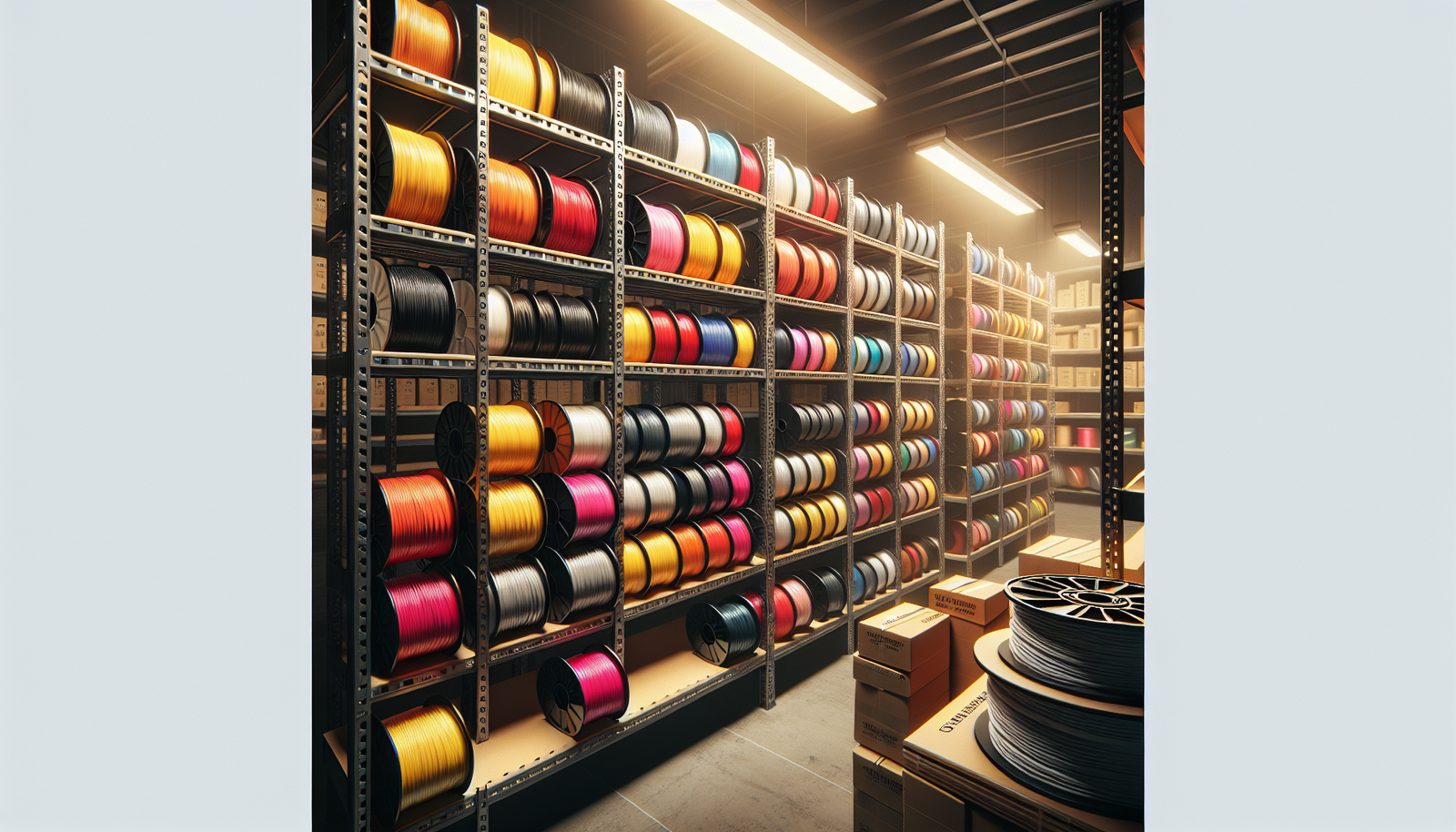
I’ll be honest, when I first got into 3D printing , I thought filament was just filament. You buy the roll, you load it in, you print stuff. Simple, right?
Then I tried to print a mounting bracket for the garage, used the wrong material, left it near a warm window, and came back to find something that looked like Salvador Dalí had designed it. Turns out, what you print with matters just as much as what you print. So let me save you the melted bracket and the confused Googling, and break this down properly.
What Even Is Filament?
If you’re new to 3D printing, here’s the quick version. FDM printers (the kind most of us have at home, the ones that look like a robot drawing in mid-air) work by melting a thin strand of plastic and laying it down layer by layer until your object appears. That thin strand is your filament.
It comes on a spool, usually 1.75mm in diameter, and it looks a bit like fancy weed-whacker cord. The material that strand is made from determines almost everything about how your print behaves: how easy it is to get right, how strong the finished part is, and whether it’ll survive being left in a warm car.
The three materials you’ll hear about constantly as a beginner are PLA, PETG, and ABS. Each one has its strengths, its quirks, and its ideal use case. Let’s go through them one at a time.
PLA: Start Here, Full Stop
PLA (Polylactic Acid) is where virtually every beginner should start, and it’s where I started too. It’s made from plant-based materials like corn starch, which makes it more environmentally friendly than traditional plastics, and it’s the most forgiving filament you’ll find.
It prints at relatively low temperatures, around 190 to 220°C at the nozzle, with a bed temperature of 50 to 60°C, and it doesn’t really warp. You don’t even need a heated bed with PLA, though having one helps. It also produces virtually no smell while printing, which matters quite a bit when your printer lives in a shared space.
The detail quality you get from PLA is genuinely impressive. It handles overhangs and fine features better than the other two options, which makes it great for models, decorative prints, and anything where appearance counts.
The catch? PLA is brittle. Drop a detailed PLA print on a hard floor and it may well shatter. More importantly, it starts to soften above around 60°C. Leave a PLA print on a car dashboard in summer and you’ll return to a puddle of good intentions. So while it’s perfect for decorative items, low-stress parts, and prototyping, it’s not the right choice for anything that needs to be genuinely tough or exposed to heat.
For getting started, a reliable mid-range PLA is hard to beat.
PETG: The Versatile Middle Ground
Once you’ve got a few PLA prints under your belt and you start thinking “I want to print something that actually does something,” PETG is the natural next step.
PETG stands for Polyethylene Terephthalate Glycol. The “G” (glycol-modified) part is what makes it easier to print with than standard PET. What it gives you is a genuinely useful upgrade over PLA: where PLA snaps under stress, PETG bends. Where PLA softens around 55°C, PETG holds firm to about 80°C. It doesn’t need an enclosure, it warps far less than ABS, and the fumes are minimal.
I’ve used PETG for functional prints around the house. Brackets, mounts, clips, cable tidies, replacement parts for things that broke. This is where 3D printing starts to feel genuinely useful rather than just entertaining.
The main headache with PETG is stringing. As the nozzle travels between parts of your print, it can leave fine, hair-like threads behind, like a tiny cobweb has moved in. It’s fixable with retraction settings and a bit of tuning, but it does take some patience. PETG also absorbs moisture from the air fairly readily, which will wreck your print quality if you leave a half-used spool sitting out. Store it properly, dry it at around 65°C for a couple of hours if it’s been exposed, and you’ll be fine.
One more thing worth noting: PETG can be quite sticky on certain bed surfaces, particularly glass. A thin layer of glue stick between the print and the bed prevents it bonding too aggressively. Small detail, saves big frustration.
A quick note on food safety, too. You might see PETG described as “food safe,” but for 3D printing that’s not quite the full picture. The layer lines in a printed part can harbour bacteria, and the filament itself may not carry the relevant certifications. If you’re printing anything intended for direct or prolonged food contact, look for filament that’s been explicitly approved for that purpose, and consider appropriate post-processing.
ABS: Powerful, But Not for Beginners
ABS (Acrylonitrile Butadiene Styrene) is the stuff LEGO bricks are made from, which tells you a lot. It’s strong, it handles heat well, and it’s been around in manufacturing for decades. But printing with it at home is genuinely tricky, and I’d steer most beginners away from it until they’ve built up some confidence.
Here’s the problem. ABS prints at high temperatures, around 230 to 260°C at the nozzle and 90 to 110°C at the bed, and it really wants to be inside an enclosed print chamber. Without one, the print cools unevenly, warps, and sometimes peels right off the bed mid-print. It also produces fumes that you don’t want to be breathing in without proper ventilation.
ABS absolutely has its place. If you need something heat-resistant, impact-tough, and genuinely durable for a mechanical application, ABS delivers. But if you’re still figuring out bed levelling and first-layer adhesion, ABS will test your patience in ways that aren’t fun or educational. Come back to it later.
Real Home Life: Which One Do You Actually Need?
In our house, the Bambu Lab P2S in the garage gets used for a real mix of things. Decorative stuff, school project parts, things the kids have designed and want to see come to life. That’s all PLA. Quick, reliable, looks great.
Anything functional, a replacement part, a mount, a clip for something that broke, gets printed in PETG. It’s become my default for anything that needs to survive beyond sitting on a shelf. If your kids want prints that’ll last being shoved in a school bag, PETG is the right call.
ABS gets used only when there’s a specific reason. High-heat environments, parts that need serious mechanical strength. It’s not the default for anything.
Should You Care Right Now?
If you’ve just got a printer or you’re thinking about getting one, yes. Understanding filament types is one of the most genuinely useful things you can learn early. The wrong material for the wrong job wastes time, filament, and patience. The right material means your print works first time and keeps working.
If You Want to Try It
Start with a 1kg spool of PLA in a neutral colour, print a few models from somewhere like Printables or Thingiverse, and get comfortable with your printer’s settings. Once you’ve nailed a few clean prints, buy a spool of PETG and try a practical functional part. A cable clip, a wall mount, something small. That’s the learning curve. It’s not steep; it just needs to be walked in order.
A good filament dry box or storage solution is worth getting early too, especially once you move to PETG.
If you found this useful and you want more practical guides like this one, covering 3D printing, smart home kit, family tech, and everything in between, come and join the Tech Dads Life newsletter. No spam, no faff. Just useful stuff, when it’s actually worth sending.
Sign up here: techdadslife.beehiiv.com