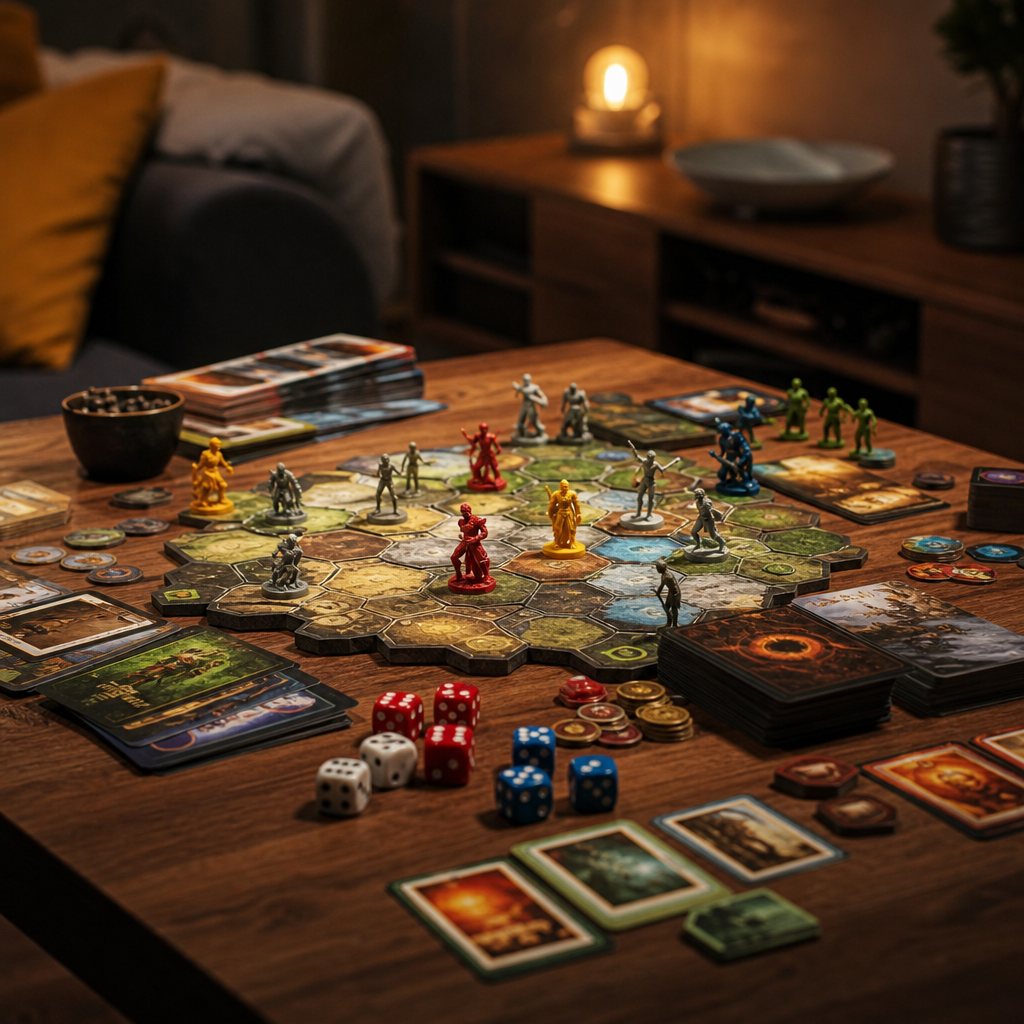
There’s a certain irony in my house. I’ve got an ASUS ROG gaming rig, a PS5, an Xbox Series X, and more screens than I care to count, yet some of the best evenings we’ve had as a family involve zero electricity. Just cardboard, dice, and the kind of negotiating that would make a used car salesman blush. If you’re a tech-minded parent looking to get the family round the table (dinner is always at the table in our house, so we’re halfway there), board games are a brilliant way to scratch that strategic, problem-solving itch without anyone disappearing into a screen.
The trouble is, the board game market has exploded. There are thousands of options now, and wading through them is genuinely confusing. Do you go for a classic gateway game the whole family can play? Something with deeper strategy for the teenagers? A coding-themed game that sneaks in computational thinking? I’ve spent a lot of evenings testing games with my three kids, and here’s what I’ve learned about picking the right ones.
Look for scalable complexity
The best family board games work on multiple levels. Your eight-year-old should be able to play and have fun, while a tech-savvy teenager or adult finds genuine depth. This is what game designers call “scalable complexity”, and it’s the single most important thing to look for. A game like Catan is a perfect example. On the surface, you’re collecting resources and building roads. Dig deeper, and you’re running probability calculations on dice rolls (six and eight come up far more often than two and twelve), negotiating trades where supply and demand genuinely affect value, and planning several turns ahead. When sheep are everywhere, nobody wants your sheep. When ore is scarce, suddenly you’re the most popular person at the table. That’s economics, probability, and negotiation wrapped in a game that plays in about an hour.
Prioritise interaction over isolation
Some board games are essentially solo puzzles that happen to have other people at the table. They’re fine, but they miss the point of a family game night. The games that work best for us are the ones where you’re constantly interacting, whether that’s trading, blocking, competing for the same route, or laughing at someone’s misfortune. Uno Show No Mercy is a brilliant example. The base Uno concept is simple enough, but the “Show No Mercy” variant adds delicious chaos. When someone plays a seven, they get to swap their entire hand with anyone at the table. The fallout when you’re sitting on two cards and suddenly inherit a fistful of twelve is absolutely priceless. It’s fast, it’s great for numbers and reaction speed, and honestly, it’s just a really good laugh. Never underestimate a game that makes everyone laugh.
Think about replay value
Tech people hate waste, and a board game that gets boring after three plays is poor value. Look for games with variable setups, expansions, or campaign modes that keep things fresh. Catan’s expansion packs add new mechanics and extend the player count. Wingspan has an Americas expansion launched in January 2026 with 111 new cards. The 2025 Spiel des Jahres winner, Bomb Busters, has a 66-mission campaign that’ll keep a family going for months. Replay value is where board games punch well above their weight compared to, say, a cinema trip that’s over in two hours and costs you the thick end of sixty quid for a family of five.
Consider the “teach time”
If it takes longer to explain the rules than to actually play the game, you’ve lost the room. With three kids at different ages, I’ve learned that setup and teach time matter enormously. Anything over fifteen minutes of explanation and the younger ones start building dice towers. The sweet spot for a family is a game you can teach in under ten minutes but that still rewards repeated play. Ticket to Ride is the gold standard here. The core idea (collect cards, claim train routes, complete tickets) takes about five minutes to explain, setup is roughly two minutes, and yet the route optimisation decisions keep even the adults properly engaged.
The picks
Catan (with the expansion)
This is the one that lives permanently on our shelf. The base game teaches resource management, probability, and negotiation in a way that genuinely sticks. What I love is how the trading dynamic teaches real-world economics. Abundant resources are worth less, rare ones are worth more, and it doesn’t take long before everyone at the table figures that out without a single lecture. Add an expansion pack and you’ve got fresh mechanics and room for more players. At around £35 to £40 for the base game, it’s outstanding value for the hundreds of hours you’ll get from it.
Pros: Deep strategy that rewards repeated play, brilliant for teaching negotiation and probability. Cons: Can run a little long with newer players, and someone always gets salty about the robber.
Uno Show No Mercy
Don’t let anyone tell you Uno is “just a card game.” The Show No Mercy variant transforms it into something genuinely tactical and hilarious. The hand-swap mechanic on a seven is a masterstroke, and it keeps everyone on their toes the entire game. It’s fast enough that you can squeeze in three rounds after dinner, and it works brilliantly across age groups. This one gets requested more than anything else we own.
Pros: Cheap, fast, incredibly fun, works with all ages from about seven upward. Cons: Can feel chaotic if you prefer pure strategy. You will get loud.
Ticket to Ride: Europe
The gateway game to end all gateway games. Collect coloured cards, claim railway routes across Europe, and score points for completing destination tickets. The route-planning element is essentially graph theory for families, which appeals to any tech-minded parent. The Europe edition adds tunnels and ferries for a touch more depth than the original. At around £27, it’s a bargain.
Pros: Two-minute setup, ten-minute teach, and genuinely strategic route optimisation. Cons: Two-player games can feel a bit spacious. Best with three to five.
Bomb Busters
The 2025 Spiel des Jahres winner, and it deserves the award. This is a cooperative card game where two to five players work together to defuse a bomb across a 66-mission campaign. Games take about twenty minutes each, so you can fit one in on a school night. Cooperative games are having a real moment. Five of the last seven Spiel des Jahres winners have been cooperative, and this one nails the tension of working as a team under pressure. Ages 10 and up.
Pros: Cooperative play means no sore losers, brilliant campaign keeps it fresh for months. Cons: The theme might not suit every family. Not ideal for very young players.
Wingspan
If your family leans more towards engine-building and optimisation (and honestly, what tech dad doesn’t love a good optimisation loop), Wingspan is superb. You’re building an ecosystem of birds, and each card triggers combos that chain together in satisfying ways. The Americas expansion adds 111 new cards. It’s a bit pricier at around £50, and the teach time is closer to fifteen minutes, but the depth here is remarkable. Ages 10 and up, one to five players.
Pros: Gorgeous components, deep engine-building strategy, massive replay value. Cons: Higher price point and longer teach time. Not the best choice for a quick after-dinner round.
Quick comparison
| Game | Price (GBP) | Best For | Verdict |
|---|---|---|---|
| Catan (base game) | ~£35–£40 | Strategy, negotiation, economics | The essential family strategy game |
| Uno Show No Mercy | ~£10 | Quick fun, all ages, reaction speed | Best laughs per pound you’ll find |
| Ticket to Ride: Europe | ~£27 | Gateway strategy, route planning | Perfect first “proper” board game |
| Bomb Busters | ~£20–£25 | Cooperative teamwork, campaign play | 2025 Game of the Year for good reason |
| Wingspan | ~£50 | Engine-building, deeper strategy | Gorgeous and rewarding for older families |
Bottom line
If you’re just starting out with family game nights and your kids are eight or older, grab Ticket to Ride: Europe. It’s cheap, fast to learn, and hooks everyone. If your family already plays games and you want something with real strategic depth, Catan with an expansion is the one. It teaches more useful thinking skills than half the apps on your phone, and the trading dynamic alone is worth the price. And honestly, do yourself a favour and pick up Uno Show No Mercy regardless. It costs about a tenner, fits in a coat pocket, and will generate more genuine family laughter than anything else on this list. Sometimes the best tech is no tech at all.
📬 Want more recommendations like this? I send out a weekly newsletter covering tech, builds, and family-friendly finds. No spam, no fluff, just the stuff I’d actually tell a mate. Sign up here at Tech Dads Life .