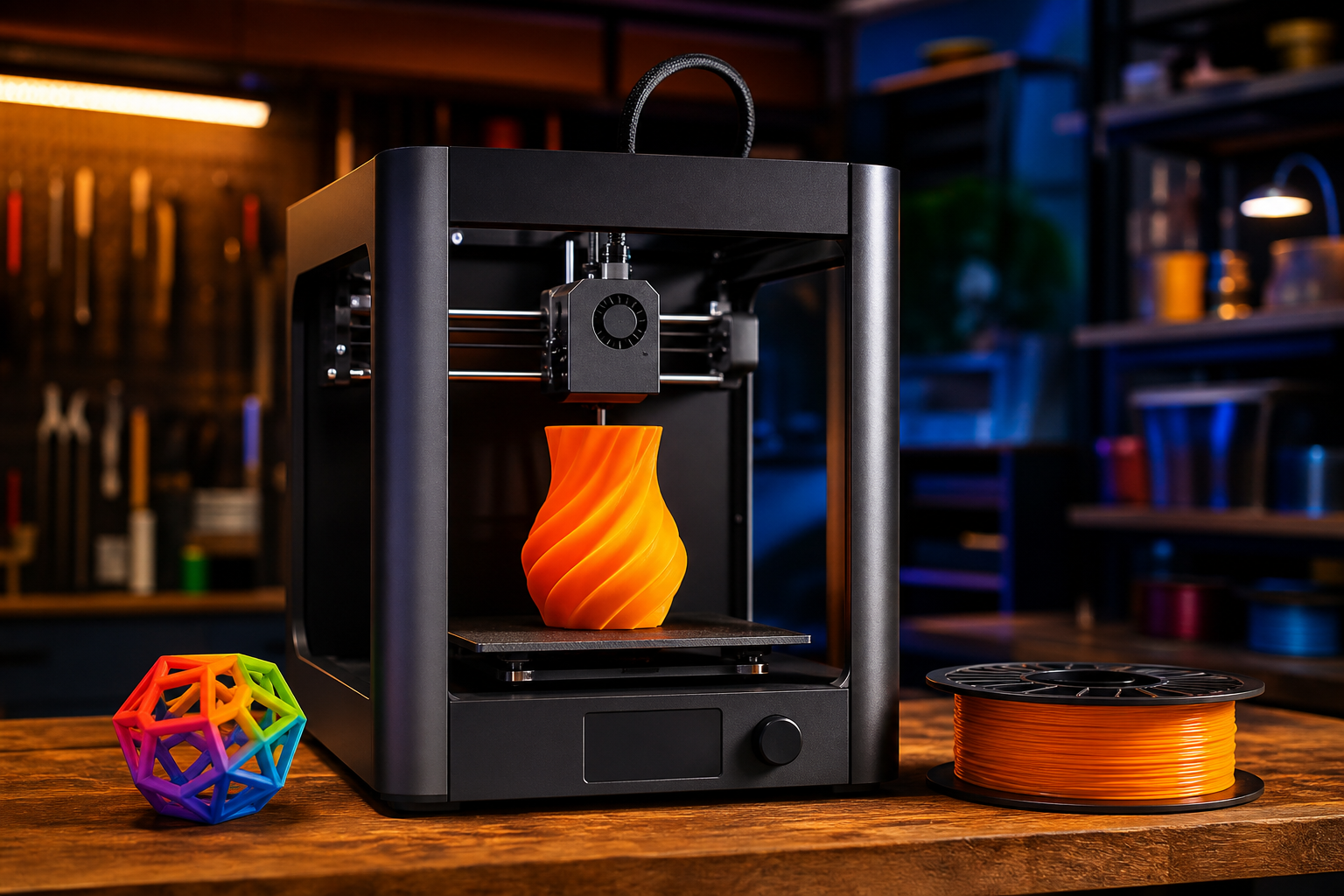
If you have curious kids at home and you’re thinking about getting into 3D printing, the timing has never been better. Prices have dropped, the machines have genuinely improved, and you no longer need to be a hobbyist with a toolbox full of hex keys just to get a decent print out of the box. The problem is that the budget end of the market is now crowded with options, and the spec sheets all start to blur into one. Fast speeds, auto bed levelling, direct drive, PEI plate. It all sounds impressive until you’re standing in a garage at 11pm wondering why your Benchy looks like it melted.
I’ve been 3D printing for years and currently run a Bambu Lab P2S , which sits well above the budget tier. But I started with an Ender I built from a kit, and I know exactly what the experience is like when things go wrong at a price point where support is limited and the manual is a PDF written in three languages simultaneously. If you’re completely new to this, my beginner’s guide to getting started covers the basics this article assumes you already know. This guide is aimed at families who want a printer that actually works, is reasonably safe with inquisitive children nearby, and doesn’t require an engineering degree to operate.
Build volume: bigger isn’t always better
The first number people fixate on is the build volume, and honestly, it matters less than you’d think for a family machine. Most things people actually want to print, organisers, toys, spare parts, little gifts, fit comfortably within a 180mm cube. Where build volume does matter is if you want to print larger single-piece objects without splitting the model across multiple prints. At under £300, you’re looking at build plates ranging from roughly 180 x 180mm up to around 220 x 220mm or more depending on the machine. Don’t reject a printer purely on build size. Look at the whole package first.
Automatic bed levelling: no longer optional
A few years ago, manual bed levelling was something you just accepted. Now that nearly every printer in this price range ships with some form of automatic levelling, there’s really no reason to settle for a machine without it. Getting the first layer right is the single biggest factor in whether a print succeeds or fails, and for a parent who just wants things to work, having the printer handle that itself is genuinely transformative. Look for CR Touch, a strain gauge, or similar. If the listing says “manual levelling only,” move on.
Enclosure and safety with kids around
Open-frame printers expose a hot end that runs at around 200°C for PLA. That’s something to think hard about if you have younger children who are likely to be nearby when the printer is running. An enclosed machine keeps the heat inside, contains fumes better, and generally gives you more peace of mind. Most budget machines are open-frame, so if safety is a priority, your shortlist shortens quickly. I’d say an enclosure is close to mandatory for children under ten. For older kids who understand to keep their hands clear, an open-frame machine is manageable with sensible house rules.
Software and ecosystem: the hidden differentiator
This is the one people skip in the spec comparison and then regret. The software experience, from slicing to sending prints to the machine and monitoring progress, varies enormously. Some printers ship with excellent, beginner-friendly software that handles most decisions for you. Others dump you into a complex interface and expect you to know what you’re doing. For a family printer, you want something with a short learning curve, good default settings for PLA, and ideally some form of remote monitoring so you can check on a print from the sofa without walking back out to the garage.
The picks
Bambu Lab A1 Mini (approx. £299)
If budget stretches to the ceiling of this category, the A1 Mini is the one to get. It’s a CoreXY machine that calibrates itself, connects to the Bambu Handy app for remote monitoring, and can finish a Benchy in around 16 minutes. More importantly for this guide, it just works. Setup is straightforward, the software is excellent, and the print quality on PLA out of the box is genuinely impressive. Every review source I trust has landed on this machine as the best beginner printer in 2026, and having used Bambu’s ecosystem myself, I understand why. It’s open-frame, so you’ll want to think about where it lives if you have very young children, but for school-age kids who want to get involved in printing, it’s ideal.
Pros: Self-calibrating, superb software, fast, reliable out of the box Cons: Open-frame, build volume smaller than some rivals at 180 x 180 x 180mm
Creality Ender 3 V3 SE (approx. £149)
If the A1 Mini is too much, the Ender 3 V3 SE is the honest budget pick. It comes with CR Touch for automatic bed levelling, a direct drive extruder (better for flexible materials), and can push up to 250mm/s. There’s no WiFi, which means you’re physically carrying a card to the machine to start prints, but at around £149, it’s hard to argue with what you get. Print quality is solid for PLA, and the Creality community is enormous. If something goes wrong, someone has already solved it online. I started my 3D printing journey on a Creality machine, and while this generation is far better than what I had, the fundamentals are the same: capable but not hands-off.
Pros: Excellent value, huge community support, reliable auto levelling Cons: No WiFi, less automated than the A1 Mini, can feel fiddly for complete beginners
Elegoo Neptune 4 Pro (broadly under £250)
Elegoo has built a reputation for packing more machine into a lower price than the competition, and the Neptune 4 Pro is the best example of that philosophy. It runs Klipper firmware, which is powerful but does have a steeper learning curve. It hits 500mm/s speeds and includes dual Z-axis lead screws for better stability. The PEI flex plate makes removing prints satisfying rather than stressful. You’ll occasionally need to level the bed manually, and the high-speed fans can be noisy at peak performance, so consider where you’ll put it. But as a first printer for someone who wants to grow into the hobby, it’s an excellent choice.
Pros: Klipper firmware, fast, great value for the spec sheet Cons: Klipper has a learning curve, can be noisy, less automated than the A1 Mini
FlashForge Adventurer 5M (approx. £280)
For families where the printer will be in a shared living space and younger children are in the picture, the FlashForge Adventurer 5M earns its spot through one key advantage: it’s enclosed. That keeps fumes in and curious fingers out, and for a family machine, that’s worth paying for. Print quality is solid, it handles PLA well, and the enclosed design means it runs quieter than open-frame machines at similar speeds. It’s not the fastest or the most feature-rich machine on this list, but if safety and a calmer home environment are priorities, it’s the sensible pick.
Pros: Enclosed design, quieter, safer for younger children Cons: Slightly fewer community resources than Creality or Bambu, not as fast as the Neptune 4 Pro
Quick comparison
| Model | Price (GBP) | Best For | Verdict |
|---|---|---|---|
| Bambu Lab A1 Mini | ~£299 | Most families | Best all-rounder at this price |
| Creality Ender 3 V3 SE | ~£149 | Tight budgets | Best value for money |
| Elegoo Neptune 4 Pro | ~£250 | Growing hobbyists | Best spec-per-pound |
| FlashForge Adventurer 5M | ~£280 | Families with young kids | Best for safety and shared spaces |
Bottom line
If you can stretch to £299, buy the Bambu Lab A1 Mini. It’s the closest thing to a genuinely plug-and-play printer at this price point, the software ecosystem is excellent, and it will stay useful as you grow into the hobby. If budget is the hard limit, the Creality Ender 3 V3 SE at around £149 is a proper machine that delivers the fundamentals without fuss. For families with children under ten who will be in the same room as the printer, move the FlashForge Adventurer 5M to the top of your list. The enclosed design changes the safety equation entirely.
Whatever you pick, start with PLA. It’s forgiving, it smells less than other materials, and it’s available everywhere. You can always branch out once you’ve got a feel for the machine, and once the kids are hooked, our 3D print cost calculator is worth a look for working out what each print is actually costing you in filament and power.
If you found this useful, I write a regular newsletter covering family tech, 3D printing, and everything in between. Sign up at techdadslife.beehiiv.com and I’ll land it in your inbox whenever something’s worth your time.