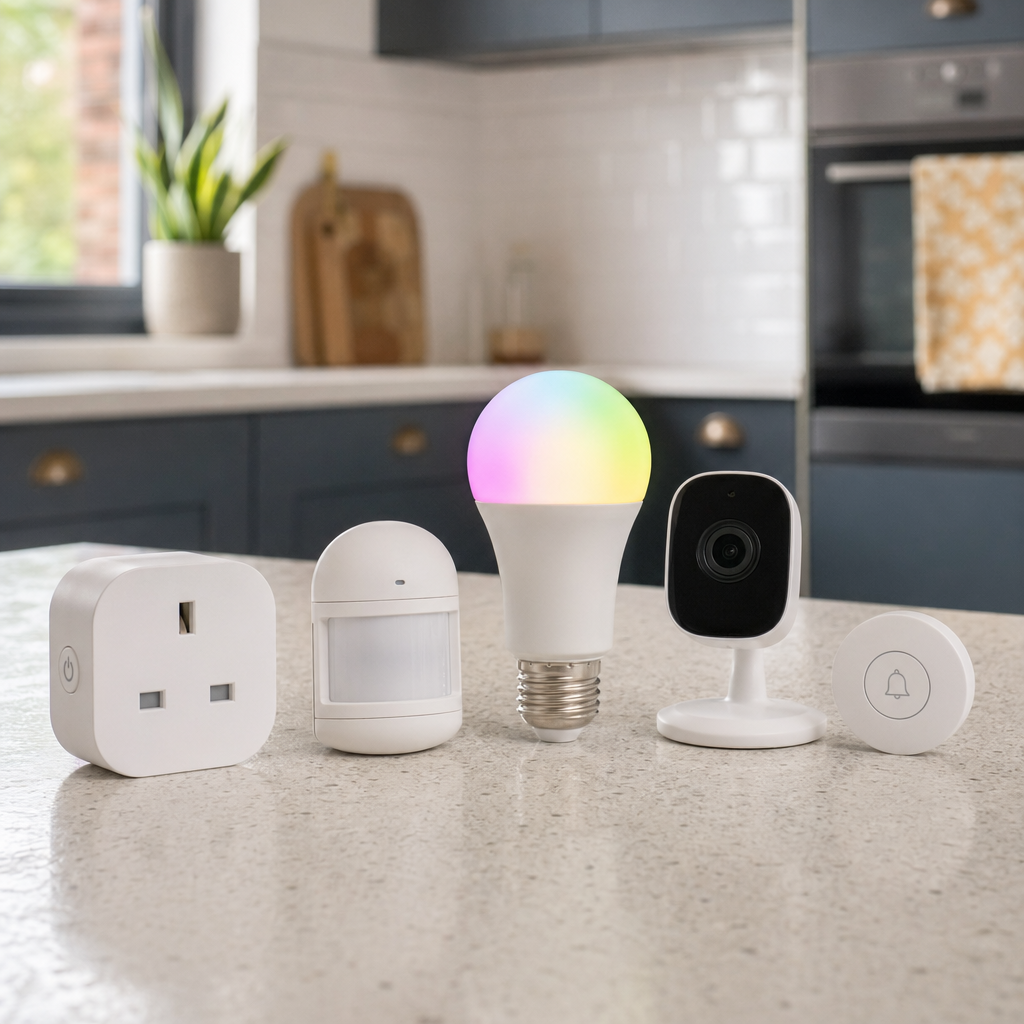
I’ll be honest, the moment I realised I’d spent more on a single “smart” light bulb than my weekly food shop for the kids’ packed lunches, I knew something had gone wrong. That was a few years back, and the smart home market has changed dramatically since then. You no longer need to remortgage the house to automate a few things, and you definitely don’t need a computer science degree to set it all up.
These days, some genuinely brilliant kit sits comfortably under the £50 mark. I’m talking plugs, bulbs, sensors, and cameras that actually work, that play nicely with whatever ecosystem you’ve already got running, and that don’t need a monthly subscription to justify their existence. That last point matters. Nothing winds me up more than buying a device only to discover it’s essentially a paperweight unless you cough up £4.99 a month forever. So everything on this list earns its keep out of the box, no strings attached.
I’ve tested a fair few of these in our house, where Alexa devices run the show across pretty much every room. My family includes teenagers who will find any weakness in a setup within about four seconds, so reliability isn’t optional. Here’s what’s actually worth your money in 2026.
Smart Plugs: The Single Best Place to Start
If you’re only going to buy one smart home device, make it a smart plug. They’re cheap, they’re useful immediately, and they give you a taste of what automation can do before you commit to anything bigger.
The TP-Link Tapo P110 is the one I recommend to everyone. I’ve been running these around the house for a while now, and they just work. At around £12 to £18 per plug, or as little as £8 each if you grab the four-pack, they’re absurdly good value. The killer feature is genuine energy monitoring. The Tapo app shows you real-time power draw plus daily, weekly, and monthly usage in kWh, with estimated costs. When standby power alone can cost a UK household somewhere between £35 and £86 a year according to the Energy Saving Trust, knowing exactly what’s eating your electricity is properly useful. They work with Alexa and Google Home, and setup takes about two minutes.
If you want to future-proof things, the Tapo P110M adds Matter support for only a couple of quid more. Matter is the universal standard developed jointly by Apple, Google, and Amazon, and it means the plug will connect natively to Alexa, Google Home, and Apple HomeKit without needing anything proprietary. With over 750 Matter-certified products now on the market, it’s no longer a niche bet. It’s the direction everything is heading.
For Apple households specifically, the Meross Matter Smart Plug is a cracking alternative. At roughly £13 per plug in the two-pack, it works with HomeKit, Alexa, Google Home, and SmartThings, all via Matter. That’s roughly half the price of an Eve Energy and just as cross-platform.
One important note: most UK smart plugs are rated at 13A, which is roughly 3,000W. That handles lamps, TVs, games consoles, phone chargers, and most kitchen appliances without breaking a sweat. But if you’re thinking about plugging in a fan heater or tumble dryer, you’ll want the TP-Link Tapo P115, which handles 16A (3,680W).
Smart Bulbs: Cheap Enough to Do the Whole House
Lighting accounts for around 11 to 15 per cent of a typical UK electricity bill, so smart bulbs that let you schedule, dim, and actually turn things off properly can make a real dent. The good news is that prices have fallen through the floor.
The TP-Link Tapo L530B is my go-to budget recommendation. It’s a multicolour B22 smart bulb that connects directly over Wi-Fi, so there’s no hub to buy. It works with Alexa and Google Home, supports scheduling and grouping, and the RRP is £11.99, though I’ve seen it dip below £7 on Amazon. At that price, you can outfit several rooms for the cost of a takeaway pizza.
The big story for 2026, though, is IKEA’s new KAJPLATS range. These are the successors to the TRADFRI bulbs, and IKEA has gone all-in on Matter-over-Thread. The range includes eleven variations covering different shapes, sizes, lumen levels, and colour options, with prices starting at just £4 per bulb. That almost certainly makes them the cheapest Matter-compatible smart bulbs you can buy in the UK. Because they support Matter, they’ll work with Alexa, Google Home, Apple Home, and Samsung SmartThings. The catch is you’ll either need IKEA’s DIRIGERA hub or another Matter-compatible controller, but that hub is a one-off purchase and it unlocks IKEA’s entire smart home range. Given IKEA also sells the GRILLPLATS smart plug for just £6, with energy monitoring and full Matter support, you could build a surprisingly capable smart home setup for the price of a couple of cinema tickets.
Philips Hue remains the gold standard for smart lighting if you want the richest app experience and rock-solid reliability. But starter kits typically land between £60 and £90, which pushes them outside the scope of this guide. If you’re already in the Hue ecosystem, individual bulbs can sneak under £50, but for newcomers on a budget, Tapo or KAJPLATS get you 90% of the way there at a fraction of the cost.
Smart Sensors and the IKEA Ecosystem Play
This is where things get interesting for families. A motion sensor in the hallway that triggers the landing light at 2am, so nobody stubs a toe on the way to the bathroom? That’s not a luxury. That’s survival when you’ve got kids who raid the fridge at midnight.
IKEA’s smart sensor range pairs beautifully with their KAJPLATS bulbs and GRILLPLATS plugs. Because everything runs on Matter-over-Thread, devices communicate directly with each other with very low latency, and the whole lot is controlled through the DIRIGERA hub. You can pair a motion sensor with a smart plug or bulb so that lights come on automatically when someone enters a room and turn off after a set period. No cloud dependency, no subscription, no fuss.
The Tapo ecosystem offers similar functionality through the Tapo T100 motion sensor and Tapo H200 hub, which together let you trigger plugs, bulbs, and automations based on movement or schedules. Both the sensor and hub sit comfortably under £50 each, and the app is genuinely one of the best in the budget smart home space.
The key question for most families is whether to go all-in on one ecosystem or mix and match. My advice: if you’re starting from scratch and budget is king, IKEA’s 2026 lineup is hard to argue with. If you already have Alexa or Google running the show and want to add devices gradually, Tapo gives you the widest range of affordable kit with excellent app support.
Product Comparison: Best Smart Home Devices Under £50
| Device | Price (approx.) | Energy Monitoring | Matter Support | Works With | Hub Required |
|---|---|---|---|---|---|
| TP-Link Tapo P110 (4-pack) | £8 per plug | Yes | No | Alexa, Google | No |
| TP-Link Tapo P110M | £12–18 | Yes | Yes | Alexa, Google, HomeKit | No |
| Meross Matter Plug (2-pack) | £13 per plug | No | Yes | Alexa, Google, HomeKit, SmartThings | No |
| IKEA GRILLPLATS Plug | £6 | Yes | Yes | Alexa, Google, Apple Home, SmartThings | DIRIGERA hub |
| TP-Link Tapo L530B Bulb | £7–12 | N/A | No | Alexa, Google | No |
| IKEA KAJPLATS Bulb | £4–9 | N/A | Yes | Alexa, Google, Apple Home, SmartThings | DIRIGERA hub |
Hype Cycle Check
LIKELY TO LAST: Matter compatibility across all major ecosystems. This isn’t a fad. Apple, Google, and Amazon built it together, and with 750+ certified products already, the interoperability problem is genuinely being solved. Buy Matter where you can.
Smart plugs with energy monitoring. With the Ofgem price cap at £1,758 per year and electricity sitting around 24.5p per kWh, knowing exactly where your energy goes has real financial value. These devices pay for themselves.
WATCH CLOSELY: IKEA’s 2026 smart home push. The KAJPLATS and GRILLPLATS ranges are aggressively priced and fully Matter-compatible. If IKEA nails the reliability and keeps the DIRIGERA hub stable, they could become the default budget smart home brand. The pricing is extraordinary, but long-term software support is the question mark.
Thread networking. It’s the low-power mesh protocol that underpins a lot of Matter devices, and it’s what allows sensors and bulbs to talk to each other without hammering your Wi-Fi. Most people won’t notice it working, which is exactly the point.
VAPOURWARE RISK: Any smart home device that requires a subscription to unlock its core features. If a camera needs a monthly plan to save clips, or a sensor needs a paid tier to send notifications, it’s not really a £30 device. It’s a £30 device plus £60 a year. Read the small print.
What This Means for CES 2027
Having attended CES regularly over the years, I can tell you the smart home floor has shifted dramatically recently. The conversation used to be about flashy demos and concept products. Now it’s about interoperability, price points, and Matter certification.
I’d expect CES 2027 to showcase the next wave of Matter-over-Thread sensors, particularly around energy management and home heating. With heating accounting for roughly 55% of the average UK energy bill, smart TRVs (thermostatic radiator valves) and zone heating controls that work across ecosystems are the obvious next frontier. If someone cracks a reliable, Matter-compatible smart TRV at a sub-£30 price point, that’ll be the story of the show.
I’ll also be watching for consolidation in the budget space. TP-Link, IKEA, and Meross are all fighting for the same wallet, and CES is where we’ll see whether anyone pulls ahead with a genuinely unified starter kit that bundles plugs, bulbs, and sensors together at a family-friendly price.
What to Watch in the Next 6 Months
IKEA KAJPLATS availability in the UK. The range has been announced with stunning prices, but stock availability and real-world reliability reports will determine whether this is the budget smart home breakthrough it promises to be.
Matter 2.0 developments. The standard is evolving rapidly, with energy management, cameras, and robot vacuums all on the roadmap. Devices you buy today with Matter support will likely gain new capabilities through firmware updates.
Energy tariff integration. Some smart plug apps are beginning to factor in time-of-use tariffs, showing you not just how much energy a device uses but when the cheapest time to run it is. With Ofgem rates fluctuating, this could turn a simple £12 plug into a genuinely money-saving tool.
TP-Link Tapo ecosystem expansion. Tapo has quietly built one of the most comprehensive budget smart home ranges on the market. Watch for new Matter-compatible cameras and sensors joining the lineup, which would make it a one-stop shop for families who want everything in a single app.
The smart home doesn’t have to be expensive or complicated. A few well-chosen devices under £50 each can save you money on energy, make your daily routine a bit smoother, and give you that small but satisfying feeling of living in the future. Even if “the future” is just being able to turn off the landing light from bed.
If you want more guides like this, plus honest takes on the tech that actually matters for families, sign up for the Tech Dads Life newsletter at techdadslife.beehiiv.com . No spam, no fluff, just practical tech for real life.