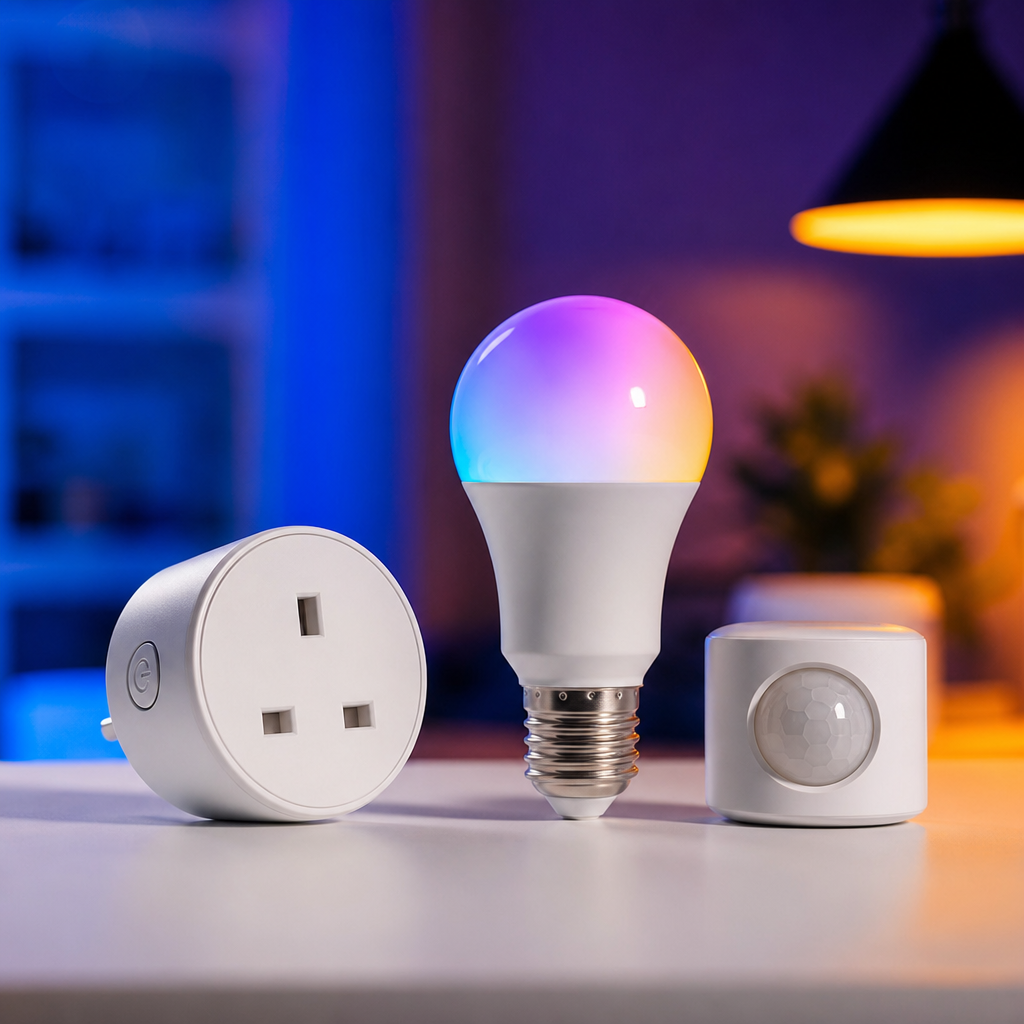
Smart home tech has a funny reputation. Ask most people and they’ll picture a £400 Philips Hue starter kit, a smart speaker on every shelf, and a monthly subscription to make the heating turn itself on. The reality in 2026 is far more accessible than that. Some of the best smart home upgrades you can make cost less than a takeaway for four, and a few of them will actually pay for themselves by cutting your energy bills.
I’ve been adding bits and pieces to our house for years now, and the honest truth is that the under-£50 stuff has made more day-to-day difference than some of the pricier gear. With the Ofgem price cap sitting at £1,641 a year for a typical household from April 2026, and standby power costing the average UK home somewhere between £35 and £86 a year according to the Energy Saving Trust, there’s a genuine case for spending £15 on a smart plug that shows you exactly what your devices are using. Here’s what’s worth your money right now.
Does it actually do something useful, or is it just clever?
This is the first question I ask before anything else. A smart bulb that changes colour is fun for about a week. A smart plug that tells you your old gaming monitor is drawing 40W on standby and lets you cut it with a voice command is genuinely useful every single day. Before buying anything, ask yourself: will this save me time, save me money, or make the house run more smoothly? If the answer is no, walk away.
Does it need a hub, and do you have one?
Some devices, like certain IKEA TRÅDFRI bulbs, use Zigbee and need a hub to unlock their full feature set. Others, like the TP-Link Tapo range, connect directly to your WiFi with no middleman. For most families starting out, WiFi or Matter-based devices are the easier route. Matter, for the uninitiated, is a relatively new smart home standard that lets devices from different brands talk to each other and work locally, so things still function even if the company’s servers go down. It’s worth looking for that logo on the box.
Is it compatible with what you already have?
We’ve got Alexa devices dotted around the house, and that shapes every smart home purchase I make. If something only works with Apple Home or only works with Google, it’s not coming through the front door unless there’s a very good reason. Most decent devices in 2026 support all three, but double-check before you buy. It takes thirty seconds and saves a lot of hassle.
Does it need a subscription to work properly?
This one catches people out. Some smart home gadgets offer basic functionality for free but lock the useful stuff, like energy history or automations, behind a monthly fee. Check before you buy. Everything recommended here works fully without a subscription.
The Picks
TP-Link Tapo P110 Smart Plug with Energy Monitoring
At around £12 to £18 for a single plug, and roughly £8 per plug in a four-pack, the Tapo P110 is the easiest recommendation I can make. It monitors energy in real time, showing you exactly what each device is using, and connects directly to your WiFi with no hub needed. Setup takes under ten minutes. It works with Alexa, Google Home, and Apple Home, and supports Matter for local control. If you want to know which appliances are silently costing you money on standby, start here.
Pro: Genuine energy monitoring at a price that’s hard to argue with. Con: The Tapo app is good but slightly cluttered if you have a lot of devices.
Meross MSS310 Smart Plug
Typically priced between £18 and £25, the Meross MSS310 is the pick if you’re deep in the Apple ecosystem. It works with Alexa, Google Home, and Apple Home, and crucially it supports Matter local control, which means it keeps working even if Meross’s own servers ever go offline. That’s a real differentiator. Energy monitoring is included, the UK plug design is compact, and the app is clean and straightforward.
Pro: Works offline via Matter local control, and plays nicely with all three major ecosystems. Con: Slightly pricier per plug than the Tapo P110 for equivalent functionality.
TP-Link Tapo L530E Smart Bulb
For most people starting out with smart lighting, this is the answer. At £8 to £10 per bulb, it delivers full colour, adjustable white, Alexa and Google Home support, and Matter compatibility, with no hub required. A four-pack for the living room and bedrooms comes in well under £40. One important note for UK buyers: check whether your light fittings use a B22 bayonet cap, which is common in older British homes, or an E27 screw fitting. The Tapo L530E is available in both, so make sure you’re ordering the right one.
Pro: Excellent value, full colour, no hub needed, Matter support included. Con: App can occasionally be slow to respond compared to Hue, though it’s improved significantly.
Nanoleaf Essentials Smart Bulb
Nanoleaf has quietly become one of the stronger smart lighting choices for anyone who cares about future-proofing. The Essentials bulbs use Thread and Matter, which makes them genuinely fast to respond and well-suited to Apple Home in particular. Typically priced under £20 per bulb, they sit above the Tapo range on price but offer noticeably snappier response times and strong cross-platform support. If you’re building a Matter-first setup, these are worth the small premium.
Pro: Thread plus Matter means fast, reliable, and future-proof performance. Con: Costs more per bulb than the Tapo range for broadly similar brightness and colour output.
TP-Link Tapo L535 Smart Bulb
For under £15, the Tapo L535 steps up from the L530E with 16 million colours, Matter-over-WiFi, and native support across Apple Home, Google Home, and Alexa without needing any additional hardware. In testing it matched pricier bulbs on both colour accuracy and brightness. If you want a single bulb that covers all the bases and fits into any smart home setup you might build down the line, this is a very sensible buy.
Pro: Covers all platforms natively, solid colour accuracy, no hub needed. Con: Very similar to the L530E in daily use, so only worth the extra couple of pounds if you’re prioritising Matter.
Worth Considering: IKEA’s Matter Ecosystem and Motion Sensors
If you’re starting from scratch and want a single ecosystem rather than mixing brands, IKEA’s KAJPLATS bulb range and GRILLPLATS smart plug are worth a look. They run on Matter-over-Thread, prices start at just £4 per bulb and £6 for the plug, and everything is controlled through IKEA’s DIRIGERA hub, a one-off purchase that then unlocks IKEA’s whole smart home range including motion sensors. A sensor in the hallway that triggers a light automatically when someone gets up at night is a genuinely useful upgrade for families with kids, and because it all runs on Matter, there’s no cloud dependency or subscription. Tapo’s own T100 motion sensor paired with the Tapo H200 hub does much the same job if you’re already in the Tapo ecosystem, both sit comfortably under £50 each.
Quick Comparison Table
| Model | Price (GBP) | Best For | Verdict |
|---|---|---|---|
| TP-Link Tapo P110 | ~£12–18 | Energy monitoring on a tight budget | Best value smart plug you can buy |
| Meross MSS310 | ~£18–25 | Apple Home users, offline reliability | Top pick for Matter local control |
| TP-Link Tapo L530E | ~£8–10 | First smart bulbs, full colour, no hub | Best starting point for smart lighting |
| Nanoleaf Essentials | Under £20 | Thread/Matter, Apple Home focus | Best for future-proofed lighting |
| TP-Link Tapo L535 | Under £15 | All-platform colour bulb, Matter support | Excellent step-up from the L530E |
Bottom Line
If you’re on a budget and just want to start saving money today, grab a four-pack of TP-Link Tapo P110 plugs and put them behind your TV setup, your washing machine, and anything else that sits on standby. The energy monitoring alone will tell you things you didn’t know about your house.
If you’ve got kids and you want smart lighting that just works without a lot of fiddling, the Tapo L530E four-pack under £40 is genuinely brilliant. Start with the living room, see how you get on, and go from there.
If you’re an Apple household and you want everything to work locally and reliably without depending on anyone’s cloud, the Meross MSS310 and Nanoleaf Essentials are the two to look at. A bit more money, but proper peace of mind.
None of this requires an electrician, a hub, or a weekend of your life. That’s the whole point.
If you found this useful, I round up the best family tech, honest reviews, and no-nonsense buying guides every week. Come and join the Tech Dads Life newsletter at techdadslife.beehiiv.com , no spam, no faff, just the stuff that’s actually worth knowing.