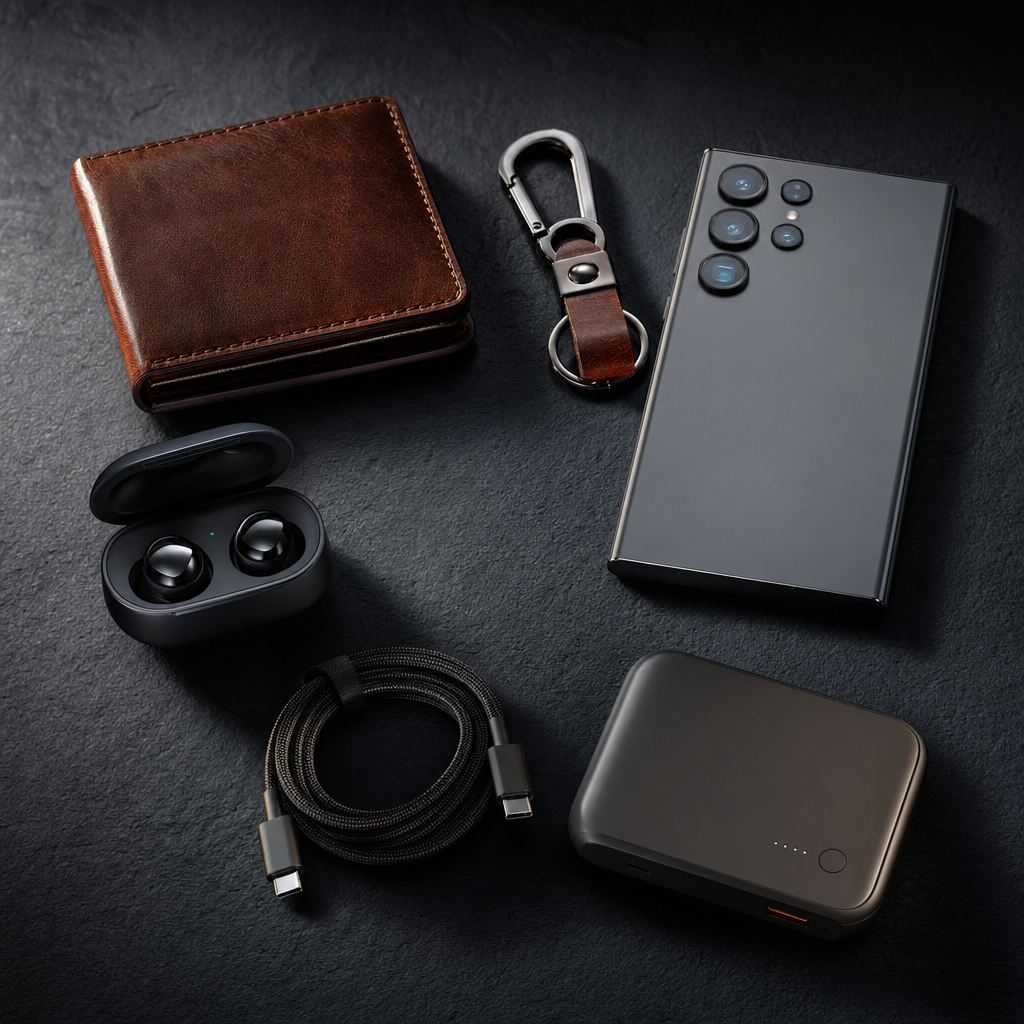
There’s a particular kind of low-level stress that comes from patting your pockets and not immediately knowing where everything is. Phone, keys, wallet. The holy trinity of leaving the house. I’ve been doing some version of that pat-down routine for decades, and at some point it stopped being a habit and started being a system. What goes in my pockets, what clips to my belt loop, what lives in my bag. None of it is accidental any more.
I get asked about this stuff more than you’d expect. Partly because I write about tech, partly because I’m the sort of person who will absolutely spend forty-five minutes researching the best way to carry six cards and a rail pass. Occupational hazard. But also because there’s something genuinely satisfying about getting your everyday carry right. When it works, you don’t notice it. When it doesn’t, you notice it constantly.
So here’s what I’m actually carrying in 2026. Not the fantasy loadout, not the aspirational gear. The real stuff that comes with me every single day and has earned its place.
The Phone: Still the Centre of Everything
The phone is the non-negotiable. Everything else in my kit orbits around it. I’ve been a Samsung Galaxy Ultra man for a few years now and I’m not changing that. The latest Samsung Galaxy Ultra is what I’m running, and it does everything I need from a single device. Camera, navigation, NFC payments, the lot.
For EDC purposes specifically, the Galaxy Ultra earns its place because of the screen size and camera system. I shoot a lot of video with my DJI Osmo Pocket 3 when I’m being deliberate about it, but for quick captures, the kids doing something worth remembering, a sunset on the drive home, a shot of something I want to reference later, the Ultra’s camera is fast and sharp enough that I don’t need to think twice. The S-Pen is also one of those things I didn’t expect to use and now use constantly, mostly for quick sketches when I’m working through a build idea.
It’s not a light phone. I know that. But I’d rather carry one capable device than compromise and end up reaching for something else.
The Wallet: Smaller, Smarter, Safer
This is where I’ve done the most deliberate thinking over the last couple of years. I used to carry a full bifold, stuffed with cards, receipts, and the kind of loyalty cards you forget exist until they fall out on the pavement. That went in the bin.
The 2026 wallet situation is genuinely better than it’s ever been, and the driving force is pretty simple: we’re using cash less, contactless more, and the traditional thick wallet is just friction. I’ve moved to a minimalist card holder and it has been one of those quality-of-life upgrades that sounds small and isn’t.
I’m currently using an Ekster Parliament, which I picked up a while back and have stayed loyal to. The aluminium cardholder that fans your cards out at the click of a button sounds like a gimmick until you’re standing at a ticket barrier at Waterloo with a queue behind you and you need your card in about half a second. It’s also properly RFID-blocked, which matters more than some people realise. The threat of contactless skimming is real, and a wallet that looks metallic isn’t the same thing as one with properly integrated shielding. The Ekster does it properly.
If I were buying fresh today, I’d also seriously look at the Secrid and the Bellroy Slim Sleeve. The Secrid’s card ejector mechanism is elegant and reassuringly solid. The Bellroy is softer, more traditional-feeling leather, and the layout is thoughtful. Wingback is worth a look if you want something British-made and personal. Their full-grain leather and initial engraving options are excellent for a gift too. Not that I’m dropping hints.
Keys and Tracking: AirTag 2 Changes the Game
Keys are the one thing I lose most often. Not frequently, but badly. The kind of lose where you’re running late for a train and you’re turning the house upside down and everyone gets involved and it’s miserable. First-generation AirTags solved most of that for me. The second generation has made it noticeably better.
Apple launched the AirTag 2 at the start of 2026 and while it looks almost identical to the original on the outside, the internals are a meaningful step forward. The new Ultra Wideband chip extends Precision Finding range by up to 50% compared to the first generation, which in practical terms means I can locate my keys from further away before I even need to wander around following the signal. It’s also 50% louder than the previous version, so even when they’ve slipped down the back of the sofa (a regular occurrence), I can hear them from the hallway.
The feature I didn’t expect to value as much as I do is the updated Bluetooth range for general detection. If my keys are somewhere in the vicinity, the Find My network picks them up faster. Combined with Precision Finding on Apple Watch, which the AirTag 2 now supports on Series 9 and later, the whole system is tighter.
One thing worth knowing: AirTag 2 requires iOS 26 or later. If you’re running older software, you’ll want to check compatibility before you buy.
I have one on my keys, one in my main bag, and one in the family car. At around £23 ($29) for a single AirTag, there’s no good reason not to.
The Rest of the Kit: Pen, Light, and the Bag
A few things that round out the daily carry:
I always have a pen. Always. This sounds old-fashioned and I don’t care. There are situations, a contract to sign, a form at the GP, a note for a kid’s teacher, where fumbling for a phone is slower and less professional than just having a pen. I carry a Fisher Space Pen, which is compact, writes at any angle, and won’t dry out if I leave it in my jacket pocket for three months. It’s a boring recommendation that will save you an awkward moment eventually.
I carry a small keychain torch. Again, sounds overkill until you’re in a dark car park at Waterloo at 11pm or helping one of the kids find something under the seat at a campsite. A compact LED keyring torch takes up no room and earns its keep a few times a month.
The bag itself changes depending on the day. On London days, I’m using a slim backpack. On local days, I’m often running with just pockets. But the core four, phone, wallet, keys, AirTag, are always in place before I leave the house, and the pat-down confirms it every time.
Quick Comparison: Minimalist Wallet Options in 2026
| Wallet | Material | RFID Blocking | Card Ejector | Approximate Price | Made In |
|---|---|---|---|---|---|
| Ekster Parliament | Leather + Aluminium | Yes | Yes (button-click fan) | ~£65 | Netherlands |
| Secrid Slimwallet | Leather + Aluminium | Yes | Yes (lever push) | ~£50 | Netherlands |
| Bellroy Slim Sleeve | Full-grain leather | Yes | No | ~£55 | Australia |
| Wingback | Full-grain leather | Some models | No | ~£60–£80 | UK |
Hype Cycle Check
LIKELY TO LAST: Minimalist RFID-blocking wallets. This isn’t a trend. It’s a structural shift driven by declining cash use and rising contactless fraud. The category is only going to grow.
AirTags as key and bag trackers. The Find My network is vast, the hardware is reliable, and the second generation is a genuine improvement. This is mainstream now, not enthusiast gear.
WATCH CLOSELY: Ultra Wideband integration in everyday objects. AirTag 2 shows what UWB can do when it’s implemented well. Watch for this precision-finding capability to spread beyond Apple’s ecosystem into Android and third-party gear.
VAPOURWARE RISK: Smart wallets with built-in displays or NFC pairing to your phone. These have been announced and re-announced for years without landing in a form most people actually want to buy. Until one genuinely ships and holds up to daily use, I’m unconvinced.
CES Angle: What This Means for CES 2027
EDC gear rarely gets the big stage at CES, but the underlying technologies do. At CES 2027, I’d expect to see Ultra Wideband finding its way into more non-Apple products, potentially making precision tracking a cross-platform story rather than an Apple-exclusive one. There are also whispers around next-generation biometric wallet tech, devices that authenticate via fingerprint before releasing your cards. Whether that’s genuinely useful or just clever demo bait remains to be seen. The minimalist and durability angle is real, though. Titanium and carbon fibre in everyday carry items are being taken seriously by manufacturers who previously only sold these to the tactical market. Expect more of that at CES 2027.
What to Watch
- AirTag 2 and iOS 26 rollout. How smoothly Apple handles the compatibility requirements for the new AirTag will determine whether the upgrade cycle plays out as Apple expects or causes friction.
- Android’s equivalent answer to Precision Finding. Google has been improving its network-based tracking tools. Watch for a direct competitor to UWB-based location in the Android ecosystem within the next twelve months.
- Biometric minimalist wallets. A few manufacturers are prototyping fingerprint-authenticated card carriers. One compelling product in this space could change the conversation quickly.
- Contactless fraud in the UK. As card skimming techniques evolve, expect RFID blocking to move from a premium feature to a baseline expectation across all wallet categories.
If you want this sort of thinking delivered to your inbox regularly, the real-world tech decisions, not just the press release version, come and join the Tech Dads Life newsletter. It’s free, it’s worth your time, and I won’t spam you.