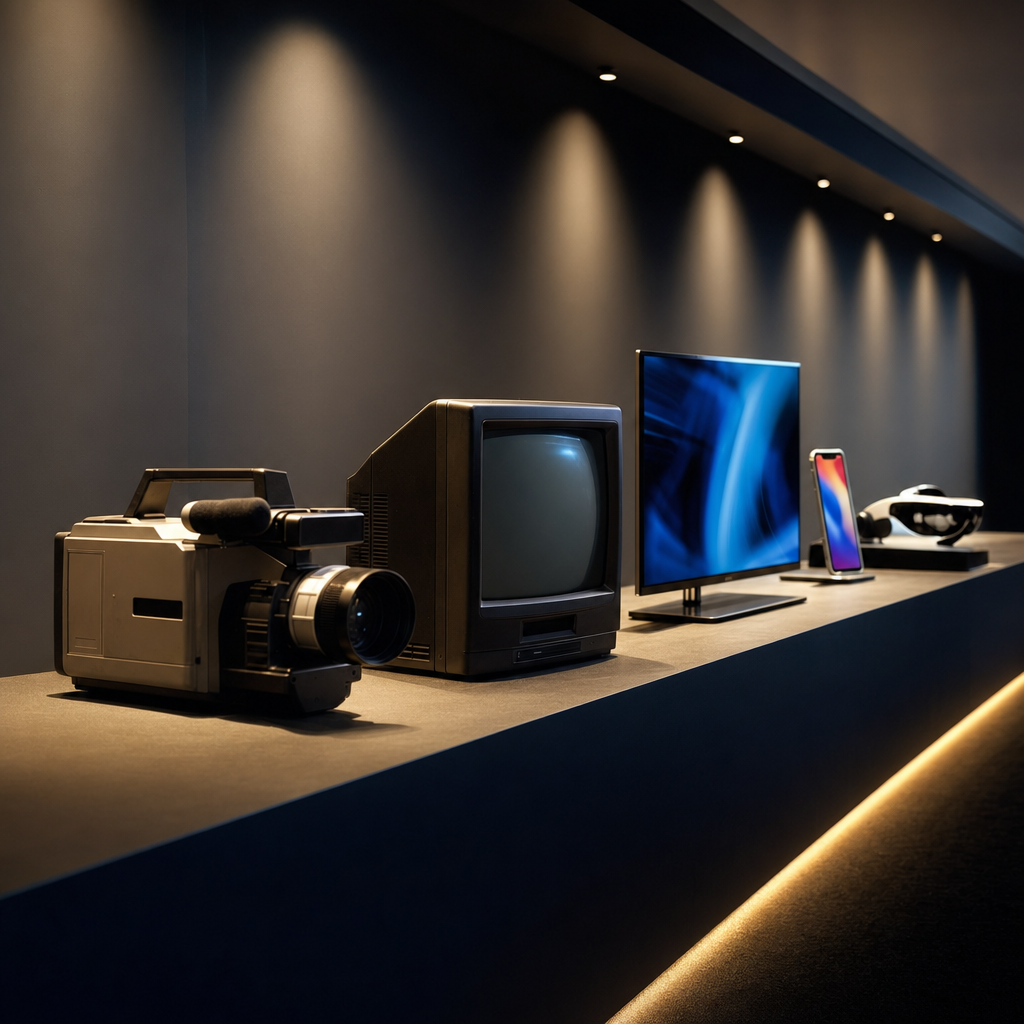
I was helping my eldest sort through some boxes in the loft last weekend when she pulled out a battered old VHS player, held it up like an archaeological artefact, and said, “Dad, what even is this?” My 13-year-old, who had followed us up to avoid homework, genuinely thought it was some kind of printer. I stood there, surrounded by cables and dusty tech relics, and realised that nearly every piece of consumer electronics that had passed through our family’s hands over the decades could trace its big public moment back to one event: CES .
The Consumer Electronics Show has been running since 1967 , and in that time it has served as the launchpad for pretty much every technology that has shaped how families live, work, and play. Some of those products changed the world overnight. Others were quietly revolutionary, taking years to filter into our living rooms and kitchens. Either way, CES has been where the future gets its first proper public outing, and looking back through its history is like flipping through a family photo album of modern technology.
With CES 2027 now very much on the horizon, I thought it would be a good time to walk through the decades, pick out the products and moments that really mattered, and remind ourselves why this show continues to be the one event every tech-curious family should have on their radar.
The Early Years: VCRs, Atari, and the Birth of Home Entertainment (1967–1989)
CES kicked off in New York City in 1967, and the early shows were dominated by the kind of tech that seems almost quaint now. Transistor radios, hi-fi systems, and television sets were the stars. But things got genuinely exciting in the 1970s. The VCR arrived at CES, sparking the legendary VHS vs Betamax format war that would rumble on for years. For families, this was transformative. For the first time, you could record a programme and watch it later. My mum still talks about the day my grandad brought home their first VCR. It cost a fortune, weighed about the same as a small car, and the whole street came round to watch a recording of Coronation Street.
Then came the Atari 2600 in 1977, which essentially created the home gaming industry. CES became the place where gaming companies showed their hand, and by the early 1980s the show floor was packed with consoles and cartridges. The Nintendo Entertainment System (NES) made its North American debut at CES in 1985, arriving at precisely the right moment to rescue the games industry from a catastrophic crash. If you are a parent currently negotiating screen time with your kids, you can trace that particular headache right back to these CES moments.
The CD player also broke through at CES during this era, with Sony and Philips showcasing the technology that would eventually kill off vinyl (temporarily, as it turned out). By the end of the 1980s, CES had established itself as the event where consumer tech went from concept to reality. The template was set.
The Digital Revolution: DVDs, HDTV, and the Connected Home (1990–2009)
The 1990s and 2000s were arguably the golden age of CES product launches. The DVD player was unveiled at CES in 1996, and within a few years it had completely replaced VHS. I remember upgrading our family collection from tapes to discs and my wife asking, quite reasonably, whether we really needed to buy The Shawshank Redemption for the third time. (The answer was yes, obviously.)
HDTV was another CES blockbuster. High-definition televisions had been teased for years, but it was at CES in the early 2000s that they really started to feel attainable for normal families rather than just the wealthy early adopters. Plasma, then LCD, then LED. Each year the screens got thinner, the pictures got sharper, and the prices gradually came down. The progression from a chunky CRT television to a flatscreen you could hang on the wall felt genuinely futuristic at the time.
This era also saw the rise of the connected home. Microsoft’s Bill Gates used CES keynotes throughout the 2000s to paint a vision of a digitally connected household, where your PC, TV, and music system all talked to each other. It sounded far-fetched at the time. Now my 17-year-old controls our entire house from his phone and looks at me with pity when I reach for a light switch.
The Blu-ray format launched at CES in 2006, winning its own format war against HD DVD. TiVo, early smart home gadgets, and the explosion of MP3 players all found their feet on the CES show floor during this period. It was relentless, and for tech enthusiasts it was absolutely brilliant.
The Smart Era: 4K, Wearables, and Voice Assistants (2010–2019)
If the previous two decades were about digitising the home, the 2010s were about making it intelligent. CES 2013 was a watershed moment for 4K television, with multiple manufacturers showing ultra-high-definition panels that made even the best 1080p screens look a bit soft. Today you can pick up a perfectly decent 4K TV for a few hundred quid, but back then they cost thousands and the content to watch on them barely existed. Classic CES, showing you the future before you could actually use it properly.
Wearable technology had its big CES moment in 2014, with fitness trackers and early smartwatches flooding the show floor. Pebble, Fitbit, and Samsung all jostled for attention. Some of those early products were genuinely terrible, with battery life measured in hours and interfaces that made you want to throw them in a river. But they paved the way for the polished wearables we have today. My daughter wears her smartwatch constantly. I am fairly sure she would notice it missing before she noticed me missing.
Then came the voice assistant explosion. Amazon’s Alexa, first shown integrated into the Echo at CES 2015, changed everything. Within two years, the entire CES show floor was “Alexa-enabled this” and “Google Assistant that.” Smart speakers, smart displays, smart fridges, even smart mirrors. The running joke was that CES stood for “Connected Everything Show.” For families, voice assistants were a genuine quality-of-life upgrade, brilliant for setting timers, playing music, and settling arguments about capital cities at the dinner table.
This decade also saw the rise of autonomous vehicle technology at CES, with car manufacturers increasingly dominating the show floor alongside traditional tech companies. CES stopped being just about gadgets and became a broader technology event covering transport, health, agriculture, and more.
The Present and Future: AI, Robotics, and What Comes Next (2020–2027)
The pandemic years disrupted CES significantly, with the 2021 show going fully virtual and 2022 running as a reduced hybrid event. But by 2023 and into 2024 and 2025 , the show had roared back with a clear new focus: artificial intelligence. If 2015 was the year of Alexa, then 2024 and 2025 were the years AI went mainstream at CES. Every product category, from televisions to kitchen appliances, suddenly had an AI angle. Some of it was genuinely useful. Some of it was marketing fluff stuck onto products that worked perfectly fine without it.
Robotics has also taken centre stage in recent shows. Home robots that can fetch items, companion robots for elderly relatives, robotic lawnmowers that actually work properly. As a dad who has spent many reluctant Saturdays pushing a mower around the garden, I can tell you the robotic lawn care demos at CES were the most exciting thing I saw in recent coverage. Transparent displays, rollable screens, and spatial computing have all had their CES moments too, hinting at a future where our relationship with screens becomes far more flexible and immersive.
With CES 2027 now building up, the expectation is that AI integration will go even deeper, sustainable tech will take a bigger share of the show floor, and the line between consumer electronics and other industries will continue to blur. You can find out more and keep track of announcements at https://www.ces.tech .
CES Product Breakthroughs: A Decade-by-Decade Comparison
| Decade | Standout Product | Impact on Families | Still Relevant Today? |
|---|---|---|---|
| 1970s | VCR (VHS) | Time-shifted TV viewing for the first time | Replaced by streaming, but the concept lives on |
| 1980s | NES / Atari 2600 | Created home gaming as we know it | Gaming is now a £150bn+ global industry |
| 1990s | DVD Player | Affordable, high-quality home cinema | Replaced by streaming and Blu-ray |
| 2000s | HDTV / Flatscreen TV | Transformed living rooms worldwide | Standard in every household |
| 2010s | Voice Assistants (Alexa) | Hands-free smart home control | In millions of homes globally |
| 2020s | AI-Integrated Everything | Personalised, adaptive technology | Rapidly expanding across all categories |
Hype Cycle Check: CES Trends Worth Tracking
LIKELY TO LAST: AI integration in everyday products. This is not a fad. The way artificial intelligence is being embedded into televisions, home appliances, and personal devices is only going to accelerate. The products getting it right are genuinely making family life easier, from smart energy management to personalised content recommendations.
WATCH CLOSELY: Home robotics. We have seen promising demos for years, but consumer-grade home robots are now reaching a tipping point where they are actually useful rather than just novelty items. The next two to three years will determine whether they become as common as smart speakers or remain a niche purchase.
VAPOURWARE RISK: Transparent and rollable displays. They look absolutely spectacular on the CES show floor, and every year we are told they are “nearly ready for consumers.” But pricing remains eye-watering and genuine use cases for everyday families are still thin on the ground. I will believe it when I see one in my local Currys at a price that does not require a second mortgage.
The CES 2027 Angle: History in the Making
Every decade, CES produces a handful of products that go on to define how we live. The VCR, the DVD player, HDTV, Alexa. These were not just gadgets. They were inflection points. CES 2027 is shaping up to be another one of those pivotal years, with AI, robotics, sustainable tech, and next-generation displays all converging.
For anyone in the UK who has ever watched CES coverage from afar and thought about experiencing it first-hand, our self-organised UK Meetup is a way to make it happen. You get to walk the same show floor where every major consumer technology breakthrough of the last 50-plus years was first revealed. Whether you are a tech professional, a startup founder, or simply a parent who loves technology and wants to see what is coming next, it is genuinely a chance to watch history being made in person. Head to https://www.ces.tech for all the details as the event builds.
What to Watch: Near-Term Developments
CES 2027 exhibitor announcements. As we get closer to the show, keep an eye on which companies confirm their attendance and what they are teasing. The pre-show period is often just as revealing as the event itself.
AI regulation and its impact on products. Governments around the world are starting to set rules around AI in consumer products. How manufacturers respond will shape what we see on the CES 2027 show floor and what eventually reaches our homes.
The home robotics price war. Several major manufacturers are now competing in the consumer robotics space, and prices are starting to drop. By CES 2027, we could see the first genuinely affordable, multi-purpose home robot aimed at families.
Sustainable tech mandates. Energy efficiency and right-to-repair legislation are pushing manufacturers to rethink product design. Expect CES 2027 to feature a much bigger sustainability angle, which is great news for budget-conscious families who want tech that lasts.
Relive the History, Get Ready for the Future
If this trip down CES memory lane has got you thinking about what comes next, that is exactly what we cover every week at Tech Dads Life. From product reviews and deal alerts to CES previews and honest takes on whether the latest tech is worth your family’s hard-earned money, we keep it real and we keep it useful.
If you want to keep up with all the CES 2027 build-up, UK tech deals, and family-friendly product recommendations, sign up for the Tech Dads Life newsletter and get it all straight to your inbox. No spam, no jargon, just useful tech advice from one dad to another.