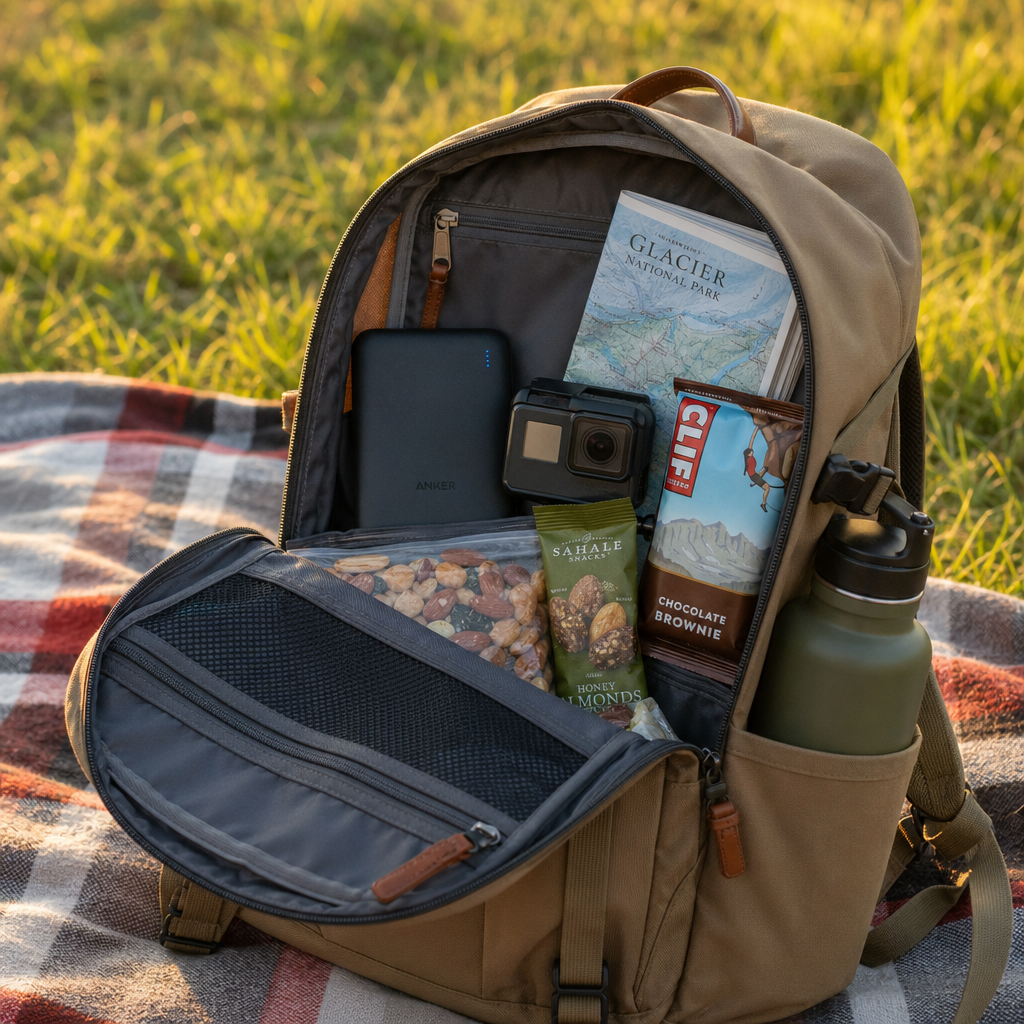
There’s a moment every parent knows. You’ve driven forty minutes to a country park, the sun’s out, the kids are actually in a decent mood, and you reach for your phone to snap a photo of everyone grinning by the gate. Four percent battery. No cable. No power bank. Just the slow, creeping realisation that you’ll be navigating home from memory like it’s 1997. I’ve been that dad. More than once, if I’m honest.
Over the years, I’ve learned that the difference between a brilliant family day out and a mildly stressful one often comes down to what’s in the bag. Not a rucksack full of gadgets, mind you. Just a handful of things that quietly solve problems before they start. The right charger, a decent camera that won’t break if it hits a rock, and an app or two that actually earns its place on your home screen. The rest can stay at home.
So here’s my actual weekend toolkit. Not a fantasy wish list, not a pile of gear you’d need a sherpa to carry. Just the stuff I genuinely pack when we head out as a family, whether it’s a beach trip, a camping weekend, or one of those “let’s just drive somewhere and see what happens” Saturdays in the Tesla.
The Power Bank That Pays for Itself
If you take one thing from this article, let it be this: buy a decent portable charger and keep it in your day bag permanently. I cannot overstate how many minor crises this prevents. Dead phone at a theme park. Kid’s tablet dying on a long drive. Smartwatch gasping for life halfway through a hike.
For most families, a 10,000mAh power bank is the sweet spot. That gives you roughly two full smartphone charges, which is more than enough for a day out. My pick right now is the Cuktech 10 Mini, which comes in at around £25 to £30 and punches well above its weight. It has three ports (two USB-C and one USB-A), charges devices at up to around 40W in practice, and weighs about the same as your phone. It’s genuinely pocket-sized. For context, comparable power banks from Anker or UGREEN often cost £45 to £70 for similar performance, so this is a proper bargain.
One important note: avoid those cheap, no-name power banks you see in petrol stations. They often overstate their capacity and, more seriously, can be a fire risk. Stick to recognised brands. If you’re flying abroad this summer, both 10,000mAh and 20,000mAh banks fall comfortably under the 100Wh airline limit, so you can pack them in hand luggage without drama.
If your family is deeper into the Apple ecosystem and you want something that magnetically snaps onto an iPhone, the Anker MagGo Power Bank (10K, Slim) is excellent. It’s the fastest MagSafe power bank I’ve seen tested, charging an iPhone in under two hours. At around £50 to £56 it’s pricier, and it only works with iPhone 12 and later, so it’s no good for Android. But the convenience of wireless magnetic charging while you’re walking around is genuinely useful.
An Action Camera That Survives Your Kids
I own a Nikon D800, and I love it. But I am not bringing it to the beach. Not with sand, sea spray, and a thirteen-year-old who treats every outing like an obstacle course. For family days out, an action camera is the better tool. It’s small, tough, waterproof, and shoots video that’s good enough to make you look like you know what you’re doing.
My recommendation for most families is the DJI Osmo Action 5 Pro. It’s currently around £265 in the UK following the launch of the newer Action 6, and at that price it’s outstanding value. The battery lasts around four hours, which is a genuine game-changer. Most action cameras need a spare battery swapped in after ninety minutes or so. Four hours means you can film an entire day out without thinking about it. It’s waterproof to 20 metres without any additional case, so it handles pools, rivers, and beach days without fuss. The dual touchscreens make it easy for kids to use too, and it shoots 4K at 120fps if you want those slow-motion clips of someone falling off a paddleboard.
If you want the latest and greatest, the DJI Osmo Action 6 launched in November 2025 at £329. It has a larger sensor and a clever variable aperture lens, which improves low-light performance noticeably. For most weekend use, though, the Action 5 Pro at that reduced price is the smarter buy.
The GoPro Hero 13 Black is the other serious contender, currently selling for around £270. It shoots 5.3K video and has a modular lens system that’s impressive if you’re into creative filming. But for pure family practicality, DJI’s longer battery life and superior waterproofing win out on the days that matter most.
The Free App That Replaces Everything
Here’s one that costs absolutely nothing. Google Maps offline downloads. Before any trip, I spend thirty seconds downloading the map for the area we’re heading to. This means navigation works even when signal drops to nothing, which happens more often than you’d think in the countryside, on coastal paths, or at campsites in Wales where 4G is apparently still a rumour.
On Android (which I use daily on my Samsung Galaxy Ultra), you tap your profile picture in Google Maps, select “Offline maps,” and draw a box around the area you need. Done. On iPhone it works the same way. The downloaded map includes driving directions, points of interest, and even some business information. It’s saved us on camping trips where the nearest town was twenty minutes away and the signal was nonexistent.
For proper hiking and walking, I’d also mention OS Maps from Ordnance Survey. The free version gives you basic route planning, but the premium subscription unlocks the full suite of detailed OS maps on your phone. If you do regular walks with the family, it’s worth looking into. The detail on footpaths, contour lines, and terrain is leagues ahead of Google Maps for off-road navigation.
The Bits That Round Out the Bag
Beyond the headline items, there are a few small additions that have earned a permanent place in my day bag through sheer usefulness.
A short, braided USB-C cable lives in the side pocket at all times. Not one of those flimsy ones that came free with something. A proper braided cable that won’t snap after three uses. I bought a multipack of Anker USB-C cables about a year ago and they’ve been indestructible.
A dry bag. Nothing fancy, just a cheap roll-top waterproof bag that fits a phone, wallet, and car key. For beach days and river walks, this removes about ninety percent of the anxiety. You can pick one up for under a fiver and it packs down to almost nothing.
And finally, a decent Bluetooth speaker. We’ve got a JBL Clip that hooks onto a rucksack strap. It’s not going to fill a festival tent with sound, but for a picnic or sitting around a campsite in the evening, it’s perfect. Waterproof, surprisingly loud for its size, and the battery lasts longer than our patience for setting up tents.
What’s Worth Packing vs. What Stays Home
| Item | Pack It? | Why |
|---|---|---|
| 10,000mAh power bank | ✅ Always | Two full phone charges, pocket-sized, solves most battery emergencies |
| Action camera | ✅ Most trips | Waterproof, tough, captures memories without risking expensive gear |
| Offline maps (Google Maps) | ✅ Always | Free, works without signal, essential for rural areas |
| Short USB-C cable | ✅ Always | Weighs nothing, prevents “wrong cable” disasters |
| Dry bag | ✅ Beach/water days | Protects phone and keys, costs under a fiver |
| Bluetooth speaker | ✅ Camping/picnics | Adds atmosphere without bulk |
| Laptop | ❌ Leave it | It’s a day out, not a co-working retreat |
| Full camera kit | ❌ Usually | Too heavy, too fragile, too stressful around water and sand |
| Drone | ❌ Most places | Restrictions everywhere, setup takes too long, kids get bored waiting |
| Tablet | ⚠️ Long drives only | Useful for car journeys, deadweight once you arrive |
Hype Cycle Check
LIKELY TO LAST: Compact power banks with USB-C and 30W+ charging. These are now essential everyday carry, not luxury items. The prices keep dropping and the quality keeps improving. This category is mature and here to stay.
WATCH CLOSELY: AI-powered trip planning apps. Google and Apple are both building smarter itinerary features into their maps platforms. The promise of “tell me what’s good for kids within thirty minutes of here” is close to being genuinely useful, but not quite reliable enough to trust blindly yet.
VAPOURWARE RISK: Smart glasses as a family camera replacement. Every year at CES someone pitches AI-enabled glasses that can record your day hands-free. Every year the battery life is terrible, the video quality is mediocre, and they cost more than a decent action camera. We’re not there yet.
What This Means for CES 2027
Having walked those Las Vegas show floors more times than I can count, I can tell you the “portable power” and “outdoor tech” categories get bigger every year. For CES 2027, I’m expecting to see more solar-integrated power banks aimed at the camping and festival market, action cameras with genuinely useful on-device AI editing (trim, stabilise, and share without touching a phone), and possibly some interesting developments in mesh communication devices that work without mobile signal. The family outdoor tech space is quietly becoming one of the most practical categories at the show, and I’ll be keeping a close eye on it.
What to Watch
DJI Osmo Action 5 Pro price drops. With the Action 6 now on shelves, expect the Action 5 Pro to dip below £250 through the summer. That would make it an absolute steal for family use.
USB-C becoming truly universal. The EU mandate is pushing every device towards USB-C, which means one cable and one charger for almost everything in the bag. We’re nearly there.
Ordnance Survey app improvements. OS Maps has been steadily adding features including better route sharing and live tracking. If they nail a family group tracking feature, it could become essential for hiking families.
Google Maps AI recommendations. Google is testing AI-curated “family-friendly” suggestions in Maps. If this rolls out properly in the UK, it could replace the twenty minutes of searching I currently do in the car park when we arrive somewhere with no plan.
One Last Thing
I write about tech for a living and I genuinely love this stuff. But the honest truth about family days out is that the best moments usually happen when everything is in the bag and the phones are in pockets. The power bank’s job is to make sure you can take a photo when it matters, check the map when you’re lost, and then put it all away again. The tech should be invisible. If you’re spending more time fiddling with gadgets than watching your kids try to skim stones or arguing about who gets the last sausage roll, you’ve packed too much.
Keep it simple. Charge the power bank the night before. Download the map. Bring the action camera if you feel like it. Then just be there.
If you want more of this sort of thing, practical tech advice for real families without the jargon, sign up for the Tech Dads Life newsletter at https://techdadslife.beehiiv.com/ . No spam, no nonsense. Just useful stuff, delivered to your inbox.