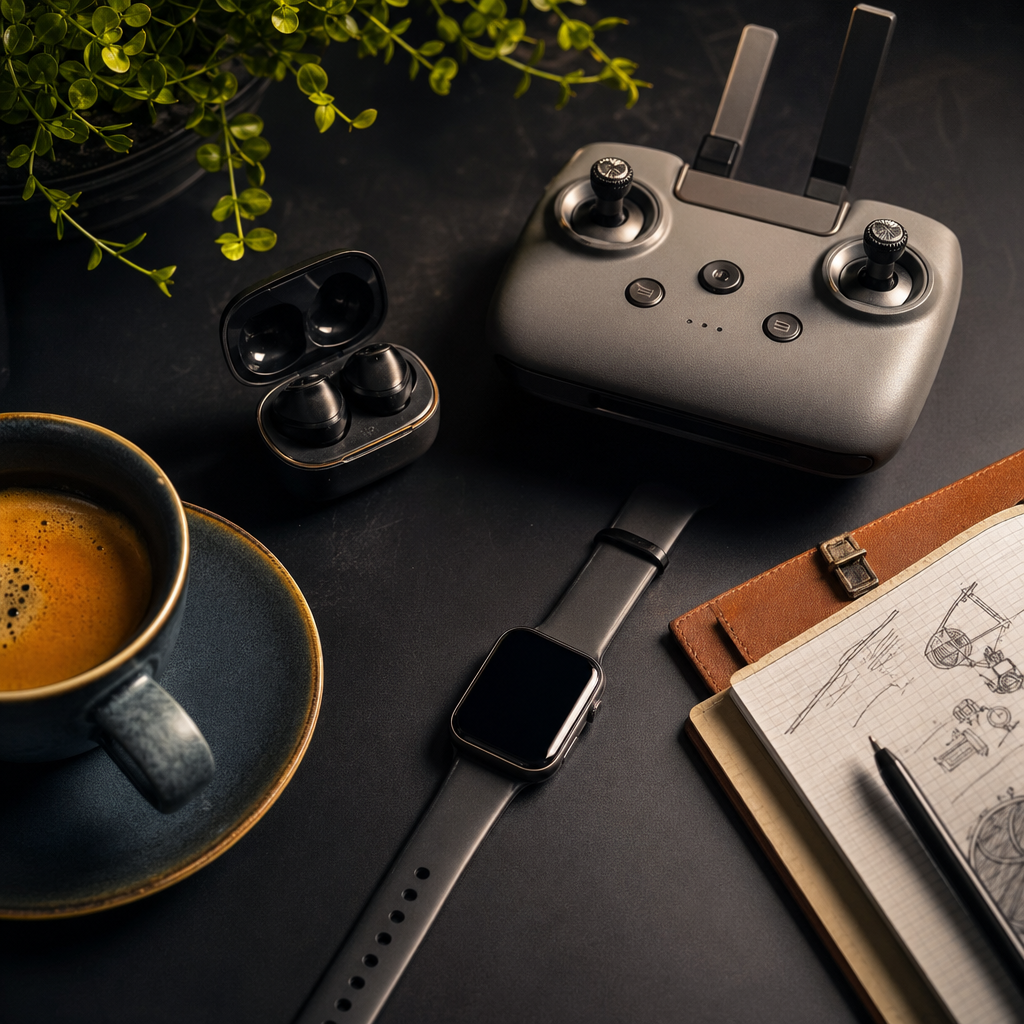
You know that feeling when you’re supposed to be doing something useful, like hanging out the washing or fixing the bathroom tap that’s been dripping since February, but instead you’re sat on the sofa at 11pm watching a YouTube video about a tiny speaker for the fourth time? That’s been my month. Not one thing, but a whole collection of tech, gadgets, and ideas that have lodged themselves firmly in my brain and refuse to leave.
I’m not reviewing any of this stuff. I haven’t been sent anything. Nobody’s paying me to talk about it. This is just the honest list of things that have genuinely captured my attention over the past few weeks. Some of it I want to buy. Some of it I want to build. And one item on this list is winding me up so much I had to include it just to get it off my chest. Consider this my monthly brain dump, served with a cup of tea and zero filter.
So here we go. Five things living rent-free in my head this month, in no particular order.
1. The IKEA Kallsup: A Bluetooth Speaker That Costs Less Than a Pint
I’ve been to CES about eight times now, and I’ve seen some genuinely wild product launches. But IKEA turning up for their very first appearance at the show and casually dropping a £10 Bluetooth speaker? That caught me off guard. The Kallsup is a tiny cube, about 7cm on each side, runs Bluetooth 5.3, charges over USB-C, and gives you roughly nine hours of playback at half volume. Those are perfectly respectable specs for something that costs the same as a meal deal.
But here’s the bit that’s been rattling around my head. You can pair up to 100 of them together. No app. No PIN. No fiddly configuration. Just press a button and they link up. The idea of scattering a dozen of these around the garden for a barbecue, or dotting them around the house for a party, is genuinely appealing. Sound quality has been compared to a second or third-generation Echo Dot Mini, which for ten quid is more than acceptable.
I keep thinking about buying, say, five of them. One for the garage next to the 3D printer. One for the kitchen. A couple for outside when the weather cooperates. And one for my youngest’s room, because he’s currently using his phone speaker like some kind of animal. The replaceable battery is a nice touch too. At this price point, most companies would make the whole thing disposable. IKEA didn’t. I respect that. Three colours available: pink, white, and yellow-green. I suspect the white ones will sell out first.
2. The Pebble Round 2: A Smartwatch That Knows When to Shut Up
I have a complicated relationship with smartwatches. I’ve owned several. I’ve liked exactly none of them for more than a month. The constant notifications, the charging every night, the feeling that my wrist is just another screen demanding attention. So when I read that Eric Migicovsky, the original Pebble creator, was bringing back the Pebble Round with a deliberate “intentionally less” philosophy, something clicked.
The Pebble Round 2 runs a colour e-paper display at 260x260 pixels, sits in a stainless steel body that’s only 8.1mm thick, and lasts 10 to 14 days on a single charge. Ten to fourteen days. Let that sink in while you’re plugging your Apple Watch in for the third time this week. It doesn’t have a heart-rate sensor. No GPS. No NFC. No speaker. It does step tracking, sleep tracking, and notifications. That’s roughly it.
And honestly? That might be exactly what I want. A watch that tells me the time, shows me a notification when something actually matters, and then leaves me alone. It runs open-source PebbleOS, works with both Android and iOS, and comes in matte black, brushed silver, or polished rose gold. At $199 (around £160), it’s positioned well below the premium smartwatch crowd. Shipments from Asia aren’t subject to US tariffs, and all duties are prepaid, which is a nice touch for international buyers.
Fair warning though: production is expected to begin late May, with first shipments now pushed to July 2026. So if you preorder, patience is required. But the concept itself, a smartwatch that’s deliberately not trying to replace your phone, feels like it belongs in 2026. Digital minimalism isn’t just a trend any more. It’s a survival strategy.
3. Samsung’s Tri-Fold Phone: Impressive, Impractical, and I Can’t Look Away
Samsung showed off the Galaxy Z Trifold outside Asia for the first time at CES 2026, and I’ve been going back and forth on it ever since. The concept is straightforward enough. It’s a phone with a 6.5-inch screen that unfolds twice to become a 10-inch tablet. That transition is genuinely impressive. There’s even a clever alert system that sounds if you try to fold it the wrong way, which tells you everything you need to know about the engineering complexity involved.
It already went on sale in Korea, where it sold out quickly. No UK price or release date has been announced yet, but given that the Galaxy Z Fold7, which only folds once, starts from around £1,800, it’s safe to assume we’d be looking at well north of two grand. That’s a lot of money for something I’d be terrified of handing to one of my kids.
And yet, I can’t stop thinking about it. Not because I want to buy one. I genuinely don’t, not at that price. But because it represents a question I find fascinating: what is a phone supposed to be in 2026? Are we heading towards a future where everyone carries a pocket tablet? Or is this a solution looking for a problem? I commute into London sometimes, and the idea of unfolding a full tablet screen on a packed SWR train from Farnborough to Waterloo is both appealing and hilariously impractical. Someone would elbow it within thirty seconds.
Still, the form factor is bold. Samsung deserve credit for pushing boundaries, even if the price puts it firmly in “look but don’t touch” territory for most families.
4. My Ongoing Frustration with Mesh WiFi and Smart Home Devices
Right, this one isn’t a shiny new product. It’s a grumble. But it’s been living in my head rent-free, so it qualifies.
I run a Deco X60 and Deco M5 mesh network at home. It works well for normal stuff. Laptops, phones, streaming, gaming. No complaints there. But I’ve been adding more smart home devices recently, and the experience of getting certain gadgets to play nicely with a mesh network is still, in 2026, far more painful than it should be.
Some devices insist on connecting to the 2.4GHz band but can’t find it because the mesh network presents a single SSID. Others drop off randomly and need a full reset. One particular smart plug, which I won’t name because I’m still trying to make it work, has been set up from scratch four times this month. Four times. I’ve spent more time configuring that plug than I have actually using whatever it’s plugged into.
The broader issue is that smart home manufacturers still assume everyone has a simple single-router setup. Mesh networks have been mainstream for years now. The fact that setup processes don’t account for them properly is genuinely frustrating. If you’re a smart home product maker reading this, please, for the love of everything, test your gear on mesh networks before shipping it. Rant over. For now.
5. Local AI Getting Genuinely Useful at Home
This last one is less about a specific product and more about a shift I’ve noticed in my own habits. I’ve been running local AI setups at home for a while now, using Ollama and LM Studio to self-host large language models. For months, it was mostly a tinkering project. Fun to set up, interesting to play with, but not something I actually relied on day to day.
That’s changed this month. I’ve started using local models for real tasks. Drafting emails. Summarising long documents. Helping with research structure. Even generating quick scripts for automation around the house. The models have improved enough, and my Mac Mini M4 handles them well enough, that it’s become a genuine tool rather than a novelty.
What I love about running it locally is the privacy. Nothing leaves my network. No subscriptions. No data being harvested. For a family with three kids at various stages of education, having an AI assistant that works offline and costs nothing beyond the initial hardware is incredibly valuable. It’s not perfect. The responses can be slower than cloud-based alternatives, and the models aren’t as capable as the biggest commercial offerings. But for everyday tasks? It’s more than enough.
I think 2026 is the year local AI goes from hobbyist curiosity to practical household tool. If you’ve got a reasonably powerful machine and a bit of patience for setup, it’s worth exploring.
Comparison: This Month’s Rent-Free Tech at a Glance
| Item | Category | Price | Excitement Level | Likelihood I’ll Buy It |
|---|---|---|---|---|
| IKEA Kallsup | Bluetooth Speaker | £10 | High | Almost certain |
| Pebble Round 2 | Smartwatch | ~£160 ($199) | Very High | Waiting for reviews |
| Samsung Galaxy Z Trifold | Smartphone | TBC (likely £2,000+) | Fascinated | Not a chance (yet) |
| Mesh WiFi + Smart Home | Frustration | N/A | Annoyed | Already own it, sadly |
| Local AI at Home | Software/Trend | Free (with hardware) | Growing | Already doing it |
Hype Cycle Check
LIKELY TO LAST: Local AI running on home hardware. The models are improving rapidly, the hardware is getting cheaper, and the privacy argument only gets stronger. This isn’t going away. The IKEA Kallsup approach of ultra-affordable, multi-pairing Bluetooth speakers also feels like a category that will grow.
WATCH CLOSELY: The Pebble Round 2 and the broader digital minimalism movement. The appetite is clearly there, but execution matters. Shipping delays are already a concern, and the smartwatch market is brutal. If Core Devices can deliver on time and the software experience holds up, this could carve out a loyal niche.
VAPOURWARE RISK: The Samsung tri-fold form factor becoming mainstream anytime soon. The engineering is real and the product exists, but the pricing and durability questions mean this stays a luxury curiosity for at least another generation or two. Most families aren’t spending over two grand on a phone that folds three ways.
What This Means for CES 2027
CES 2026 gave us IKEA’s first ever appearance and Samsung’s tri-fold reveal, both of which are still generating conversation months later. For CES 2027, I’m expecting the ultra-affordable audio space to explode. If IKEA can do a decent Bluetooth speaker for a tenner, every competitor will be scrambling to match it. I’d also expect to see more “intentionally simple” tech on the show floor. The Pebble Round 2 philosophy of doing less on purpose resonates with a growing audience tired of feature bloat. And local AI hardware? I’d bet good money that CES 2027 has an entire section dedicated to home AI appliances that run models locally. The building blocks are already here. Someone just needs to package them for normal people.
What to Watch in the Coming Months
IKEA Kallsup real-world reviews. CES demos are one thing. How does it actually sound in a garden with ambient noise? And does the multi-pairing feature work reliably beyond a dozen units? I want someone to try all 100.
Pebble Round 2 shipping updates. The July 2026 target is the current estimate, but water resistance testing is still pending. If you’ve preordered, keep an eye on the rePebble.com site for production updates.
Samsung UK pricing for the Galaxy Z Trifold. No official UK launch details yet. When pricing drops, we’ll know whether Samsung is positioning this as a mainstream product or an aspirational halo device.
Smart home manufacturers improving mesh network compatibility. I’m watching for firmware updates and new product launches that specifically address mesh WiFi setups. It’s 2026. This should be solved by now.
That’s my brain this month. Five things I didn’t ask to think about, but here we are. Some exciting, some frustrating, all genuinely occupying my attention.
Now I want to hear from you. What’s living rent-free in your head this month? A gadget you’ve seen? An app you can’t put down? A piece of tech that’s driving you up the wall? Drop a comment below. I’m always looking for the next thing to obsess over.
And if you want this kind of stuff landing in your inbox every month, along with honest takes on the tech that actually matters to families, sign up for the Tech Dads Life newsletter at techdadslife.beehiiv.com . No spam. No fluff. Just a dad who can’t stop thinking about speakers the size of a Rubik’s cube.