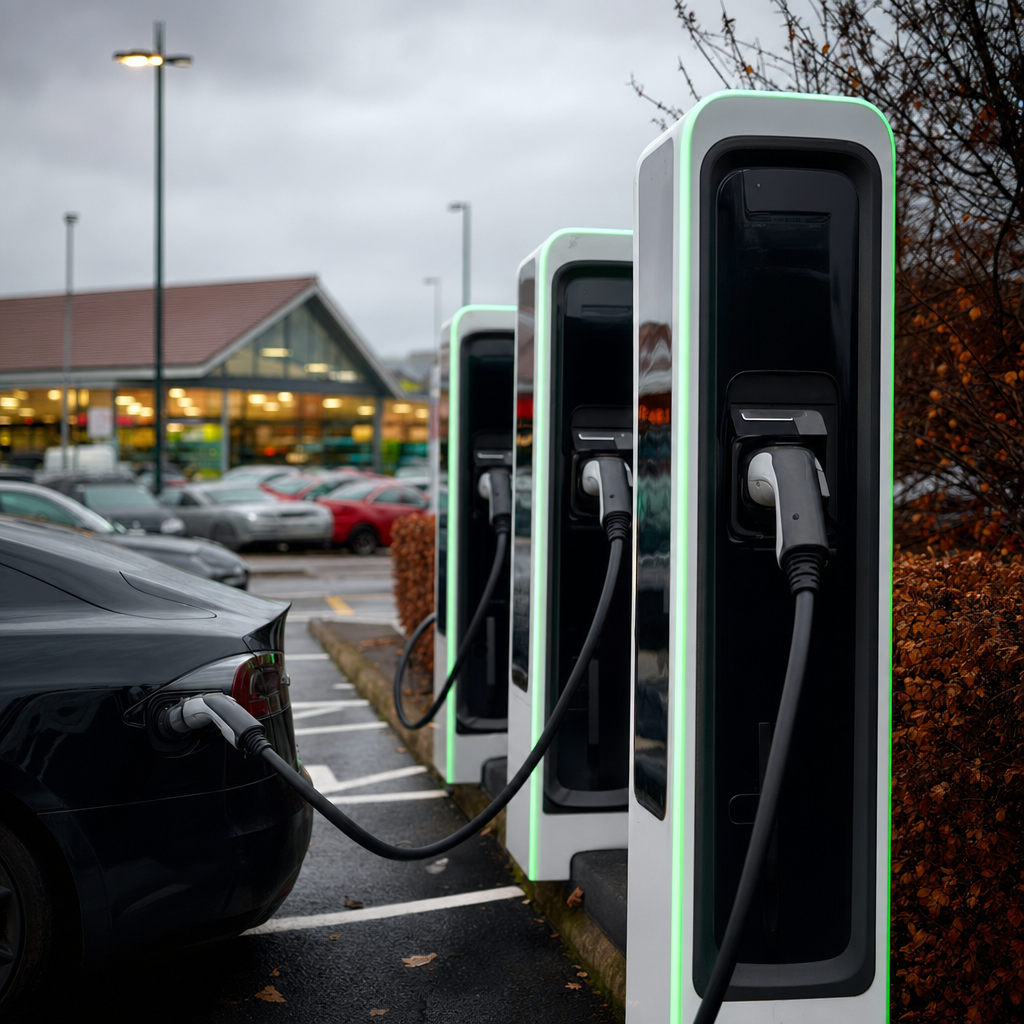
I drive a Tesla Model 3, and I have a wall charger in the garage. For day-to-day life, that means I plug in at home, wake up to a full battery, and the whole public charging debate feels fairly distant. But it does not stay distant for long. Family road trips, the odd longer drive up to London, or simply ending up somewhere I did not plan to be with 18% battery left, and suddenly the state of the UK’s public charging network becomes very personal, very quickly.
Last summer we drove down to the coast for a few days away. I had planned the route, checked the chargers, and felt smugly prepared. One of the rapid chargers I had lined up was out of service. The backup was operational but only accepted a specific app I had not registered with. By the time we sorted it, I had spent longer fussing about charging than I had actually charging. The car was fine. My patience was not.
So when I decided to take a proper look at the state of the UK’s public EV charging network in 2026, I did it with that experience in mind. Not as someone who hates EVs, because I genuinely do not. But as someone who wants the infrastructure to be as good as the cars that depend on it. Here is what the numbers actually say.
The Network Is Growing Fast. But Fast Enough?
Let us start with the headline figure, because it is genuinely impressive. As of March 2026, there are 119,080 public EV chargers across the UK, spread across 46,107 locations. At the end of 2024 that number sat at around 102,771, and it climbed to 116,052 by the end of 2025. That is 13% growth in a single year, and the ultra-rapid end of the market is moving even faster. In 2025 alone, 3,425 ultra-rapid chargers (those running at 150kW or above) were added to the network, representing a 40% year-on-year increase. That is not nothing.
The government has set a target of 300,000 public charge points by 2030, and the National Audit Office said in late 2024 that the rollout was on track. Whether 300,000 is the right number for 2030 is a separate debate, but the trajectory is moving in the right direction.
One thing worth clarifying: the Department for Transport changed its reporting metric in 2026, moving from counting “charging devices” to counting individual “EV chargers” (EVSE). That is actually a more useful measure because it counts how many vehicles can be charged simultaneously, rather than how many units are installed. It does mean older figures and newer ones are not always directly comparable, so if you see different numbers floating around, that is usually why.
What the raw growth figures do not tell you is where those chargers are. Motorway services and urban centres have seen the biggest gains. Rural Hampshire? Still patchy in places. That is an ongoing problem that raw national totals conveniently obscure.
Reliability: Better Than It Was, Still Not Good Enough
Here is where things get more complicated. Driver satisfaction has improved. The average score in 2025 was 69 out of 100, up 5 points from 2024, and 61% of EV drivers said they felt the public charging infrastructure had improved over the past year. On the surface, that sounds encouraging.
Dig into the detail, though, and it is a more mixed picture. Four in ten drivers surveyed by Which? said they had personally experienced a non-working charger. That is not a niche, edge-case problem. That is nearly half of all EV drivers reporting direct, personal experience of a failed charger.
The Public Charge Point Regulations 2023 (PCPR) introduced mandatory reliability standards that came into force in November 2024. From that point, all rapid chargers running at 50kW or above must maintain an average 99% reliability score across the course of a year, and operators are required to report that data publicly and submit an annual report from January 2026. Penalties for non-compliance can reach £10,000 per charge point, rising to £250,000 for businesses that deliberately obstruct enforcement.
Whether those penalties are being applied with any real bite remains to be seen. Annual reliability reports are only beginning to emerge. But the framework exists now, which is more than we could say two years ago.
The 24/7 helpline requirement is a welcome addition too. Knowing you can call someone when a charger fails at 10pm on a wet Tuesday in a motorway services somewhere is more reassuring than you might think.
App Chaos and the Payment Problem
If reliability is the first frustration, the payment and app experience is the second. Arguably, it is the one that causes more low-level daily aggravation. The numbers are damning. Payment is the single largest complaint theme in EV charging app reviews, appearing in 25% of all reviews. Payment satisfaction has dropped 19 percentage points since 2023, falling from 54% to just 35%.
Around eight in ten EV owners have said they want to be able to pay by bank card, which is a completely reasonable expectation in 2026. The PCPR mandated contactless payment on all new 8kW+ charge points and existing 50kW+ rapid chargers from November 2024. The contactless readers are appearing. The problem is they are not always working. Since the deadline, 85% of reviews mentioning contactless are complaints rather than praise. The hardware is there. The reliability of it is not yet matching the ambition.
Roaming is also a piece of this puzzle. From November 2025, charge point operators were required to connect via at least one roaming provider, meaning drivers could theoretically access multiple networks through a single account. Partnerships like Zest and Octopus Electroverse are exactly the kind of integration that makes this workable in practice. But the roaming deadline only passed in November 2025, which is too recent for the full effect to have bedded in. It is the right direction. It is just not done yet.
Most EV drivers I know still carry multiple apps. I have three on my phone. That should not be the answer in 2026.
Comparing the Major UK Public Charging Networks
| Network | Ultra-Rapid Available | Contactless Payment | Roaming Support | App Required |
|---|---|---|---|---|
| Gridserve Electric Highway | Yes | Yes | Yes | Optional |
| BP Pulse | Yes | Yes | Yes | Optional |
| Pod Point | Some locations | Yes | Partial | Recommended |
| Osprey | Yes | Yes | Yes | Optional |
| Zest | Yes | Yes | Yes | Optional |
| Char.gy | Varies | Some | Partial | Sometimes |
Note: Network capabilities change frequently. Always verify before travelling on unfamiliar routes.
Hype Cycle Check
LIKELY TO LAST: Ultra-rapid charging hubs at motorway services are here to stay, and the growth trajectory is real. The regulatory framework the PCPR introduced creates genuine teeth for accountability. Reliability reporting obligations and financial penalties are the right mechanisms, even if enforcement rigour is still developing.
WATCH CLOSELY: Roaming and cross-network payment integration. The legal requirement is in place, but the practical experience has not yet caught up. If roaming genuinely works seamlessly by the end of 2026, that would be a meaningful shift. If it stays patchy, fragmentation remains the dominant story.
VAPOURWARE RISK: The 300,000 charge points by 2030 target is credible in terms of trajectory, but quantity and quality are different conversations. Adding 180,000 more chargers that are unreliable, poorly located, or locked behind app wallets does not solve the problem. The risk is a headline number being hit while the underlying user experience stays mediocre.
CES Angle: What This Means for CES 2027
CES 2027 is already shaping up to be heavily EV-adjacent. Smart charging infrastructure, vehicle-to-grid (V2G) technology, and integrated payment platforms are all expected to feature. What the UK’s public network story tells us is that the technology is not really the bottleneck anymore. A 150kW charger is a solved problem. The unsolved parts are payments, reliability, and the fragmented app layer sitting on top of the hardware. Expect CES 2027 to bring announcements around unified charging platforms, AI-driven network monitoring for predictive maintenance, and more V2G demonstrations. Whether any of it reaches UK motorway services by 2028 is a different matter entirely.
What to Watch
Annual reliability reports from CPOs. January 2026 marked the first deadline for operators to submit their PCPR reliability data. What those reports actually show, and whether any enforcement action follows, will tell us a lot about whether the 99% target is real or theoretical.
Roaming adoption in practice. The November 2025 roaming deadline passed. Watch for user experience feedback through 2026 to see if the single-account, multi-network promise is actually working at the charger.
Rural and regional rollout. National totals are growing healthily. Whether that growth is reaching smaller towns, rural areas, and less commercially attractive locations is a much more meaningful measure for most families.
V2G and smart home integration. Bidirectional charging is beginning to appear in the UK market. Once that links properly to home energy systems and smart tariffs, the economics of EV ownership change considerably.
If you found this useful, there is plenty more where it came from. I cover EVs, home tech, and everything in between over at the Tech Dads Life newsletter. No spam, just genuinely useful reads for people who actually use this stuff rather than just read about it. Sign up at https://techdadslife.beehiiv.com/ and join a few thousand others who like their tech straight-talking and dad-approved.
Products worth having for public charging peace of mind: