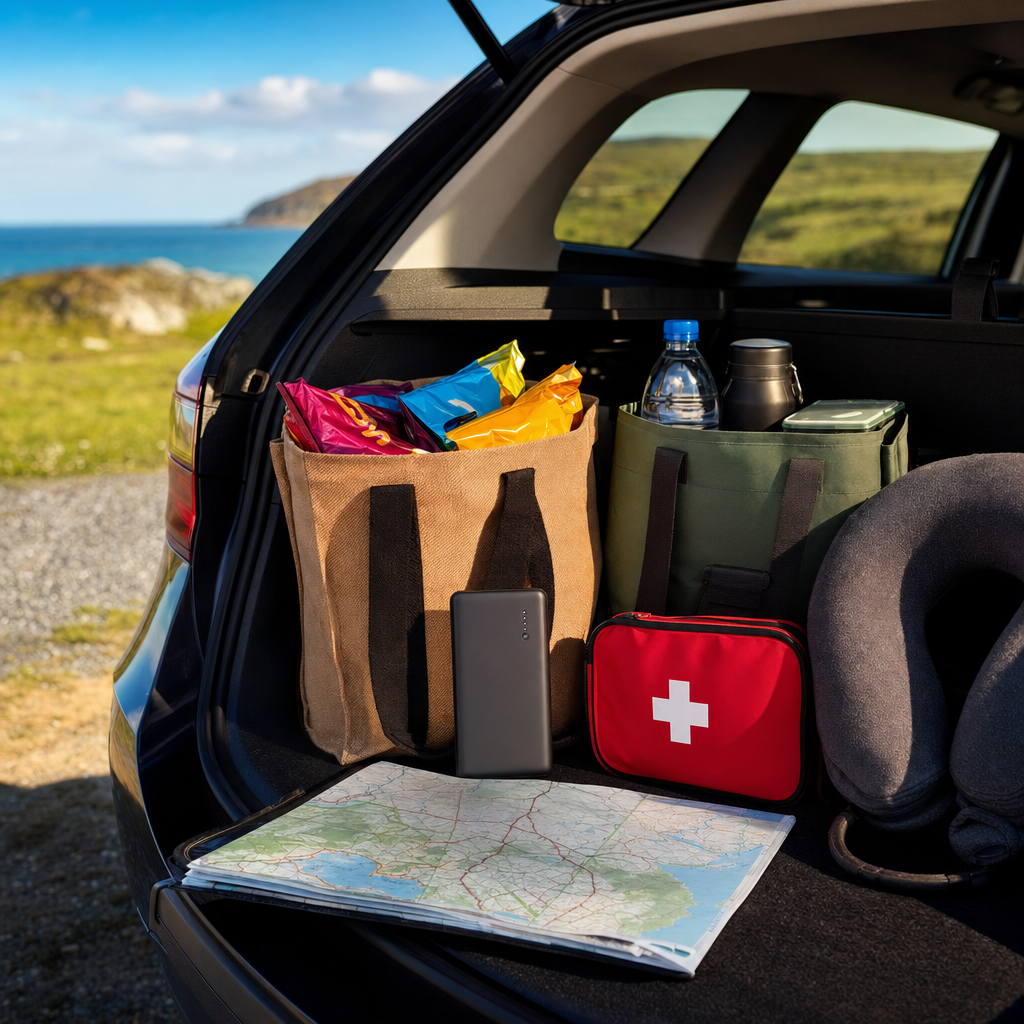
There’s a moment every family road trip has. You’re twenty minutes down the motorway, the kids are already bored, someone needs a wee, and you’re quietly wondering whether you remembered to pack the thing that definitely would have saved you last time. I know this feeling well. After years of loading up the Tesla with three kids, a boot full of camping gear, and enough snacks to survive a minor apocalypse, I’ve gone from winging it to having a proper system. Not a laminated checklist on the fridge (although, honestly, not far off), just a solid, road-tested packing routine that means we actually enjoy the journey rather than spend it firefighting.
This isn’t a generic “don’t forget your passport” list. This is what we actually pack, what’s genuinely saved us, and the stuff I used to throw in the car that’s now stayed home for years.
Before You Even Think About Packing
Before anything goes in the boot, the car itself needs to be sorted. Check your MOT is valid, your tax is up to date, and your insurance covers the trip. If you’ve got breakdown cover, make sure the number is in your phone. The Highway Code is straightforward on this: before any journey, you should carry out basic vehicle checks, make sure you have enough fuel or charge, and have a charged mobile with emergency numbers on it. That last one sounds obvious, but it’s worth saying.
Also worth flagging if you’re heading through Wales or Scotland: 20mph zones have been rolling out across urban and residential areas. Wales introduced them a few years back, and Scotland has been implementing them from early 2025. Local councils across England are also adopting them in high-risk areas like school zones and busy pedestrian streets. If you’re passing through towns and villages, keep an eye on the signs. They catch you out if you’re used to assuming 30mph through built-up areas.
Step 1: Documents and the Boring-But-Critical Stuff
Get these sorted the night before, not in the driveway.
Driving licence, insurance documents, breakdown cover details. If you’re hiring a vehicle or lending someone else’s, make sure the insurance specifically covers additional drivers. It’s one of those things that seems fine until it very much isn’t.
If you have younger kids, double-check your car seats before departure. UK law requires children to use a child car seat until they’re 12 years old or 135cm tall, whichever comes first. After that, a seatbelt is legally sufficient, though safety experts including Which? recommend car seats for children under 150cm. The legal fine for an unsuitable or incorrectly fitted seat is up to £500. Look for seats labelled R129 (height-based) or ECE R44 (weight-based). And never fit a rear-facing seat in front of an active airbag.
One more thing worth knowing: since March 2017, all new backless booster seats are only approved for children taller than 125cm or weighing more than 22kg. If you’ve got an older booster seat pre-dating that change, it might still technically be legal, but safety experts no longer recommend them for smaller children.
Step 2: Fuel Strategy (This One Will Save You Real Money)
Paying motorway services fuel prices is something I will go to considerable lengths to avoid. With good reason: motorway stations charge on average around 29p per litre more than regular petrol stations. The AA’s figures from summer 2025 put motorway petrol at around 155.7p per litre versus a UK average of around 134.6p. On a full tank, you’re potentially spending £15 more for the convenience of not turning off the motorway.
My rule: fill up at a supermarket before we leave. Supermarkets account for more than 40% of all motor fuel sold in the UK, and they consistently offer the lowest prices. I’ll also use Google Maps or Waze to spot cheap stations along the route if we need a top-up. It takes about 90 seconds of planning and genuinely adds up over a long trip.
One important note: running out of fuel on a motorway is classified as careless driving. You can be fined. So yes, fill up properly before you go.
Step 3: Safety and Emergency Kit
This is the area most people underpack, and the area I’ve learned to take seriously after one very cold afternoon on the A303 with a slow puncture.
A few things to be clear on: in the UK, you are not legally required to carry a warning triangle, reflective jacket, or fire extinguisher. Those are mandatory in many European countries, but not in Great Britain. That said, I’d strongly recommend carrying them anyway, particularly if you’re travelling in winter or on rural roads. They cost almost nothing and the one time you need them, you’ll be very glad they’re there. The Highway Code does recommend carrying high-visibility clothing for emergency use, which is good enough reason for me.
What I actually carry:
Jump starter/power bank. A compact lithium-ion jump starter is one of the best bits of kit I’ve added to the car. If the battery dies in a car park or layby, you don’t need to wait for breakdown recovery. You can get the engine running yourself within minutes. Most of them also function as a power bank for phones and tablets, which with three kids in the car is never a useless feature.
First aid kit. A pre-made kit covers the basics: plasters, painkillers, antihistamines. These typically cost around £20 online. If anyone in the family takes regular medication, pack more than you think you need. Pharmacies in rural areas are not always where you want them to be.
Tyre pressure monitor. Bluetooth tyre pressure monitors clip onto your valves and alert you via an app if pressure drops. Under-inflated tyres affect fuel economy, handling, and tyre life. I check ours before any long run.
Spare tyre, jack, and tools. Not every modern car comes with a full-size spare (some have run-flats, some have a foam sealant kit). Know what your car has, and make sure you know how to use it.
Step 4: Tech for the Journey
Navigation first. I use Apple Maps or Google Maps as the primary, with Waze as a backup for live traffic. But I’ll be honest: I also keep a road atlas in the door pocket. Sounds old-fashioned, but signal drops in rural Scotland or parts of Wales, and having a map that works offline without faffing around with downloaded regions has saved us more than once.
Phone mounting is worth sorting properly before you leave. You cannot legally use a handheld mobile for navigation while driving, and a poorly positioned mount that blocks your view can invalidate your insurance. Get a decent mount that positions the screen without obstructing sightlines.
Dash cam. I have one fitted and I wouldn’t drive without it now. In the event of a minor bump or a dispute at a junction, time-stamped footage is worth more than any amount of polite disagreement. It’s become as standard to me as the wing mirrors.
For the kids: we have a 12V multi-port USB charger in the car so everyone can keep devices topped up. It prevents at least three arguments per trip.
Step 5: Comfort and the Stuff We Used to Leave Behind
After trial and error over many years, here’s what’s made the cut:
Snacks and drinks in an accessible bag, not buried in the boot. Obvious, but worth stating. If it’s in the boot, you will not stop the car to get it. You will instead listen to complaints for 40 miles.
A small bag behind each front seat. Keeps kids’ stuff in reach without the whole car becoming a tip.
Window shades. For younger kids, sun directly in the eyes on a long motorway stretch is miserable for everyone.
Carrier bags. For litter, for impromptu sick bags (yes, really), for wet things. Bring more than you think you need.
A blanket. Even in summer. Service stations are cold, kids fall asleep in odd positions, and it’s the sort of thing you only miss when it’s not there.
What we’ve stopped packing: full changes of clothes for the adults (we’re going on a road trip, not a swamp expedition), heavy books nobody reads in the car, and a second cool box. That last one took years to let go of. One is plenty. Two just means two things taking up space.
If Something’s Still Not Working
If you’re mid-trip and something’s gone wrong, the RAC and AA both have solid apps for reporting breakdowns with location data. If you’ve got a flat and no spare, most tyre retailers like ATS and Kwik Fit can do same-day fitting if you can get the car to them. Keep a £50 emergency buffer in your travel fund specifically for this. It sounds pessimistic. It’s actually just sensible.
The goal is to get there, enjoy it, and come back without having spent the whole trip solving problems you could have avoided. With a bit of prep the night before, that’s genuinely achievable. If you’ve got a tip I’ve missed or a piece of kit that’s saved your trip, drop me a message. I’m always happy to hear what’s working for other families.
And if you want more practical family tech and travel content delivered straight to you, come and join the Tech Dads Life newsletter over at techdadslife.beehiiv.com . No spam, no fluff. Just useful stuff, when it’s ready.