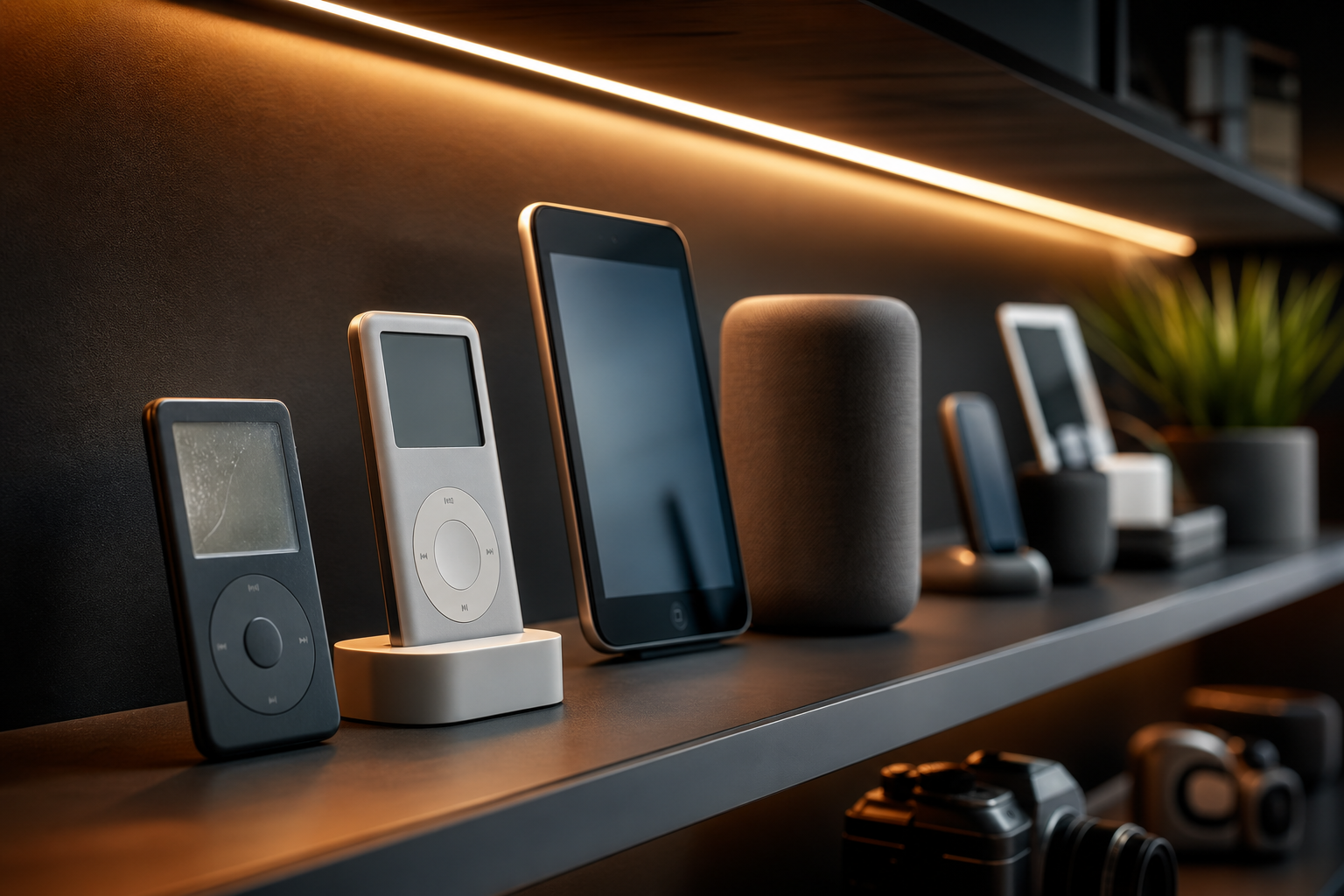
There’s a box in my garage. Not a small one. It’s one of those deep plastic storage crates, and at some point in the last decade it became the unofficial graveyard for tech I bought with great enthusiasm and used with almost none. There’s a fitness tracker in there that I wore for three weeks before the novelty wore off completely. A smart home hub that turned out to be incompatible with half the devices I already owned. A pair of wireless earbuds that sounded genuinely terrible but cost enough that I couldn’t bring myself to admit it for six months. The box is a monument to optimism, poor research, and the very specific kind of madness that grips you when a new product drops and you convince yourself this one will be different.
I’ve been writing about tech for a good few years now, and I’ve attended CES in Las Vegas around eight times over more than a decade. I’ve seen more product launches, demos, and breathless press releases than most people see in a lifetime. You’d think that would make me a more disciplined buyer. And in some ways it has. But it’s also made me worse in others, because when you’re surrounded by genuinely brilliant ideas all the time, the line between “this will change my life” and “this will change the contents of my garage” gets blurry very quickly.
So here it is: a decade of buying tech, distilled into the lessons that actually stuck. The mistakes I kept making, the purchases I’m genuinely proud of, and the rules I now follow before I hand over so much as a pound.
The Recurring Mistakes (Or: How I Funded Several Startups That Didn’t Deserve It)
The single biggest mistake I made, over and over again, was buying first-generation hardware. I did it with smart home devices, I did it with wearables, and I absolutely did it with 3D printers. I bought early, paid full price, and then watched the second-generation versions arrive six months later with the problems fixed and the price dropped. My Bambu Lab P2S is one of the best purchases I’ve made in years, but it wasn’t my first printer. I built an Ender from a kit before that, which was a fantastic learning experience that also aged me visibly.
Subscription creep is the other one. The research backs this up in a pretty uncomfortable way. UK households were spending around £41.70 per month on subscriptions in 2022, and by 2025 that figure had jumped to around £65.50 per month, a 57% increase in three years. Wages haven’t come close to keeping up. I currently pay for Sky, Netflix, Amazon Prime, Disney+, Spotify, and a couple of others. Each one felt like a sensible individual decision. Collectively, they represent a meaningful monthly outgoing that I genuinely had to sit down and audit last year because I’d lost track of it. The gadget drawer gets the attention, but the subscriptions are where the money quietly disappears.
Then there’s the smart home trap. I bought into multiple ecosystems over the years without thinking about whether they’d play nicely together. I’ve got Alexa devices throughout the house, which works well now, but getting there involved a fair amount of friction and at least two devices that turned out to be essentially useless once I standardised. According to recent research, most UK households now own an average of around 30 networked devices. I believe it. I might have more.
The Purchases I’d Make Again Without Hesitation
Not everything went in the box. Some purchases were genuinely transformative, and what they have in common is instructive.
The Bambu Lab P2S 3D printer sits at the top of the list. It’s reliable, fast, and it gets used constantly, whether that’s printing practical household bits, parts for RC builds, or things the kids have designed themselves. It earns its place. The Mac Mini M4 is another one: powerful, quiet, compact, and excellent value for what it does. My Tesla Model 3 Long Range has been brilliant, and while the upfront cost was significant, the running costs have been genuinely lower than I expected, and the tech integration is still better than most alternatives I’ve seen.
What these have in common is that they’re all mature products from established manufacturers with real ecosystems behind them. None of them were first-generation bets. None of them came bundled with a mandatory subscription I hadn’t accounted for. And all of them had clear, practical use cases in my actual life, not just in the imaginary life I was projecting onto them in the checkout flow.
The DJI Osmo Pocket 3 is another one I’d buy again immediately. I use it for video far more than I expected to, and the footage quality relative to the size is still remarkable. When a product surprises you by being better than you thought it would be, rather than worse, you remember it.
The Total Cost Problem Nobody Talks About Honestly
The sticker price is almost never the real price, and it took me longer than I’d like to admit to internalise that properly.
Printers are the classic example everyone uses, but it applies much more broadly now. Smart home devices often lock you into a particular hub or platform. Action cameras want you buying accessories, mounts, and filters. Gaming consoles come with a subscription model baked in. Even my Cricut Explore 4 involves ongoing spend on materials and software access. None of that is necessarily a reason not to buy, but it absolutely needs to be part of the calculation.
The subscription angle is the one that’s changed most dramatically over the last decade. When I bought my first smart speaker, the services it connected to were relatively cheap and the market was simple. Now, the average household is managing a small portfolio of recurring charges, and the tech industry has become very good at making each one feel individually trivial while the total quietly grows. I’ve started treating subscriptions as part of any hardware purchase decision. What ecosystem am I buying into, and what will that cost me monthly for the next three years?
Why CES Makes All of This Harder
I want to be honest about something. CES is my favourite week of the year, and it’s also the most dangerous week of the year for my wallet. When you’re in a hall full of the most impressive technology in the world, and you’re watching live demos of things that genuinely feel like the future, the filter between “I want this” and “I need this” stops functioning properly.
| Product Type | Typical Hype Level | How Often It Delivers | Best Strategy |
|---|---|---|---|
| AI hardware gadgets | Very High | Rarely at launch | Wait 12 months |
| Smart home sensors | Medium | Often, if ecosystem fits | Check compatibility first |
| Next-gen laptops/PCs | Medium-High | Usually yes | Wait for reviews |
| Wearables (first gen) | High | Inconsistently | Watch and wait |
| Established brand upgrades | Low-Medium | More reliably | Buy when needed |
The honest answer is that CES is brilliant for understanding where technology is going. It is a terrible place to decide what to buy next. The products you see on the floor in January are often nine to twelve months from shelves, and the ones that actually ship frequently look different from the ones you saw. The gap between demo and reality is real, and I’ve learned to enjoy the spectacle without treating it as a shopping list.
Hype Cycle Check
LIKELY TO LAST: Mature ecosystem devices from established manufacturers. If a company has been making a product category for several years, has strong support infrastructure, and the second or third generation is out, the risk profile drops significantly. The Mac Mini M4, the DJI Osmo Pocket 3, and the Bambu Lab P2S all fit this pattern.
WATCH CLOSELY: AI-integrated hardware. The integration of AI into physical devices is genuinely interesting and worth following, but 2026 is still early days for a lot of it. The gap between what’s being promised and what’s being delivered remains wide in several categories. Worth tracking, not worth betting on yet.
VAPOURWARE RISK: First-generation smart home devices from new entrants. Every year at CES there are half a dozen compelling-looking smart home gadgets from companies you’ve never heard of, backed by a crowdfunding campaign and a very polished render. Some of them are great. A meaningful number of them end up as expensive paperweights. The box in my garage has at least two of these.
What This Means for CES 2027
CES 2027 is already building up to be a significant one, with AI-hardware integration, home robotics, and the next wave of spatial computing devices all likely to dominate the floor. Based on everything I’ve learned over a decade of attending, my prediction is this: the most hyped categories will be the ones most worth being sceptical about, and the genuinely useful innovations will be the quieter announcements from companies with track records. I’ll be there, I’ll be watching everything, and I’ll be trying very hard not to buy anything until I’ve slept on it for at least a fortnight.
What to Watch
- Subscription bundling from hardware manufacturers. More brands are moving toward hardware-plus-subscription models. Understanding the total cost before purchase is becoming essential, not optional.
- Smart home ecosystem consolidation. The fragmentation that caused so many early smart home headaches is slowly resolving. Matter and Thread adoption is growing, and the next two years should make compatibility far less of a lottery.
- AI device second-generation releases. The first wave of dedicated AI hardware gadgets (pins, glasses, ambient devices) largely underwhelmed. Second-generation versions arriving in 2026 and 2027 will be more telling about where this category is actually going.
- Consumer regulation on subscription traps. The UK’s Department for Business and Trade has been consulting on measures to crack down on auto-renewal and hidden subscription costs. If legislation moves forward, it could meaningfully change how tech is sold and bundled.
My Rules Before Buying Any New Tech
After ten years of getting this wrong often enough to know better, here’s what I actually do now before buying anything with a charger.
1. Wait at least one generation. Unless there’s a specific reason I need it now, I wait for the second version. The price drops, the bugs get fixed, and the reviews get honest.
2. Work out the real monthly cost. Sticker price plus any subscriptions, consumables, or ecosystem lock-in, divided over a realistic ownership period. If that number doesn’t feel right, it usually isn’t.
3. Ask whether I’d use it in my actual life, not my imagined one. The imaginary version of me who goes to the gym every day and tracks every metric was the one who bought the fitness tracker. The real version of me, who mostly needs to print things, take video footage, and run a home network reliably, buys different stuff.
4. Check the ecosystem before the spec sheet. A great device in a broken ecosystem is still a frustrating device. I now check compatibility with what I already own before I look at anything else.
5. Give it a fortnight. If I still want it two weeks later, it’s probably a genuine need rather than launch-day excitement. Most things don’t survive the fortnight test. The ones that do are usually worth it.
The box in the garage isn’t going anywhere. But it’s not getting much new company these days.
If you want more of this kind of honest, practical tech thinking delivered straight to your inbox, come and join the Tech Dads Life newsletter at techdadslife.beehiiv.com . No fluff, no affiliate padding, just tech that actually makes sense for real family life.