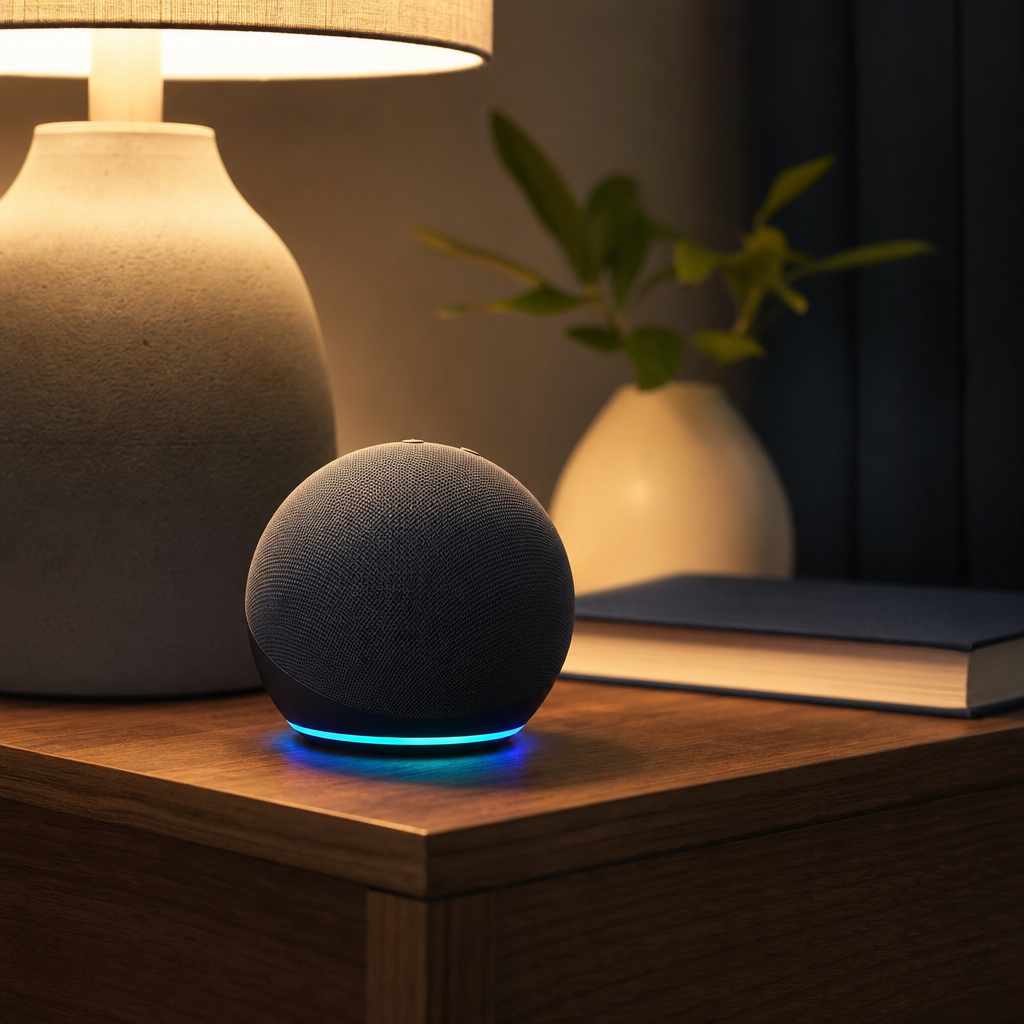
I resisted it for a long time. The bedroom, in my view, was the one room in the house that should stay off the grid. No screens, no microphones, no tech quietly listening in the dark. I had Alexa devices in the kitchen, the living room, the hallway, but the bedroom felt like a line I wasn’t prepared to cross.
Then the phone crept onto the bedside table. First for alarms, then for white noise, then for “just quickly checking the weather before getting up,” and before long it was there all night, screen flickering, notifications buzzing at 2am. I figured a dedicated smart speaker, with no social media, no email, no doomscrolling temptation, might actually be the lesser evil. So I tried it. And now, a few months in, I genuinely do not know how I feel about it.
What I can tell you is that it has made me think more carefully about where these devices belong in a family home, and whether “convenient” and “private” are always as compatible as the marketing suggests.
The Convenience Case Is Real
Let me be honest about this: the bedroom smart speaker has earned its place on the bedside table in some genuinely useful ways.
The biggest one, for me, is lights. We have smart bulbs in the bedroom, and being able to say “turn off the lights” when I am already horizontal and comfortable is one of those tiny quality-of-life wins that feels silly to admit but adds up. Now it is sorted in two seconds. This is exactly the kind of frictionless convenience that smart home tech promises and occasionally delivers.
The Goodnight routine has also grown on me. A single command sets the alarm, turns off the lights, and starts a low-volume ambient sound. Alexa’s whisper mode means if I wake up at 3am and want to check what time the alarm is set for, I can ask quietly and get a quiet answer back. It does not jolt anyone awake. That is genuinely thoughtful design.
We have also started using the Drop In feature across the house, something I have become quite fond of. Rather than shouting up the stairs to tell the kids dinner is ready, I can just drop in to whatever room they are in. It is the closest thing to a house intercom system without spending serious money on one, and with three kids spread across different floors, it actually gets used every single day.
The Privacy Problem I Cannot Shake
Here is where I have to be straight with you, because this is not a small issue.
Smart speakers do not record everything, all the time. They listen for a wake word and, in theory, only start recording after that. But research from Northeastern University found that devices can accidentally activate up to 19 times a day, with recordings lasting up to 43 seconds. In a bedroom, those accidental activations could be capturing conversations you absolutely would not want stored anywhere.
The bigger concern, for me, landed in March 2025. Amazon removed the option to process voice requests locally on three Echo models: the Echo Dot 4th Gen, Echo Show 10, and Echo Show 15. What this means in plain terms is that if you had previously opted out of sending your voice recordings to Amazon’s servers, that choice was overridden. Everything now goes to the cloud. Amazon has replaced local processing with a “Don’t Save Recordings” setting, which does delete recordings after processing, but they still travel to Amazon’s servers first. The distinction matters.
This change came alongside the launch of Alexa+, Amazon’s new subscription AI assistant, and appears tied to its Voice ID feature. I get the business logic. I do not have to like it.
The National Cybersecurity Alliance is pretty clear on this: avoid placing smart speakers in bedrooms or private spaces where sensitive conversations happen. Security experts echo that advice consistently. A living room speaker hears you discussing what to have for dinner. A bedroom speaker hears everything else.
If you do have an Echo Show device with a camera, cover the camera when it is not in use. I mean this sincerely. A physical camera cover costs almost nothing and removes one layer of worry entirely.
How the Main Options Compare
| Device | Display | Price (approx.) | Local Processing | Best For |
|---|---|---|---|---|
| Amazon Echo Dot (newest gen) | No | £30–£55 | No (cloud only) | Minimal bedside use |
| Amazon Echo Show 5 | 5.5" | ~£90 | No (cloud only) | Bedside clock + smart display |
| Amazon Echo Show 8 (3rd Gen) | 8" | £149.99 | No (cloud only) | Fuller bedroom setup |
| Google Nest Audio | No | ~£80 | No (cloud only) | Sound quality, Google users |
| Apple HomePod mini | No | ~£99 | Partial (on-device Siri) | Apple ecosystem, privacy-leaning |
The Apple HomePod mini is worth a mention here. Siri handles a larger share of requests on-device, particularly on newer hardware, and when cloud processing is needed, Apple uses a randomised device identifier rather than a persistent account-linked profile. It is not perfect, but it is meaningfully different from the Amazon and Google approach. If privacy is your primary concern, the Apple ecosystem leans in the right direction.
Does It Affect Your Sleep?
This one is genuinely nuanced. On one hand, there is research suggesting acoustic sleep technology, including the kind of ambient sounds and guided relaxation routines smart speakers can deliver, can reduce the time it takes to fall asleep and improve overall sleep quality. White noise, sleep stories, progressive muscle relaxation through Alexa or Google. These are not gimmicks. Clinical studies have shown real results.
On the other hand, having any networked device in the bedroom introduces a psychological layer that is hard to ignore once you are aware of it. The accidental activation issue is not theoretical. And if you are someone who already thinks about digital privacy, knowing that your bedroom conversations have a non-zero chance of being processed on a remote server is not a thought that helps you drift off.
My personal experience sits somewhere in the middle. The ambient sounds help. The routine helps. The light control definitely helps. But I have had moments at 1am where the thing lit up briefly for no obvious reason, and the flicker of the display in a dark room is genuinely unsettling.
Hype Cycle Check
LIKELY TO LAST: Voice-controlled bedroom routines, hands-free light control, and whole-home intercom via Drop In. These solve real problems and the convenience dividend is genuine.
WATCH CLOSELY: Amazon’s Alexa+ subscription tier and its AI assistant ambitions. The move to cloud-only processing suggests Amazon sees serious commercial value in voice data. How that evolves over the next 12 to 24 months will matter a great deal.
VAPOURWARE RISK: True privacy-preserving smart speakers that match Alexa’s functionality. Apple’s approach is better, but the gap in smart home integration remains wide. The idea of a fully local, fully private smart speaker with Alexa-level utility does not really exist yet at a mainstream price point.
What This Means for CES 2027
CES 2026 showed us that AI is being baked into absolutely everything, and smart speakers are no exception. Heading into CES 2027, I will be watching closely for any serious moves on on-device AI processing for smart speakers, something that could address the cloud privacy concern without sacrificing capability. The pressure from regulators in both the UK and EU around voice data retention is building, and manufacturers who get ahead of that could have a genuine competitive edge. I would also not be surprised to see more hybrid devices. Part smart display, part ambient screen, part home hub, blurring the line between what a bedroom speaker is and what it does.
What to Watch
- Amazon’s Alexa+ rollout and voice data policy: How Amazon handles consent and data retention as Alexa+ expands will shape the entire category. The Illinois class action over Voice ID biometrics is one to follow closely.
- On-device AI processing in speakers: If Apple, Google, or a new entrant manages to deliver full smart speaker functionality without cloud dependency, that changes the privacy calculation entirely.
- UK and EU regulatory pressure: British and European privacy regulators have been increasingly active around connected devices. Any ruling that forces clearer disclosure or opt-in consent for voice data could reshape how these products work.
- Sleep tech integration: The crossover between smart speakers and clinical sleep technology is still early. Watch for partnerships between device makers and sleep research bodies as the evidence base grows.
The truth is I have not made my mind up. The speaker is still on the bedside table, and it will probably stay there, because the convenience is real and the Drop In feature alone has changed how we communicate across the house. But I do not feel entirely comfortable with it, and I think that discomfort is reasonable rather than paranoid.
If you are thinking about doing the same, go in with open eyes. Cover any camera. Think about which device you choose, because not all of them handle your data the same way. And decide what you are actually comfortable with before you start a Goodnight routine that tells a server in another country that you are going to sleep.
That is a genuinely personal call, and only you can make it.
If you found this useful and want more honest tech takes without the hype, come and join the Tech Dads Life newsletter over at techdadslife.beehiiv.com . I write it for real families making real decisions about tech, not press release rewrites. See you there.