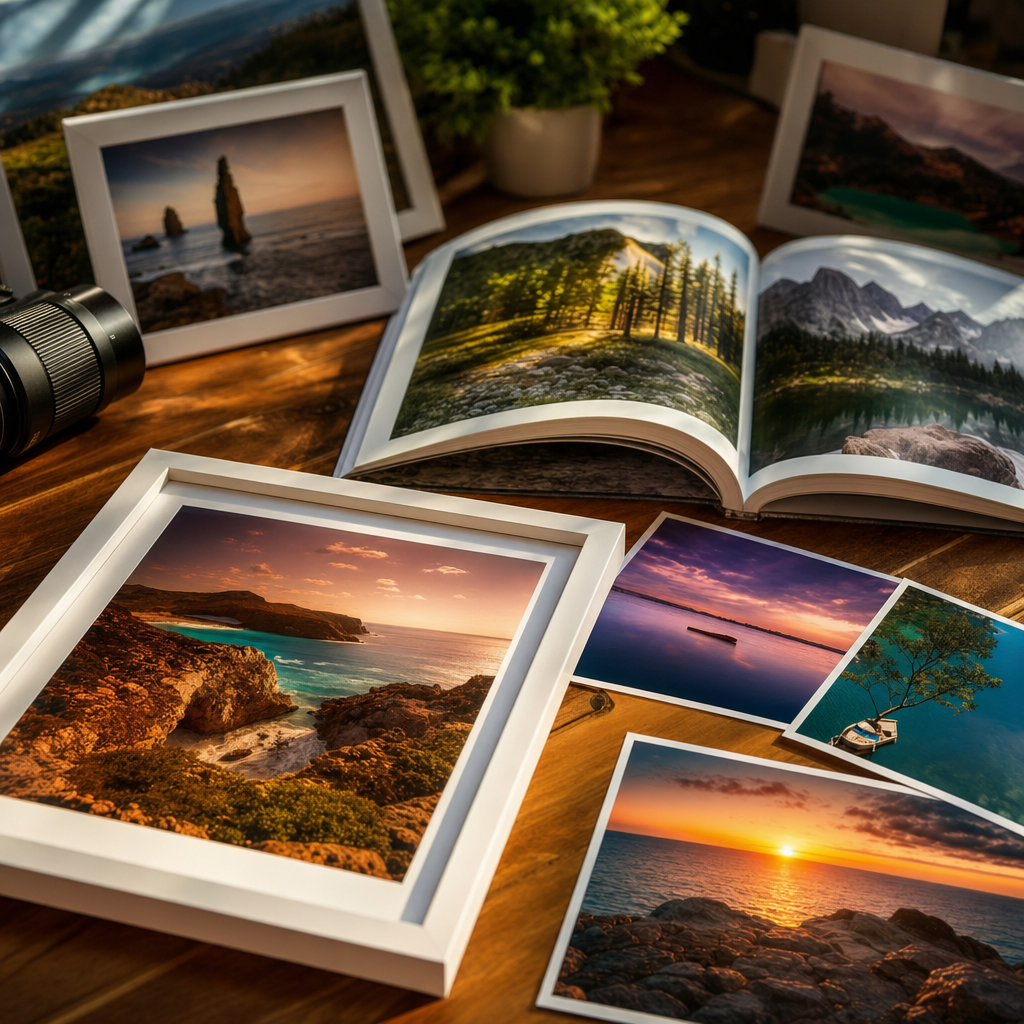
There’s a drawer in our house that I open maybe twice a year. It’s stuffed with printed photos from the early 2000s. Holidays in South Africa, my kids as babies, a couple of terrible haircuts I’d rather not discuss. Every time I open it, I end up standing there for far longer than I planned, flicking through faded six-by-fours like time has stopped. Then I close the drawer, walk away, and think: when did I last actually print a photo?
That thought stopped me in my tracks about eighteen months ago. I have thousands of photos on my Samsung Galaxy. Thousands more in Google Photos. A Plex server full of video. A Nikon D800 that’s produced some genuinely beautiful shots over the years. And yet, if I’m honest, most of those images exist in a kind of digital limbo. I see them occasionally when the algorithm throws up a memory notification, or when I’m hunting for a specific shot. But they’re not lived with. They’re not on a wall, not in a frame, not on a shelf where someone can just pick them up.
That’s why I still print photos in 2026. And if you’ve stopped, I’d gently argue you should probably start again.
The Digital Pile-Up Nobody Talks About
Here’s a stat that floored me when I came across it. An estimated 2.1 trillion photos were taken worldwide in 2025. Trillion. That’s roughly 5.3 billion photos every single day, or around 61,400 every second. Google Photos alone stores over 4 trillion images, with 4 billion more uploaded daily.
Smartphones account for around 94% of all photos taken. The average person has somewhere around 2,000 photos sitting on their phone right now, closer to 2,400 if you’re an iPhone user.
Now ask yourself honestly: when did you last look at photo number 847 in your camera roll? Or number 1,200? They’re just sitting there, perfectly preserved in theory, completely forgotten in practice. We’ve confused storage with memory. They are not the same thing.
The digital permanence argument is real but overstated. Yes, a properly backed-up digital file will outlast a physical print in ideal conditions. The operative word is properly. Most people have one copy on their phone, a partial sync to a cloud service they signed up for years ago, and no idea whether the backup is actually current. Hard drives fail. Cloud services change their pricing, their policies, or occasionally just shut down. File formats that are standard today can become unreadable in twenty years. The technology moves, and your photos sometimes don’t move with it.
Physical prints have their own vulnerabilities, obviously. Heat, humidity, direct sunlight, and water all do damage. But a print in a decent album, stored away from extremes, can last a very long time. Modern photographic papers are genuinely impressive. Fujifilm’s Crystal Archive paper, which is used by many consumer printing services, has a quoted dark storage longevity of around sixty years. Inkjet prints on archival paper using pigment inks can, according to Wilhelm Imaging Research, last well over 100 years under reasonable conditions. That’s not a marketing claim. That’s independent research.
None of this means digital is bad. It means neither approach is foolproof. Printing adds a layer of resilience, and far more importantly, a layer of presence to your photos that digital alone doesn’t deliver.
What Actually Gets Printed in Our House
I’m not suggesting you print every photo you ever take. That would be madness, and also very expensive. What I’ve settled on is a more intentional approach: a couple of times a year, I sit down, curate the best shots from the previous few months, and get them printed.
Some go into albums. Some go into frames on the wall. A few become gifts. My daughter is twenty now and has her own place, and framed prints of family photos have become one of the most meaningful things I can give her. You can’t wrap a Google Photos link and hand it over at Christmas.
For everyday prints, I use a rotation of services depending on what I need. Boots Photo is handy for speed. You can order online and collect in-store in as little as 30 minutes, which is genuinely useful when you want something quickly. Prints start from around 35p and come on recycled paper with a matte finish.
Snapfish UK is my go-to for volume. Their app gives you 50 free 6x4 prints every calendar month, and you just pay postage. Delivery costs vary by quantity but top out at £4.49 for 46 or more prints. That works out to under a tenner for 50 prints delivered to your door, which is hard to argue with. If you’re printing regularly and on a budget, it’s the most generous free tier currently available in the UK.
Photobox is solid for higher-end products, photo books, and canvas prints. Their standard 6x4 prints start at around 15p, which is competitive, and their books are the kind of thing you actually leave on a coffee table rather than hiding in a drawer.
The Case for Printing at Home
For certain things, particularly smaller prints and instant results, a decent home photo printer is worth having. I use mine for test prints from Lightroom, quick family shots, and printing photos the kids need for school projects. The cost per print is higher than a bulk service, but the immediacy is sometimes exactly what you need.
Dye-sublimation printers, like the Canon SELPHY range, produce lab-quality results from a compact machine that sits on a desk and doesn’t need a PhD in printer management to operate. The prints are waterproof, smudge-resistant, and genuinely look great.
If you’re more serious about print quality, an Epson SureColor is in a different league entirely. Pigment-based inks on proper fine art paper, and according to Wilhelm Imaging Research, those prints can last hundreds of years under the right conditions. It’s not a casual purchase, but if photography is a real hobby for you, it’s worth knowing that prints at that quality genuinely stand the test of time in a way a JPEG on a hard drive simply cannot guarantee.
Comparison: UK Photo Printing Options at a Glance
| Service | Best For | Price From | Free Prints? | Notes |
|---|---|---|---|---|
| Snapfish UK | Regular volume printing | 10p (6x4) | 50/month via app | Pay postage only, best free tier in UK |
| Photobox UK | Books, canvas, quality | 15p (6x4) | No | Good for premium products |
| Boots Photo | Speed, convenience | 35p | No | Order online, collect in 30 mins |
| Canon SELPHY CP1500 | Home printing, quick results | ~25p/print | N/A | Dye-sub, waterproof prints |
| Epson SureColor range | Archival, serious photography | Higher | N/A | Pigment ink, centuries-rated longevity |
Hype Cycle Check
LIKELY TO LAST: Physical prints. I know that sounds obvious, but the pendulum is genuinely swinging back. There’s growing awareness of digital fragility and a cultural hunger for things that are tangible and lasting. Photo books and framed prints are not going anywhere.
WATCH CLOSELY: AI curation tools built into services like Google Photos and Apple Photos. If these get genuinely good at selecting your best shots and prompting you to print them, the biggest barrier (choosing what to print from 2,000 images) starts to disappear. That could meaningfully increase print volumes.
VAPOURWARE RISK: Any service promising “permanent” cloud storage for your photo archive. The economics don’t support genuinely indefinite free or cheap storage at scale. Terms change, companies get acquired, and free tiers get cut. Don’t rely on any single cloud service as your only backup.
What This Means for CES 2027
Photo printing has been a quiet category at CES for a few years, but the home printing renaissance is gathering pace. At CES 2027, I’d expect to see more compact, Wi-Fi-enabled dye-sub printers aimed at families, tighter smartphone integration with instant print workflows, and probably some AI-assisted curation features built directly into printer apps. There may also be movement in archival inks and papers being marketed directly to consumers rather than just professional photographers. The story of printing is becoming a story about legacy and longevity, and that’s a compelling pitch for anyone with kids.
What to Watch
AI photo curation reaching a useful threshold. Google Photos and Apple Photos are getting better at identifying your genuinely memorable shots. When that curation is reliable enough to trust, the print workflow becomes much simpler.
Snapfish and Photobox pricing. Postage costs are where budget services quietly make their margin. Worth keeping an eye on how generous the free-print offers remain as inflation and logistics costs continue to bite.
Consumer-grade archival paper and ink. Epson and Canon are both pushing longer-rated inks down into more affordable printer ranges. The gap between consumer and professional print longevity is narrowing.
Photo book services improving. Flat-lay binding, lay-flat pages, and better paper stocks are becoming more common even in mid-market services. This is the format most likely to become the default family archive, replacing both the traditional album and the digital folder nobody opens.
Printing photos takes a bit of effort. It costs a little money. And it forces you to actually choose what matters, which is probably the most valuable part of the whole exercise. The drawer I mentioned at the start of this piece is full of moments that survived because someone once pressed print. I’d like the same to be true of the photos I’m taking now, twenty years from today.
If this kind of practical, family-focused tech content is your thing, come and join the newsletter. It’s where I share the stuff that doesn’t always make it onto the blog, the gear I’m actually using, the mistakes I’ve made so you don’t have to, and the occasional dad joke that my kids pretend they didn’t hear. Sign up at techdadslife.beehiiv.com and I’ll see you in your inbox.