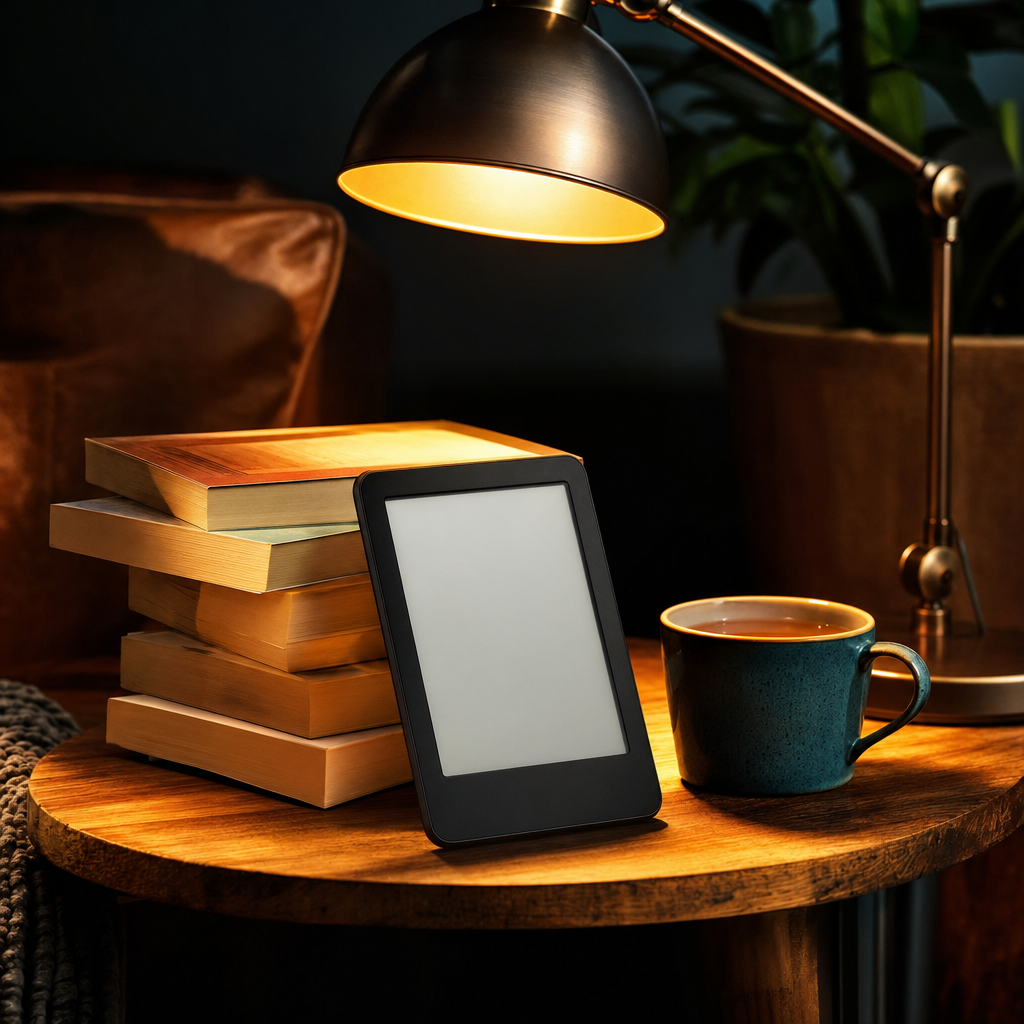
There’s a paperback sitting on my bedside table right now. Nothing fancy, just a dog-eared thriller I picked up from a charity shop for £1.50. And honestly? It’s been one of the better decisions I’ve made this year. That might sound like a strange thing to say on a tech blog, but bear with me, because I haven’t ditched my Kindle. Far from it. What I’ve done is something I suspect a lot of us end up doing eventually. I’ve stopped treating it as an either/or situation and started being a bit more deliberate about which format I reach for and when.
This probably sounds obvious to non-tech people. But those of us who love our gadgets tend to go all-in. When the Kindle arrived, it felt like the future. Everything in one place, adjustable fonts, a dictionary built right in, thousands of books in your pocket. I was convinced. For years, pretty much everything I read went through a screen. Then gradually, quietly, the physical books started creeping back in, and now I’m at a point where I actively choose one format over the other depending on what I’m reading and what I’m trying to get out of it. Here’s how I got here.
The Sleep Thing Is Very Real
Let me start with the reason that actually triggered this whole rethink, because it was annoyingly practical rather than romantic. I was going through a stretch of genuinely rubbish sleep. Nothing dramatic, just that familiar pattern of lying awake too long, brain buzzing, finally dropping off later than I wanted to. I was reading on my Kindle Paperwhite most evenings before bed, which felt fine because it’s E Ink rather than a full LCD screen.
Here’s the thing though. Even E Ink e-readers emit some blue light. It’s significantly less than a tablet or phone, and yes, the warm light settings help, but the research is fairly clear: if bedtime reading is part of your wind-down routine and you want the best chance of decent sleep, a paper book is still the safer choice. Blue light suppresses melatonin production, the hormone your brain uses to signal that it’s time to sleep. Studies have shown that reading e-books before bed can push back sleep onset and reduce how refreshed you feel in the morning. The difference may sound small until you’re a working parent trying to function on less sleep than you’d like.
Switching to a physical book in the evenings made a genuine difference within about two weeks. I’m not saying it cured anything, but the combination of no screen light and the slightly more passive, slower pace of holding a real book seemed to do something right. The Kindle still comes out during the day. In the evening, it stays on the shelf.
What the Research Actually Says About Comprehension
I want to be careful here because there’s a lot of breathless headline-writing on this subject, and the reality is more nuanced. A University of Valencia study published in late 2023, involving over 450,000 people, found that comprehension from paper books could be six to eight times better than from e-books for the same amount of reading time. That’s a striking figure. But the key detail buried in those headlines is that this advantage applies primarily to informational and non-fiction text, not narrative fiction.
For a thriller or a novel, the research suggests the gap mostly disappears. So if you’re reading for pleasure and story, the medium matters less. But if you’re working through something you genuinely need to understand and retain, whether that’s a business book, something technical, or anything with complex structure, there’s a reasonable case for reaching for the physical version.
There’s also something in how a physical book orients you spatially. Abigail Sellen of Microsoft Research Cambridge put it well: “The implicit feel of where you are in a physical book turns out to be more important than we realised. Only when you get an e-book do you start to miss it.” One study found that Kindle readers performed similarly to print readers on most comprehension measures, but where they fell behind was in tests related to chronology and sequence. The physical sense of how far through a book you are, what happened early on versus later, that tactile map actually seems to anchor memory and understanding in ways we don’t fully appreciate until it’s gone.
The Kindle Still Wins in Plenty of Situations
None of this means I’m done with the Kindle. Not even close. For travel, the thing is borderline indispensable. Heading to London on the train, I’m not hauling a stack of books. One device, multiple books, long battery life, done. When I’m away with work or the family, the Kindle earns its place every time.
The convenience argument also holds for price and access. A new physical book from a bookshop can easily run £10 to £16. Many Kindle titles are significantly cheaper, and the back catalogue available on Kindle Unlimited or at reduced prices is enormous. For the volume reader who gets through several books a month, the economics are difficult to argue with.
The current Kindle range in the UK sits around £90 for the standard model and up to around £159 to £189 for the Paperwhite 12th generation, with the Colorsoft Signature Edition sitting above that. They hold their value reasonably well, and if you catch a Prime Day deal, the savings can be substantial.
Comparing the Two Formats Honestly
Here’s how I actually think about the choice now, laid out plainly:
| Factor | Physical Book | Kindle |
|---|---|---|
| Bedtime reading | Better (no blue light) | Less ideal, even with warm light |
| Non-fiction retention | Likely better | Slightly inferior for complex texts |
| Fiction / narrative | Roughly equal | Roughly equal |
| Travel and portability | Bulky, one book at a time | Excellent |
| Cost per book | Higher (£10–£16 typically) | Lower (often £3–£10) |
| Discovery and browsing | Bookshop joy | Algorithm-driven |
| Annotations and search | Difficult post-read | Very easy |
| Battery life | None required | Weeks per charge |
| Space at home | Takes up shelf space | None |
There is no universally correct answer here. According to a 2025 YouGov survey, around 50% of UK readers use a mix of both formats, and they’ve essentially arrived at the same conclusion: use the right tool for the situation.
Hype Cycle Check
LIKELY TO LAST: The hybrid reader approach. Physical books are not going anywhere. UK print book sales still account for around £1.9 billion of the £2.4 billion consumer market, outselling digital formats by more than 4:1. The coexistence of print and digital is not a transitional phase. It is simply how people read now.
WATCH CLOSELY: Audiobooks. A 31% increase in UK audiobook sales in 2024, reaching £268 million, is a number that deserves attention. It is the highest figure ever recorded for the format in the UK. This is a third format eating into reading time that deserves its own conversation.
VAPOURWARE RISK: The idea that e-readers will eventually replicate the full physical experience. Better screens, better lighting, and better page-feel technology will keep improving. But the spatial, tactile, and sleep dimensions of physical books are not engineering problems with obvious software solutions.
What This Means for CES 2027
Physical books will not be on the CES show floor, but the technology that sits alongside reading almost certainly will be. E Ink display technology continues to improve, and colour E Ink (already in the Colorsoft) will get better, cheaper, and more mainstream. Expect to see smart reading companions, ambient lighting technology designed around sleep health, and AI-assisted annotation tools for e-readers. If the research on screen inferiority keeps accumulating, there may also be more pressure on device makers to address comprehension and retention rather than just comfort and convenience.
What to Watch
- Sleep tech and reading habits. As wearables get better at tracking sleep quality, more people will have personal data connecting evening screen use to sleep outcomes. That feedback loop could shift behaviour faster than any research paper.
- Kindle’s warm light improvements. Amazon continues to iterate on warm light and blue light reduction. Watch whether future generations close the sleep gap further, or whether physical books retain that edge indefinitely.
- Audiobook growth. At 31% year-on-year growth in the UK, audiobooks are the format to track. The question is whether they are supplementing or replacing reading time, and what that means for comprehension and habit.
- Independent bookshops. There are signs that independent bookshop numbers in the UK have been quietly recovering after years of decline. A format shift back toward physical, even partially, has real-world implications for the high street.
If you found this useful and want more honest, practical takes on tech and everyday life from someone who is figuring it out alongside you, come and join the Tech Dads Life newsletter. No spam, no fluff, just the stuff that actually matters. Sign up at techdadslife.beehiiv.com .