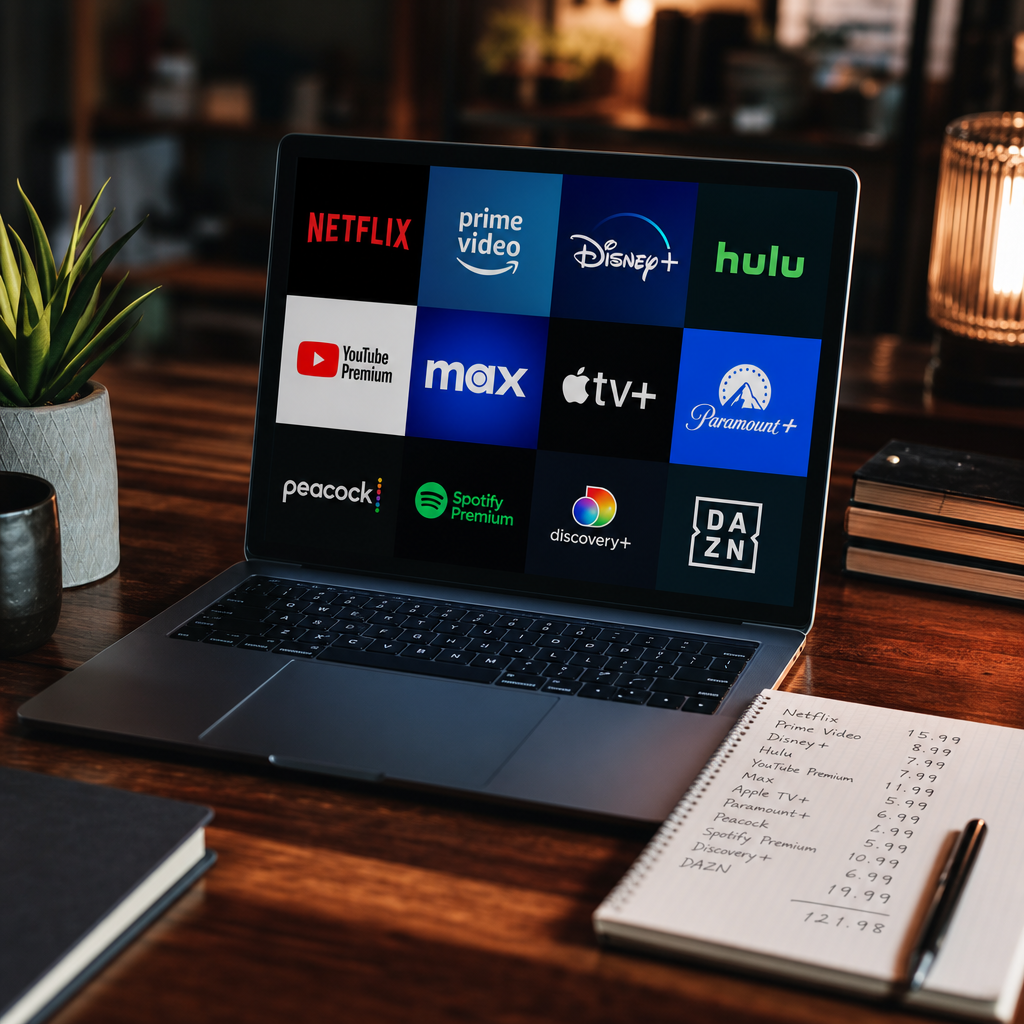
I got the shock in January. Not a big, dramatic one, just a quiet, nauseating moment of clarity while scrolling through my bank statement on my phone. I’d added up all the recurring monthly charges out of curiosity, expecting a mild wince. What I got was a full-on double-take. We were spending just under £140 a month on subscriptions. Not rent. Not food. Not petrol for the Tesla 😉. Just… services. Most of them delivering content I was fairly sure at least one member of my family was watching, but I couldn’t say with certainty which one, or when.
UPDATE 17 May 2026:
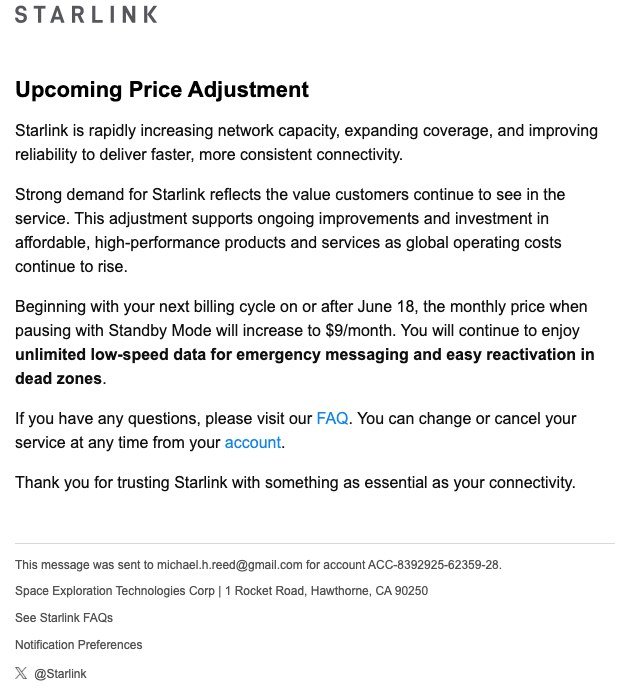
You couldn’t make this up: Just after I published this article I received an email from Starlink regarding an upcoming Price Adjustment. Beginning with your next billing cycle on or after June 18, the monthly price when pausing with Standby Mode will increase to $9/month. That’s Free one year ago, the. $5 and now $9.
I’m not a careless spender. I track things. I like spreadsheets. I am, genuinely, the kind of person who reads the small print on a broadband contract before signing. And yet there it was, £140 a month, quietly exiting my account while I was busy doing other dad things like driving to football training and working out whose turn it was to load the dishwasher.
The frustrating part is that none of it happened overnight. It crept up slowly, incrementally, one “we’re adjusting our pricing” email at a time. And apparently I’m not alone.
The Numbers That Should Make You Put Down Your Coffee
Here’s what the data actually looks like. By the end of 2024, UK consumers held 155 million active subscriptions between them. Indicative figures suggest the average UK household was spending around £65.50 a month on subscriptions by 2025, up from £41.70 in 2022. That’s roughly a 57% increase in three years. Wages over the same period? Up about 18%. So subscriptions appear to be growing at roughly three times the rate of salaries. That’s not creep. That’s a slow-motion ambush.
The streaming services are the obvious culprits, but the numbers are almost comical when you line them up. Netflix Standard is now £12.99 a month in the UK, up £2 from where it sat before February 2025. Premium is £18.99. For context, Netflix launched in the UK at £5.99 for everything. That Premium tier is now more than three times the original launch price. And that’s before you factor in the password-sharing crackdown, which means if your student son or daughter is still using your account from their flat, you’re now paying extra for that privilege too.
Disney+ raised its ad-supported tier, the cheap one, the one people chose specifically to save money, for the first time since it launched. It moved from £4.99 to £5.99 in September 2025. Premium is now £14.99 a month. That’s 150% more than it cost at launch in 2020 if you wanted 4K on four screens. Add Amazon Prime at £8.99, Apple TV+ at £8.99, and Spotify at £11.99 for an individual plan, and you’re already past £55 before you’ve touched a single piece of software.
Microsoft 365 Personal runs £84.99 a year. The BBC licence fee, which some people forget to count, went up to £174.50 a year from April 2025. Adobe Creative Cloud is somewhere in the region of £55 a month for the full suite. That one I do justify. Barely, but I justify it.
Where the Real Money Goes Missing
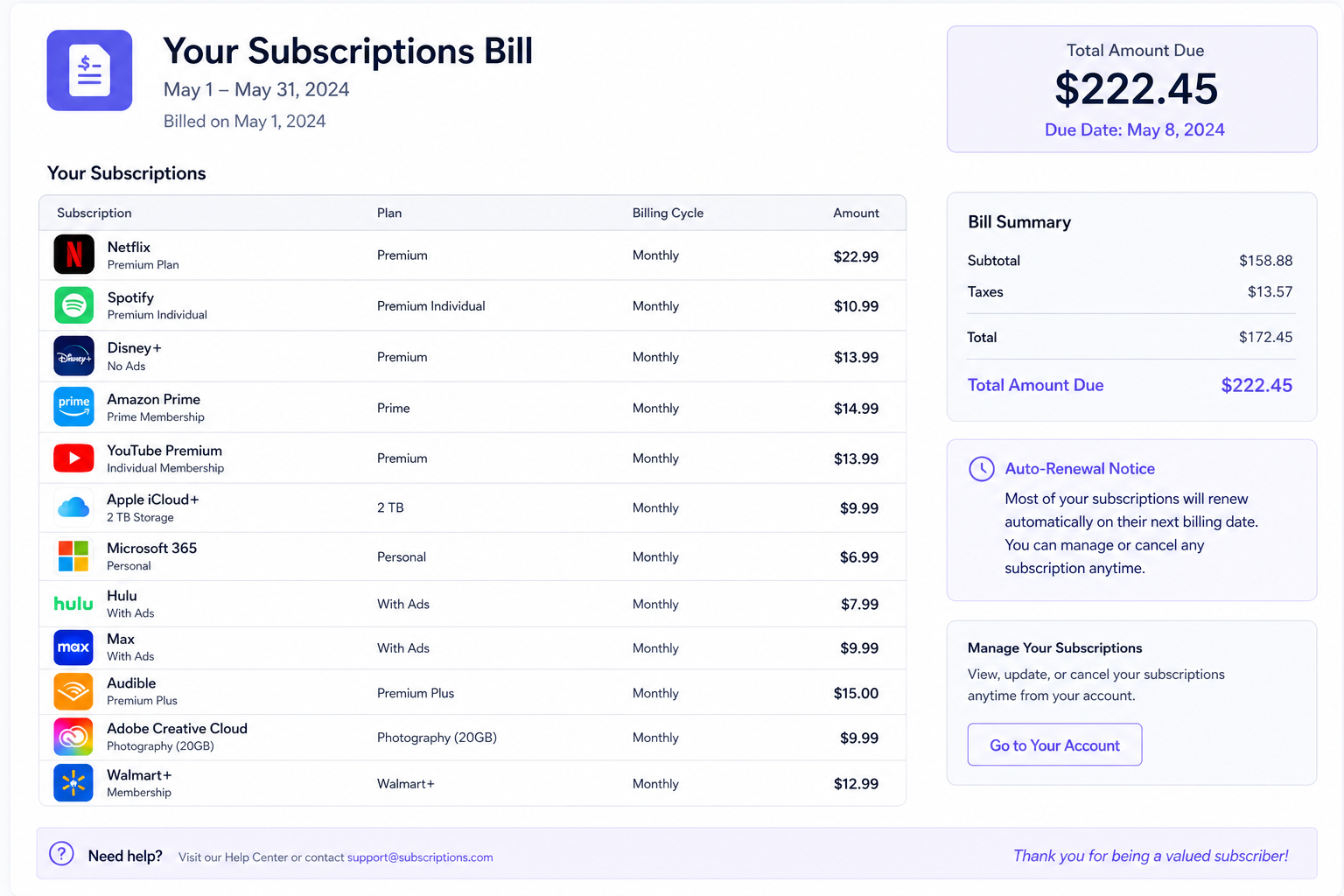
The most interesting statistic I came across while pulling this piece together was this: 17% of Brits don’t track their subscriptions at all. One in five people are paying for something they rarely use. The UK government reckons around 10 million of those 155 million subscriptions are essentially unwanted, burning through £1.6 billion a year between them. That’s not small change. That’s an enormous collective shrug.
A study by Recharge in 2025 found that 23% of UK adults failed to cancel a subscription in the past year, losing an average of £123.40 each. The companies know exactly what they’re doing. A £7.99 monthly charge doesn’t feel painful. It doesn’t land with the same weight as handing someone a tenner. It just quietly vanishes, alongside eleven other £7.99s, every single month.
This is by design. Subscription models are built around psychological friction, or rather, the deliberate removal of it. Signing up is effortless. Cancelling involves navigating menus, confirming via email, occasionally a phone call, and often a guilt-trip screen that tells you exactly what you’ll be losing. The asymmetry is entirely intentional.
Barclays found that 59% of UK consumers are now concerned that rising subscription costs are affecting their household finances. That’s not a fringe concern anymore. That’s the majority. And yet 56% of Brits still don’t have any kind of household budget in place. So the concern is there. The action, less so.
The Tools I Actually Use to Track This Stuff
I’ve tried a few approaches to keeping on top of subscriptions, and the one that works best for me is almost embarrassingly simple. I have a Google Sheet, yes, just a spreadsheet, with every recurring charge listed, the amount, the billing date, the annual equivalent, and a column for whether I think it’s still earning its place. I review it quarterly. That last bit is the key part most people skip.
Beyond the spreadsheet, I’ve found a few apps genuinely useful. Snoop is one I’d recommend to anyone in the UK. It connects to your bank accounts (read-only), spots recurring charges automatically, and flags when a subscription price has changed since you last paid it. That last feature is the one that’s caught me out more than once.
Emma is another solid option, and does similar things with a slightly cleaner interface. It categorises your spending, shows you month-on-month trends, and gives you a running total of what your subscriptions are actually costing annually, not monthly, which is the figure companies would rather you focus on.
For the actual cutting decisions, I use a simple rule I borrowed from someone far more financially disciplined than me: if you haven’t used something in the past 30 days, it goes on the “justify or cancel” list. Not the cancel list. The justify or cancel list. Sometimes there’s a good reason you haven’t used it (you were away, it’s seasonal, there’s a specific thing coming up). But it forces you to make a conscious decision rather than letting inertia do the choosing.
The Streaming Comparison You Actually Need
Here’s how the main streaming services stack up right now, because I know you’re going to want this laid out clearly:
| Service | Cheapest Tier | Mid Tier | Premium / 4K | Annual Equivalent (Premium) |
|---|---|---|---|---|
| Netflix | £5.99 (Ads) | £12.99 (Standard) | £18.99 | £227.88 |
| Disney+ | £5.99 (Ads) | £9.99 (Standard) | £14.99 | £179.88 |
| Amazon Prime | £8.99 (includes delivery) | N/A | N/A | £107.88 |
| Apple TV+ | N/A | N/A | £8.99 | £107.88 |
| Spotify (individual) | N/A | N/A | £11.99 | £143.88 |
If you subscribe to all five at their premium or standard tiers, you’re looking at well over £700 a year before you’ve considered software, cloud storage, gaming services, or anything else.
The Hype Cycle Check
LIKELY TO LAST: Streaming subscriptions are going nowhere, but expect further consolidation. Services will keep bundling, prices will keep rising, and the “cheaper with ads” tier will become the default for anyone paying attention to their bank balance. The BBC licence fee isn’t going anywhere either, whatever the political noise around it.
WATCH CLOSELY: The password-sharing crackdown across streaming platforms is still working its way through the market. Disney+ Extra Member add-ons, Netflix’s household rules, and Amazon’s potential “Ultra” tier are all moves that could meaningfully change what you’re paying without you necessarily noticing.
VAPOURWARE RISK: The idea that streaming bundles will genuinely save families money. Every time a bundle gets announced, it sounds like a deal, until you work out you’re paying for three services when you only wanted one, and the bundle is priced accordingly.
What This Means for CES 2027
Subscription fatigue is now mainstream enough that it’s becoming a product category in itself. At CES 2026, there was already noise around AI-powered personal finance tools, smart home dashboards that integrate spending data, and platforms designed to give households a cleaner picture of their recurring costs. Heading into CES 2027, I’d expect that to mature, particularly tools that use AI to spot price increases, flag unused subscriptions automatically, and suggest optimisation. Whether they’ll be genuinely useful or just another subscription to add to the pile is, of course, the real question.
What to Watch in the Next 12 Months
- Further streaming price increases. Every major service has raised prices in the last 18 months. There’s no structural reason that stops in 2026.
- AI subscription tools going mainstream. Snoop, Emma, and similar apps are improving quickly. Watch for deeper bank integration and smarter alerts.
- Legislative pressure on subscription cancellation practices. The FCA has been paying attention to auto-renewals. Expect clearer cancellation rules to be tightened further in the UK.
- Gaming subscription pricing. Xbox Game Pass and PlayStation Plus have both shifted pricing significantly. With next-gen titles increasingly available day one on subscriptions, this is a cost that’s going to grow for families with teenagers.
Your Five-Minute Subscription Audit
Right. Here’s the practical bit. Block out 20 minutes this weekend. Open your bank statement, or better yet, open Snoop or Emma and let it do the heavy lifting. Then work through this:
Step one: List every recurring charge. Monthly and annual. Convert everything to an annual figure so you’re comparing like with like. A £4.99 monthly charge is nearly £60 a year. Looks different written that way.
Step two: For each one, ask three questions. Have I used this in the last 30 days? Would I miss it if it were gone tomorrow? Is there a cheaper tier that would actually meet my needs?
Step three: Anything you haven’t used in 30 days goes on the justify-or-cancel list. Don’t cancel blindly. Some things are genuinely worth keeping. But make a deliberate choice rather than a passive one.
Step four: Check for overlaps. If you have Sky, Amazon, and Netflix, are you actually watching content across all three regularly, or is one of them mostly just sitting there looking expensive?
Step five: Set a quarterly reminder to repeat the whole thing. Prices change. Habits change. A subscription that was genuinely useful six months ago might not be earning its place now.
The goal isn’t to cut everything and sit in the dark watching free-to-air television. The goal is to make sure every pound leaving your account is doing something you’ve actually chosen. That’s it. Simple, slightly boring, and genuinely effective.
If this kind of thing is useful, the practical, no-nonsense side of managing tech and family costs, I write about it regularly over at the Tech Dads Life newsletter. No spam, no faff, just useful stuff. You can sign up at techdadslife.beehiiv.com . Worth it. And it’s free, which after this article feels like a refreshing change.