
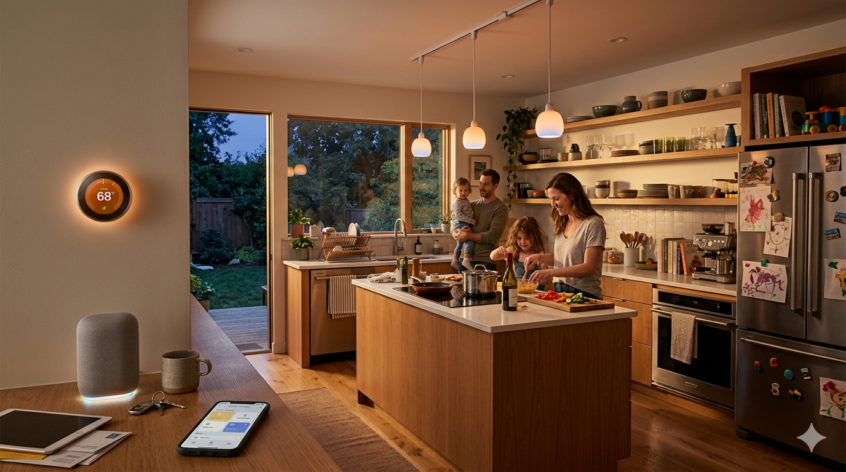
If you have ever stood in your kitchen trying to explain to your partner why the lights work with Alexa but not with Google, why the doorbell app is different from the thermostat app, and why the smart plug only works when you talk to it in a specific way, then you already understand why the Matter standard exists. Matter was supposed to be the universal language that all your smart home devices finally agreed to speak. The promise was simple: buy any product with the Matter logo and it just works, with any platform, first time. So. Does it?
This is Week 2 of my CES 2027 Build-Up series, where I track one major consumer tech trend every week and build those weekly reads into a full annual prediction for what will dominate the show floor in January 2027. Last week I looked at smart glasses. This week it is the smart home, and specifically whether Matter is finally delivering on its promise or still falling short.
What Matter Was Supposed to Do
The smart home has been a fragmented mess for years. Zigbee, Z-Wave, Wi-Fi, Bluetooth, Thread, each platform had its own preferred protocol, and getting devices from different brands to cooperate was somewhere between annoying and impossible. Matter, launched by the Connectivity Standards Alliance in 2022, was the industry’s attempt to draw a line under all of that. Backed by Apple, Google, Amazon, and Samsung from the start, it promised true cross-platform compatibility. One standard to rule them all.
In 2026, Matter is real and it is growing. The product catalogue has expanded significantly. IKEA brought native Matter support to more of its lineup. Aqara launched what it claims is the world’s first Matter-certified surveillance camera. Samsung SmartThings became the first major platform to support Matter cameras. SwitchBot added palm-vein biometrics to its Matter-compatible smart locks. Even established names like GE, Govee, Eve Systems, and Kwikset showed up with Matter hardware at CES 2026.
On paper, this is exactly what was promised. In practice, the story is more complicated.
The Part They Do Not Put on the Box
Here is the honest version of where Matter stands in April 2026. Basic on/off control, dimming, and colour temperature across lights, plugs, and simple sensors now works reliably across platforms. That is genuinely useful and represents real progress. If you are starting a smart home from scratch today, buying Matter-compatible kit is a reasonable strategy for the basics.
But the moment you go beyond the basics, the cracks appear.
IKEA’s expansion into Matter-over-Thread hit a well-publicised wall this spring, with large numbers of Apple Home users unable to add devices to their networks. IKEA acknowledged the problem openly, calling it a connection issue in certain home environments and working with the Connectivity Standards Alliance to understand it. What emerged from the reporting is the deeper truth: Apple, Google, and Amazon are all still prioritising their own platform features over genuine interoperability. The cooperative spirit that drove Matter’s early development has given way to competitive self-interest.
The result is that a Zigbee remote from IKEA might work perfectly in SmartThings but fail entirely in Google Home. Dynamic lighting effects, addressable LED zones, advanced scene control, these premium features remain locked behind proprietary apps even when you have paid for Matter-compatible hardware. The standard covers the skeleton of a smart home but not yet the experience layer that most people actually care about.
The Tech Dad Reality Check The question I always ask before recommending smart home kit to family and friends is this: does it work when the internet is down? Matter’s local-first architecture means that in theory, yes, it should. In practice, this depends heavily on which platform you are using and whether your hub runs the logic locally. Home Assistant and Homey are the strongest options here. Apple Home is improving. Google Home and Alexa still rely more heavily on the cloud than I would like for a system that controls your locks, lights, and thermostat. |
What CES 2026 Actually Showed Us
Despite the frustrations, CES 2026 gave several clear signals about where this is heading.
The BroadLink Matter SuperBridge was one of the most practically useful announcements. It acts as a bridge that brings legacy devices, air conditioners, hi-fi amplifiers, older TVs, into the Matter ecosystem. Due to launch spring 2026, this matters enormously for families who have already invested in smart home kit but do not want to replace everything just to get compatibility. If it works as advertised, it significantly expands who Matter is actually useful for.
Home Assistant released version 2026.1 in January, which moved Matter and Thread from a buried integration menu to the main settings screen. It is a small change that signals a big shift: open-source local control is becoming a first-class citizen in smart home software, not an enthusiast edge case. Combined with better energy management tools in Matter 1.5, the direction of travel is toward homes that are genuinely intelligent rather than just remotely controllable.
Matter 1.6 is expected later this year, and if the rumours are correct it will finally standardise addressable lighting, meaning the animated effects on your Govee or Nanoleaf strips will be controllable across any platform without needing their proprietary app. That would be a genuine quality-of-life improvement for a lot of families.
Hype Cycle Check: Where Does Matter Sit Right Now?
The smart home category as a whole has been climbing out of the trough of disillusionment for two or three years. Matter was supposed to accelerate that journey to the plateau of productivity. My read is that we are on the slope of enlightenment: real progress, genuine utility for straightforward setups, but still enough friction that the average family will run into at least one head-scratching moment.
- LIKELY TO LAST: Matter as the baseline for new smart home purchases. If you are buying lights, plugs, sensors, or locks in 2026, Matter compatibility is worth paying for. The basics work. The product catalogue is deep enough to build a useful home around. By the time CES 2027 arrives, Matter 1.6 should have closed most of the remaining gaps in the lighting and energy management categories.
- WATCH CLOSELY: Local AI hubs paired with Matter. The combination of on-device intelligence that understands your household patterns and Matter devices that can respond to it locally, without cloud dependency, is where the smart home gets genuinely exciting. Home Assistant is already building toward this. Expect CES 2027 to have multiple announcements in this space.
- VAPOURWARE RISK: Platform unity. Apple, Google, and Amazon have agreed to support Matter and then quietly continued building walls around their own ecosystems. The promise of one app to control everything remains further away than the marketing suggests. Do not buy on the basis that everything will just work together. Test your specific combination first.
The Tech Dad Take: Where to Start Without Losing Your Mind
If you are building or extending a smart home right now, here is what I would actually recommend. Start with one platform and commit to it. Do not try to mix Apple Home, Google Home, and Alexa in the same house. Pick the one your family already uses the most and build around it. Matter will help when you inevitably want to add a device from a different brand, but it will not solve all your problems if your base platform is inconsistent.
For families starting from scratch, Home Assistant on a local hub is the option I would look at hardest. It is more setup work upfront but gives you local control, no subscription fees, and the broadest device compatibility of any platform. If you want something simpler, SmartThings has the broadest Matter device support of the big consumer platforms right now.
For families who already have a mixed ecosystem, the BroadLink SuperBridge arriving this spring is worth watching. If it delivers on the promise of pulling legacy devices into the Matter fold, it could save a lot of households from an expensive rip-and-replace.
Planning to Attend CES 2027? Book Now. CES 2027 runs 6-9 January 2027 at the Las Vegas Convention Center. Registration is not yet open but the CES team has confirmed you can sign up at ces.tech to be notified the moment it does. This matters: CES hotel rates rise sharply as January approaches, and the most popular properties sell out well before Christmas. If you are serious about attending, getting on the notification list now and booking accommodation the moment rooms open is the move. Cancellations for paid registrations are refundable (less a small processing fee) up until 9 December 2026, so there is limited downside to booking early. |
What to Watch Over the Next Few Months
- BroadLink Matter SuperBridge real-world reviews once it ships this spring
- Matter 1.6 specification release and which platforms commit to it quickly
- Google Home progress on Matter 1.2 and above, currently lagging other platforms
- Apple HomeKit updates following the IKEA Thread compatibility issues
- Local AI hub announcements ahead of CES 2027, particularly from Home Assistant ecosystem
- Whether Amazon Alexa Plus subscription model changes how its smart home integrations work

Technology & Digital Consultant, Property Industry, Photographer, Videographer, CAA Approved Drone Pilot, DIY Enthusiast, FA Coach, Solution Finder & Thinker.