
TECHDADSLIFE.COM | Weekly Trend Watch #003 | April 2026
My father-in-law has worn a wristwatch every day for forty years. Getting him to swap it for a smartwatch felt like a negotiation that required a solicitor. But when his GP mentioned he should keep a closer eye on his heart rate variability and sleep patterns, he had an Oura Ring on his finger within a week. That shift, health tracking moving from gadget enthusiast territory into something doctors are actively recommending, is one of the most significant consumer tech trends of 2026.
This is Week 3 of my CES 2027 Build-Up series, tracking one major trend every week and building toward an annual prediction for the January show. We have already covered smart glasses in Week 1 and the smart home Matter standard in Week 2. This week it is health wearables, and specifically the smart ring, the form factor quietly eating the fitness tracker market from the inside.
The Shift From Counting Steps to Reading Bodies
The original fitness tracker did one thing: counted steps. Your first Fitbit was essentially a fancy pedometer. What is happening in 2026 is categorically different. The devices now on people’s wrists and fingers are monitoring heart rate variability, blood oxygen levels, skin temperature, breathing regularity during sleep, stress markers, and in some cases flagging potential signs of cognitive decline before any symptoms appear.
Samsung previewed Brain Health at CES 2026, a feature for Galaxy wearables that analyses walking patterns, voice changes, and sleep data to look for early warning signs associated with dementia research. It is not a diagnostic tool, and Samsung is careful to say so. But the fact that it exists at all, built into a consumer device, shows how far the category has travelled. The wearable AI market was valued at around $56 billion in 2026 and is projected to grow to over $310 billion by 2033. That is not fitness tracker money. That is healthcare infrastructure money.
Garmin earned a CES Innovation Award for the Venu 4 smartwatch, with a health status feature that highlights when key metrics drift from your personal baseline. The framing is no longer about hitting arbitrary daily goals. It is about knowing your normal and being alerted when something changes.
Why Smart Rings Are the Form Factor to Watch
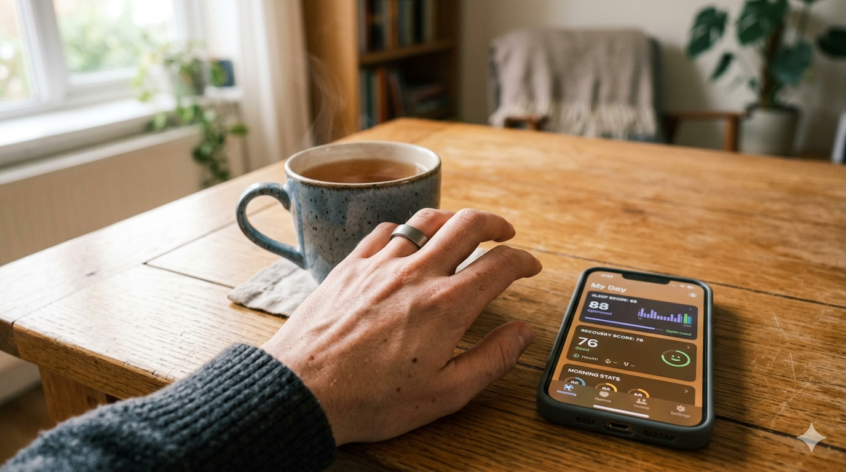
The smartwatch market is mature and increasingly crowded. The smart ring market is young, growing fast, and producing genuinely impressive hardware. For those who have not tried one, a smart ring is exactly what it sounds like: a titanium ring worn on your finger that tracks sleep, heart rate, recovery, stress, and more, and syncs to an app on your phone. No screen. No notifications pinging your wrist at 2am. Just passive, continuous health data collected in the background of your life.
The Oura Ring 4 is widely considered the category reference point in 2026, praised across testing from Wareable, Tom’s Guide, and TechRadar for its sleep staging accuracy and the depth of its readiness and recovery insights. Its Symptom Radar feature has earned a reputation for detecting illness before physical symptoms appear, which sounds like marketing until you read the number of independent reviews confirming exactly that. The catch is a subscription of around £5.99 per month to access the full insight platform.
For those who prefer a one-time cost, the Samsung Galaxy Ring at £399 delivers strong sleep and activity tracking with no ongoing fees, though it is Android-only. The Ultrahuman Ring Air suits fitness-focused users who want metabolic insights without a subscription. The RingConn Gen 2 is the entry-level pick at around £180 with no subscription, impressive battery life, and solid core tracking.
Quick Comparison: Smart Rings in 2026
|
Device | ||||
|
Price |
~£349 |
£399 |
~£299 |
~£180 |
|
Subscription |
Yes, £5.99/mo |
None |
None |
None |
|
iOS support |
Yes |
Android only |
Yes |
Yes |
|
Battery life |
7 days |
7 days |
6 days |
8-10 days |
|
Best for |
Deepest insights |
Android ecosystem |
Fitness focus |
Budget pick |
The Doctor Connection: Real or Hype?
The CES 2026 official summary noted that doctors are beginning to recommend health wearables for tracking meaningful wellness data. That sentence deserves unpacking. It does not mean your GP is prescribing an Oura Ring on the NHS. It means that an increasing number of healthcare professionals are acknowledging that the biometric data from quality wearables is accurate enough to be worth discussing in a clinical context.
Google announced a partnership with CMS to allow patients to securely access and store medical records directly within the Fitbit app, positioning consumer health platforms as centralised health data hubs that bridge clinical records with real-time wearable insights. That is a structural shift, not a feature update.
The more grounded reality is this: smart rings and watches are not medical devices. Most are marketed explicitly as wellness tools. But the gap between wellness tool and medical instrument is narrowing faster than most people realise. The Oura Ring’s sleep apnea detection flagging breathing disturbances for users who had no idea they had an issue, and prompting them to seek a formal diagnosis, is a real-world outcome happening at scale right now.
The Tech Dad Angle |
|---|
I bought a smart ring about eight months ago, primarily to track sleep. What actually changed my behaviour was the recovery score. On mornings when I felt fine but the ring showed a low score, I started paying attention to what I had done the night before: one drink too many, screens too late, a stressful call at 9pm. The data made the connection visible. That is genuinely useful parenting information, because how recovered you are affects how patient you are. I did not expect a piece of jewellery to make me a better dad, but here we are. |
Hype Cycle Check: Where Does Health Tech Sit in 2026?
Health tech wearables are in an interesting position on the hype cycle. The consumer category peaked in hype around 2015 with the original Fitbit boom, then went through a long period of incremental improvement and consumer scepticism. What is happening now feels like the plateau of productivity: quieter than the early hype, but substantively more useful. The devices actually work. The data is accurate. And the use cases are expanding into territory that matters.
- LIKELY TO LAST: The smart ring as a category. The combination of no screen, all-day comfort, accurate sleep tracking, and passive health monitoring solves real problems for real people. Oura has over a decade of clinical validation behind its algorithms. Samsung, Ultrahuman, RingConn, and Amazfit entering the market means the category is maturing, not speculating.
- WATCH CLOSELY: The consumer-to-clinical pipeline. The partnership between Google and CMS, the Samsung Brain Health feature, and FDA-adjacent sleep tracking capabilities all point toward wearables playing a formal role in preventative healthcare within the next few years. The regulatory and data privacy framework around this is still developing, and that will shape which companies win.
- VAPOURWARE RISK: Continuous glucose monitoring in non-invasive consumer rings. Multiple startups are claiming this capability. The science is not there yet for accurate, non-invasive CGM in a ring form factor. Any product making this claim in 2026 deserves serious scrutiny before you hand over your money.
What This Means for CES 2027
Health tech was one of the two dominant stories at CES 2026, alongside smart glasses. By January 2027, I expect the following at the show.
The Oura Ring 5 has been rumoured for late 2027, which means a potential announcement or preview at CES 2027. Samsung Galaxy Ring 2 is overdue and likely to appear. The broader story will be the next step toward clinical integration: more devices seeking FDA clearance rather than just wellness positioning, more platform partnerships with healthcare providers, and the first real consumer-facing continuous glucose monitoring claims that are actually backed by peer-reviewed validation.
I also expect CES 2027 to feature AI health coaching built directly into the wearable platform, not as an add-on, but as the primary interface. The raw data era of health wearables is ending. The era of the device telling you what to do about the data, in plain language, is beginning.
What to Watch Over the Next Few Months
- Oura Ring 5 rumours and any pre-announcement activity
- Samsung Galaxy Ring 2 at a Galaxy Unpacked event
- Ultrahuman Ring Pro availability in the UK and US
- Google Fitbit health records integration rollout and privacy framework
- Any FDA clearance applications from smart ring manufacturers
- Non-invasive CGM claims: which products arrive with clinical evidence and which do not
- NHS or NICE guidance referencing consumer wearable data
Stay Ahead of the Curve |
|---|
This article is part of my CES 2027 Build-Up series, where I track one major consumer tech trend every week throughout 2026 and build it into an annual prediction for what will define the January show. If you want every weekly trend article delivered straight to your inbox, along with updates on the techdadslife.com UK group trip to CES 2027 in Las Vegas, sign up to the newsletter at techdadslife.com. No spam. Unsubscribe any time. Join the list: techdadslife.com/ces-2027-uk-trip |
techdadslife.com | Weekly Trend Watch #003 | CES 2027 Build-Up Series




Technology & Digital Consultant, Property Industry, Photographer, Videographer, CAA Approved Drone Pilot, DIY Enthusiast, FA Coach, Solution Finder & Thinker.